Fiqh of Hajj:
All praise is due to Allah, the Lord of all worlds. May prayers and peace be upon our master Muhammad, his family, companions, and all those who follow him with excellence [Ihsan] until the Day of Judgement.
“Pilgrimage to this House is an obligation by Allah upon whoever is able among the people. And whoever disbelieves, then surely Allah is not in need of ˹any of His˺ creation.” – [Qur’an: Surah al-Imran: 97]
Hajj, the fifth pillar of Islam, takes place in the Islamic month of Dhul Hijjah. Performing Hajj signifies the completion of a Muslim’s identity and faith. When pilgrimage is accepted by Allah, it results in the cleansing of our sins and the purification of our mistakes, making us as pure as the day we were born.
Narrated by Abu Huraira (RA): The Prophet (ﷺ) was asked, “Which deed is the best?” He (ﷺ) replied, “To believe in Allah and His Messenger.” The questioner then asked, “What is next?” He (ﷺ) replied, “To participate in Jihad (fighting) in Allah’s Cause.” The questioner further asked, “What is next?” He (ﷺ) replied, “A Hajj Mabrur (one accepted by Allah).” – Source: Sahih al-Bukhari, Book 26, Hadith 594
Ibn Umar reported: The Messenger of Allah (peace and blessings be upon him) said, “Islam is built upon five pillars: to worship Allah and to disbelieve in what is worshipped besides Him, to establish prayer, to give charity, to perform Hajj (pilgrimage to the house), and to fast the month of Ramadan.” – Source: Sahih al-Bukhari, Book 2, Hadith 8 and Sahih Muslim, Book 1, Hadith 16
Hajj is a profound spiritual and physical journey in which Muslims travel to Makkah, known as Al Balad Al Amīn (the Secure City), with hearts devoted to worship and supplication to Allah ﷻ, the Lord of the worlds. Makkah is recognised as a place of safety, where pilgrims respond to the divine call of Allah ﷻ. Hajj carries immense virtue and reward, bestowed by Allah upon His believers who come to the holy land. Hajj is a time of immense blessings, mercy, and forgiveness that Allah ﷻ bestows upon His faithful servants who journey to this sacred site. Through this profound act of worship, we attain Allah’s acceptance and the promise of eternal bliss in Paradise (Jannah), while being saved from His wrath and the punishment of Hellfire (Jahannam). On the day of Arafat, Allah ﷻ showcases His believers to His angels, and we are graced with the pure spiritual breezes (Nafāhāt) from our generous Lord ﷻ, who is most bountiful to His guests. The Pilgrimage (Hajj) offers a profound journey where believers deepen their faith, receive Allah’s ﷻ blessings, and refine their etiquettes and manners. This esteemed accomplishment is for those who perform Hajj with excellence, avoiding any disobedience, quarrelling, or causing harm to fellow pilgrims.
The Definition of Hajj:
Linguistic Definition of the Term ‘Hajj’
The term “ḥajj” means seeking or intending. It also refers to the repetitive journey to a sacred or highly esteemed location.
The Shari’ah [Jurispridence] Definition of the Term ‘Hajj’:
Intending to visit Bayt Al-Haram (Makkah) to perform specific acts of worship under certain conditions. Hajj can only be performed during specific months: the first ten days of Dhul Hijjah (the designated month for Hajj).
When did The Pilgrimage [Hajj] become part of the Islamic Law [Shari’ah]?
Hajj was instituted in the 9th year of Dhul Hijjah. This was the year when the Messenger of Allah ﷺ migrated from Makkah to Madinah.
Narrated by Ibn Abbas (RA): The Prophet (ﷺ) said to a delegation from the tribe of Abdul Qais, “I order you to do four things: To believe in Allah alone (i.e., to testify that none has the right to be worshipped but Allah), to perform the prayers (Iqamat-as-Salat), to pay the Zakat, and to give a fifth of the war booty (to the state treasury).” – Source: Sahih al-Bukhari, Book 2, Hadith 8 and Sahih Muslim, Book 1, Hadith 16.
If Hajj had been obligatory before the 9th of Dhul Hijjah, it would have been mentioned in the hadith above.
Ruling and Evidence of Hajj:
Hajj is a mandatory act of worship in Islam, unanimously agreed upon by all Muslims. It is one of the pillars of Islam, and there is no disagreement among Muslims about its obligation. This consensus (ijmāʿ) establishes that rejecting this pillar of Islam and refusing to perform Hajj constitutes disbelief (kufr). The evidence for Hajj being compulsory is found in the Qur’an, Sunnah, and the consensus of scholars (ijmāʿ).
Say, O Prophet, “Allah has declared the truth. So follow the Way of Abraham, the upright—who was not a polytheist.” Surely the first House of worship established for humanity is the one at Bakkah—a blessed sanctuary and a guide for all people. – Qur’an: Surah Ali ‘Imran: 96-97
On the authority of Abdullah, the son of Umar ibn al-Khattab (RA), who said: I heard the Messenger of Allah (ﷺ) say, “Islam has been built on five [pillars]: testifying that there is no deity worthy of worship except Allah and that Muhammad is the Messenger of Allah, establishing the salah (prayer), paying the zakat (obligatory charity), making the hajj (pilgrimage) to the House [for those who are able], and fasting in Ramadan.” – Source: Sahih al-Bukhari, Book 2, Hadith 7; Sahih Muslim, Book 1, Hadith 19.
All scholars unanimously agree that Hajj is compulsory. They have ruled that anyone who disputes this is considered a disbeliever, as they would be denying the evidence established by the Qur’an, Sunnah, and the consensus (ijma’) of scholars.
How many times should Hajj be performed?
Scholars unanimously agree that Hajj is compulsory only once in a person’s lifetime, except when one has made a vow to perform it, which must then be fulfilled.
Abu Hurairah (RA) narrated that the Messenger of Allah (ﷺ) delivered a speech saying, “O people, Allah has made Hajj obligatory for you, so perform Hajj.” A man asked, “Every year, O Messenger of Allah?” The Prophet remained silent until the man asked three times. Then Rasul’Allah (ﷺ) said, “Leave me as long as I leave you, because if I had said yes, it would have become obligatory upon you, and you would not be able to do it. Those before you perished because of asking too many questions and their disagreements with their prophets. When I order you to do something, do it to the best of your ability. If I prohibit something, then avoid it.” – Source: Sahih Muslim, Book 7, Hadith 3096; Sunan an-Nasa’i, Book 24, Hadith 2632.
How many Hajj did the Prophet [Peace be upon him] perform?
Qutadah (RA) said: I asked Anas (RA), “How many times did the Messenger of Allah (SAW) perform Hajj?” He replied, “He performed one Hajj and four Umrahs: one Umrah in Dhul-Qa’dah, one Umrah at Hudaybiyyah, one Umrah along with his Hajj, and one Umrah at Ja’raniya (after distributing the spoils of the Battle of Hunain).”– Source: Jami` at-Tirmidhi, Book 9, Hadith 7; Sahih al-Bukhari, Book 2, Hadith 28; Sahih Muslim, Book 2, Hadith 132
Should the compulsory Hajj be performed Immediately or can it be Delayed?
According to the Shafi’i school of thought, performing Hajj and Umrah is not obligatory (wajib) to do immediately; it is permissible to delay them. However, this allowance comes with the condition that one must intend to perform these pilgrimages in the future. It is considered Sunnah to perform them as soon as possible to relieve oneself from the obligation (fard), fulfill the trust (Amanah), and hasten in obeying this act of worship.
Evidence for this: The Prophet (peace be upon him) conquered Makkah in the 8th year of Hijri but did not perform Hajj until the 10th year of Hijri. This indicates that if Hajj had been obligatory (wajib) at that time, Rasul’Allah (peace be upon him) would have performed it earlier.
Narrated Abu Hurairah (RA): The Prophet (SAW) said, “He who possesses provision and conveyance for a journey to the House of Allah (in Makkah), but in spite of this, does not perform Hajj, then he may as well choose to die either a Jew or a Christian.” – Source: Sunan at-Tirmidhi, Vol. 2, Book of Hajj and `Umrah, Chapter on Reports on the Punishment for Not Performing Hajj)
Narrated Abu Hurairah (RA): The Prophet (SAW) said, “Allah Ta’ala says: ‘A person whose body I make healthy and to whom I grant enough provision, but five years go by and he does not come to Me [visit My house for ‘Umrah or Hajj] is indeed deprived of My mercy.'” – Source: Sahih Ibn Hibban (Al Ihsan, Hadith: 3703); Musannaf ‘Abdur Razzaq, Hadith: 8826; Musnad Abi Ya’la, Hadith: 1031; Al Mu’jamul Awsat, Hadith: 490; Shu’abul Iman, Hadith: 3838.
The Wisdom and Benefits of Hajj:
Allah has blessed His servants with divine laws, revealing the wisdom that encompasses what is beneficial for them both in their faith and in their worldly lives. The Qur’an highlights the significance of Hajj, emphasising its numerous benefits and the goodness it brings to people.
“So they may obtain the benefits in store for them, and pronounce the Name of Allah on appointed days over the sacrificial animals He has provided for them. So eat from their meat and feed the desperately poor.” Qur’an: Surah al-Hajj: 28
Ibn Abbas (RA) explains that this verse mentions the benefits of Hajj for both one’s worldly life (Dunya) and the Hereafter (Akhirah). The benefits in the Hereafter include gaining Allah’s pleasure and contentment (Rida). In the worldly sense, the benefits encompass the acquisition of animals for sacrifice, opportunities for business and trade, and the overall economic activities and prosperity that result from Hajj.
The Benefits of Hajj:
1. The Unity of Muslims: Islam places a strong emphasis on unity and fostering closeness among its followers. Allah has established various forms of worship that encourage Muslims to come together. These include the daily congregational prayers (Salat) performed five times a day, the weekly Jumu’ah (Friday prayer), the annual fasting during the month of Ramadan, and the once-in-a-lifetime pilgrimage of Hajj to the holy city of Makkah. Each of these practices serves as a means for Muslims to gather, strengthen their bonds, and support one another.
2. Reviving the Reality of Brotherhood in Islam: One of the most distinctive features of Islamic brotherhood is its transcendence beyond language and geographical barriers. This unity is vividly demonstrated through the act of Hajj, where Muslims from diverse linguistic and cultural backgrounds converge at Allah’s house (the Ka’bah) in Makkah. Here, they perform the same rituals, pray to the same God, and face the same direction. This powerful gathering symbolises the essence of Islamic brotherhood, highlighting the solidarity and unity that surpass all differences.
3. Encouraging Muslims to Travel from All Corners of the World: The journey to Makkah, the birthplace of Islam, serves as a powerful symbol of unity and shared values among Muslims. This holy city, where the light of Tawheed (the oneness of Allah) first emerged and spread to the rest of the world, represents the centre of Islamic faith. By travelling to Makkah for Hajj, Muslims from diverse regions come together, reinforcing their solidarity and highlighting the principles of their faith in a tangible way. This pilgrimage emphasises the importance of unity and the act of glorifying the core beliefs of Islam.
4. A Symbol of Equality Among Muslims: Hajj embodies the essence of equality among Muslims, erasing all signs of social status and inequality. Every kind of distinction that typically separates people in their daily lives disappears. Whether in Arafat, Mina, while throwing stones, or during Tawaf, one cannot distinguish between the rich and the poor, the masters and their servants, the employers and the employees. All participants are immersed in a united spiritual state, seeking closeness to Allah ﷻ and His acceptance (Rida). This profound scene reminds people of the fundamental principles of equality: just as everyone is born equal, they will stand before Allah on the Day of Judgment, without shoes, naked, and without any distinction of relatives or lineage. It is a powerful reminder of the ultimate equality before Allah.
5. The Ultimate Reminder for Muslims: Hajj serves as a profound reminder of the spiritual states experienced by the Prophets, Messengers, and our forefathers. Each stage of Hajj is deeply connected to significant historical events, enhancing the spiritual experience for the pilgrims (Hujjaj).
· When at the Ka’bah, pilgrims are reminded of Ibrahim and Ismail عليھم السلام building it, and they envision Rasul’Allah ﷺ kissing the Black Stone and toppling the idols.
· The Sa’i between Safa and Marwa evokes memories of Hajar عليها السلام running between the hills in search of water for her son Isma’il عليه السلام.
· At Mina, while throwing stones, pilgrims remember Ibrahim عليه السلام resisting Shaytan and obeying Allah’s command to sacrifice his son.
· In Arafat, the believer’s conscience grows in seeking Allah’s mercy and forgiveness, recalling Rasul’Allah (peace be upon him) during the Farewell Pilgrimage, teaching principles of equality, justice, and brotherhood, and warning against reverting to ignorance (Jahiliya).
Hajj is a powerful spiritual journey that connects Muslims to their history and strengthens their faith.
Abu Nadrah reported: The Messenger of Allah, peace and blessings be upon him, said during the middle of the day at the end of the pilgrimage, “O people, your Lord is one and your father Adam is one. There is no favor of an Arab over a foreigner, nor a foreigner over an Arab, and neither white skin over black skin, nor black skin over white skin, except by righteousness. Have I not delivered the message?” They said, “The Messenger of Allah has delivered the message.” – Source: Musnad Aḥmad 23489
6. Provision for the Poor through Hajj: Through the great pillar of Hajj, Allah grants provisions (Rizq) to the poor, enriching them for the entire year. This act brings to life the prayer of Prophet Ibrahim, as mentioned in Surah Ibrahim (14:37).
“Our Lord! I have settled some of my offspring in a barren valley, near Your Sacred House, our Lord, so that they may establish prayer. So make the hearts of ˹believing˺ people incline towards them and provide them with fruits, so perhaps they will be thankful.” – Qur’an: Surah Ibrahim 14:37
7. Building Resilience Through Hajj: Hajj also prepares the body for hardship, reminding pilgrims to cultivate patience, endure the trials of Hajj, improve their manners, become humble, and forgive others. It trains the ego to give, sacrifice, offer charity and goodness, and to purify the inner self with a consciousness of Allah ﷻ.
“Get yourself used to hardship, for indeed blessings are not continuous.” – Source: Ibn Abi Shaybah, Al-Musannaf, ʿUmar ibn al-Khattab 7/213, Hadith 21469
“Commitment to pilgrimage is made in appointed months. Whoever commits to ˹performing˺ pilgrimage, let them stay away from intimate relations, foul language, and arguments during pilgrimage. Whatever good you do, Allah ˹fully˺ knows of it. Take ˹necessary˺ provisions ˹for the journey˺—surely the best provision is righteousness. And be mindful of Me, O people of reason!” – Qur’an: Surah al-Baqarah 2:197
Conditions for Hajj to be Compulsory:
- Islam: Hajj is only compulsory for Muslims. It is a form of worship and is not required or acceptable for non-Muslims.
- Intellect: Hajj is not compulsory for individuals who do not have their sanity. This is due to their inability to understand and follow the orders and rules, as they cannot differentiate between commands and prohibitions. Allah ﷻ has exempted such individuals from performing Hajj, as well as other obligatory acts. For example, individuals with severe depression or certain physical disabilities may be exempt from Hajj because they cannot fulfil the required duties.
- Puberty: Hajj is not compulsory for those who have not reached puberty. Islamic law holds individuals accountable for religious duties only after they have reached puberty.
Narrated Ali ibn AbuTalib: The Prophet (ﷺ) said: “There are three (persons) whose actions are not recorded: a sleeper till he awakes, a boy till he reaches puberty, and a lunatic till he comes to reason.” – Source: Sunan Abi Dawud 4403
4. Freedom: Hajj is not compulsory for slaves, as they do not own any money or wealth. A slave’s wealth is owned by their master, and thus they lack the means to perform Hajj. Since they cannot financially support the journey, they are exempt from this obligation.
5. Safety of the Journey: Hajj is not compulsory if a person fears for their safety or that of their wealth due to dangers such as enemies, war, or other hazards. The potential harm and risk to life and property exempt individuals from the obligation of performing Hajj under such circumstances.
“Spend in the cause of Allah and do not let your own hands throw you into destruction ˹by withholding˺. And do good, for Allah certainly loves the good-doers.” – Qur’an: Surah Al Baqarah 2:195
6. Ability: Hajj is compulsory only when a person has the financial means to perform it. This includes having enough money for transport, expenses for the journey, and necessary governmental expenses such as passports. This money must be extra and should not include funds needed for dependents or to pay off any debts.
“In it are clear signs and the standing-place of Abraham. Whoever enters it should be safe. Pilgrimage to this House is an obligation by Allah upon whoever is able among the people. And whoever disbelieves, then surely Allah is not in need of ˹any of His˺ creation.” – Qur’an: Surah Ali ‘Imran 3:97
Anas (RA) narrated that the Messenger of Allah (ﷺ) was asked, ‘What makes the hajj wajib?’ The Messenger of Allah (ﷺ) replied, “Provision of food and means to make the journey.” – Source: Sunan Ad-Daraqutni 6:731
Types of Ability:
1. Direct Ability: This refers to the person being able to perform Hajj on their own with a healthy body capable of traveling and performing Hajj rituals without causing unbearable harm or hardship to themselves.
2. Indirect Ability: If a person has the wealth but not the physical ability to perform Hajj (e.g., due to age or illness), they can appoint someone to perform Hajj on their behalf. This can be arranged during their lifetime or after their death by paying for someone to perform the Hajj for them.
Ibn Abbas (RA) reported that a woman from Juhayna came to the Messenger of Allah (ﷺ) and said, “My mother had vowed to perform Hajj but died before she could fulfil it. Can I perform it on her behalf?” The Messenger of Allah (ﷺ) said, “Yes, perform it on her behalf. If your mother had a debt, would you not have repaid it? Repay Allah’s debt because Allah is more deserving of loyalty.” – Sahih al-Bukhari
A woman from Khath’am said, “O Messenger of Allah (ﷺ), when Allah made Hajj compulsory for His servants, my father was a very old man who cannot ride. Can I perform Hajj on his behalf?” The Messenger of Allah (ﷺ) said, “Yes, you may perform Hajj on his behalf.” – Sahih al-Bukhari and Sahih Muslim
Compulsory Conditions for Hajj – Hanafi Madhab:
- Islam: The individual must be a Muslim.
- Sanity: The person must be sane.
- Puberty: The individual must have reached puberty.
- Freedom: The person must be free (not a slave).
- Timing: The pilgrimage must be performed during the designated time, specifically in the month of Dhul Hijjah.
- Provisions: The individual must have sufficient provisions and resources, even if already in Makkah.
- Transportation for Hajj [Rahila]: The person must have the means to travel (Rahila – the ability to ride or access transportation).
- Strength without hardship: The individual must have the physical strength to perform Hajj without facing unbearable hardship.
The consensus among the Scholars [Fuqaha] on the Conditions for Hajj:
- Islam: The person must be a Muslim.
- Puberty: The individual must have reached puberty and be an adult.
- Sanity: The person must be sane and of sound mind.
- Freedom: The individual must be free (not a slave).
- Ability: The person must have the means and physical capability to perform Hajj.
Hajj for Women:
For women, Hajj is compulsory just as it is for men, provided they meet the conditions for Hajj. However, there is an additional requirement for women: they must be accompanied by a mahram. A mahram is a male relative whom the woman cannot marry, such as her father, brother, son, or uncle. Her husband is also mahram. The presence of a mahram ensures her safety and protection during the journey.
Ibn Abbas (RA) reported that the Prophet (ﷺ) said, “A woman may not travel, unless she is accompanied by a mahram, and no man may visit her except in the presence of a mahram.” A man stood up and said, “O Allah’s Messenger! My wife has set out for pilgrimage, whereas I am enlisted to fight in such and such battle.” The Prophet (ﷺ) said, “You go and perform Hajj with your wife.” – Source: Sahih Muslim 1341a
Guardian for Women in Hajj according to Madhab al-Shafi’i:
Al Hafidh Ibn Kathir mentions that in the Shafi’i Madhab, it is a condition for a woman performing Hajj or Umrah to be accompanied by her husband, a mahram, or a trustworthy woman. Even one trusted woman is considered sufficient.
However, Al Karabisi, a Shafi’i scholar, stated that a woman can travel on her own if the road is deemed safe for those performing their compulsory Hajj or Umrah for the first time. This ruling applies specifically to the performance of the obligatory Hajj or Umrah.
In Al-Muhadhdhab by Al-Shirazi (Shafi’i), Al-San’ani mentions that some scholars opined that an elderly woman can travel for Hajj without a mahram.
However, in the Maliki Madhab, it is stated that a woman can perform her Hajj with a trustworthy group of men and women or both, ensuring her safety and protection during the journey.
Evidence for Madhab Shafi’i and Maliki on Women Performing Hajj:
“In it are clear signs and the standing-place of Abraham. Whoever enters it should be safe. Pilgrimage to this House is an obligation by Allah upon whoever is able among the people. And whoever disbelieves, then surely Allah is not in need of ˹any of His˺ creation.” – Qur’an: Surah Ali ‘Imran 3:97
Safety and Companionship: If a woman feels safe for herself, it is compulsory for her to perform Hajj. Scholars also mention that it is permissible for women to travel for Hajj without a husband or a mahram if the road is safe or if she finds a trustworthy companion for the journey.
‘Udayy bin Hatim said, “As I was with Rasul’Allah (peace be upon him), a man came and complained about his poverty, and another person complained about bandits. So he said, ‘Oh Udday, have you seen Al Hira (in Iraq)?’ He answered, ‘No, I haven’t seen it, but I was told about it.’ So Rasul’Allah (peace be upon him) replied, ‘If you have a long life, you will see that a woman (on a Hawdaj) will be able to travel on her camel from Hira to make tawaf at the Ka’bah alone, not fearing anybody but Allah.'” – Source: Sahih Bukhari 3595
Hawdaj: An enclosed structure placed on the back of a camel, or other animals used for transport. Its purpose is to offer protection, comfort and privacy for the occupants.
Historical Precedent: Umar gave permission to the wives of Rasul’Allah (peace be upon him) to perform Hajj after his death. Rasul’Allah (peace be upon him) sent Uthman bin Affan and Abdulrahman bin ‘Awf with them. While the women were in their Hawdaj, Uthman bin Affan instructed people not to come close or look at them.
Scholarly Opinions:
· Ibn Taymiyyah mentions that it is permissible for a woman to perform Hajj without a mahram if she is unable to find one.
· Some scholars say it is preferable for a woman to ask her husband to do obligatory hajj. If she dies and has the ability to perform Hajj but her husband refuses, someone else can perform it on her behalf after her death, and it is paid from her inheritance. She is not sinful for not performing the hajj.
· Other scholars advise that while a woman should seek her husband’s permission for the obligatory Hajj, if he does not grant it, he has no right to stop her, as it is a compulsory act of worship. One should not obey a creation and disobey their creator. However, for an additional Hajj or non-obligatory [Umrah], the husband has the right to stop her.
Conditions for a person’s Hajj to be accepted [al-Jamhur – consensus among Islamic Scholars]:
- Islam: The person must be a Muslim. Hajj is not accepted from non-Muslims. If someone converts to Islam, they still need to perform Hajj after conversion if they meet the necessary conditions.
- Puberty (Tamyiz): Hajj is not accepted if performed by a child who has not reached puberty. Once they reach adulthood, they must perform Hajj again.
- Proper Timing of Ihram: The correct time for performing Hajj is during the first ten days of Dhul Hijjah. Hajj performed outside of this timeframe is not accepted and is considered Umrah instead.
- Fulfilment of All Pillars: To ensure Hajj is accepted, all the obligatory pillars must be completed. A child who is mumayiiz (mature enough to understand) can have their Hajj accepted, even if they are not yet mukallaf (reached puberty).
Ibn Abbas (RA) said that the Messenger of Allah (ﷺ) met some people in Ruwah (a place beside Makkah) and asked them, “From which tribe are you?” They said, “We are Muslims.” They asked, “Who are you?” The Messenger of Allah (ﷺ) said, “I am the Messenger of Allah.” A woman then lifted her child and asked, “Can he perform Hajj?” The Messenger of Allah (ﷺ) replied, “Yes, and you will get the reward.” – Source: Sahih Muslim 1336
Conditions for Hajj to be accepted – Hanafi Madhab:
For a free person, the conditions for the Hajj to be accepted in the Hanafi Madhab are as follows:
- Al Ihram: Entering the state of Ihram, which involves specific clothing and intentions, is essential for the validity of Hajj.
- Islam: The person must be a Muslim.
- Standing in Arafah: Being present at Arafah, even for a moment, while in the state of Ihram.
- Tawaf al-Ifadah in its time: Performing the Tawaf al-Ifadah (circling the Ka’bah seven times) at its designated time after performing Hajj. This should be done after the standing in Arafah, preferably when the sun rises on the day of Eid.
Benefits & Blessings of Hajj:
- Purification from Sins: Whoever performs Hajj and Umrah without engaging in bad acts or deeds, such as arguing, swearing, or fighting—will return as pure and sinless as the day they were born.
Abu Hurairah (RA) narrated that the Messenger of Allah (ﷺ) said: “Whoever performs pilgrimage to this House, and does not utter any obscenity or commit sin, will go back as (on the day) his mother bore him.” – Source: Sahih al-Bukhari 1521, Sahih Muslim 1350
- Attainment of Paradise: The reward of an accepted Hajj is Paradise [Jannah].
Abu Huraira (RA) narrated that the Messenger of Allah (ﷺ) said: “The performance of Hajj is an expiation for the sins committed before it, (between it and the previous one). And the reward of an accepted Hajj is nothing but Paradise.” – Source: Sahih al-Bukhari 1773
- Wiping Away Past Sins: Hajj wipes away all previous sins, the same way embracing Islam and emigrating wipes away past sins.
Amr ibn al-‘As (RA), he said: “When Allah placed Islam in my heart, I went to the Messenger of Allah (ﷺ) and said, ‘Give me your right hand so I can give you the pledge of allegiance.’ He offered his right hand, but I held it back. The Messenger of Allah (ﷺ) said, ‘What is wrong, Amr?’ I said, ‘I have a condition.’ He said, ‘What condition is that?’ I said, ‘To be forgiven.’ The Messenger of Allah (ﷺ) said, ‘Do you not know that embracing Islam wipes away all sins committed before it, that emigration wipes away what came before it, and the Hajj pilgrimage wipes away what came before it?'” – Source: Sahih Muslim 121
4. Best of Actions After Jihad for Allah: An accepted Hajj is considered one of the best actions after Jihad for Allah’s sake.
Narrated by Abu Huraira (RA): The Messenger of Allah (ﷺ) was asked, “What is the best of actions?” He said, “To believe in Allah and His Messenger.” Then he was asked, “What next?” He said, “Jihad for the sake of Allah.” Then he was asked, “What next?” He said, “An accepted Hajj.” – Source: Sahih al-Bukhari 1519
5. Erases Poverty and Sins: Hajj and Umrah erase poverty and sins and the reward for an accepted Hajj is nothing but Paradise.
Abdullah (bin Mas’ud) narrated that the Messenger of Allah (ﷺ) said: “Alternate between Hajj and Umrah; for those two remove poverty and sins just as the bellows removes filth from iron, gold, and silver – and there is no reward for Al-Hajj Al-Mabrur except for Paradise.” – Source: Jami` at-Tirmidhi 810
6. Answered Prayers: Those who perform Hajj and Umrah have their prayers and requests granted by Allah.
It was narrated from Ibn Umar (RA) that the prophet (peace be upon him) said: “The one who fights in the cause of Allah, and the pilgrim performing Hajj and ‘Umrah are a delegation to Allah. He invited them, so they responded to Him, and they ask Him and He gives to them.” – Source: Sunan Ibn Majah 2893
7. The Best Supplication on the Day of Arafah: The best supplication (Dua) is made on the Day of Arafah, and the best of what the Prophet (ﷺ) and the Prophets before him have said is: “None has the right to be worshipped but Allah, Alone, without partner, to Him belongs all that exists, and to Him belongs the Praise, and He is powerful over all things. (Lā ilāha illallāh, waḥdahu lā sharīka lahu, lahul-mulku wa lahul-ḥamdu, wa huwa `alā kulli shai’in qadīr).”
Amr bin Shuaib narrated from his father, from his grandfather, that the Prophet (ﷺ) said: “The best of supplication is the supplication of the Day of Arafah. And the best of what I and the Prophets before me have said is: None has the right to be worshipped but Allah, Alone, without partner, to Him belongs all that exists, and to Him belongs the Praise, and He is powerful over all things. (Lā ilāha illallāh, waḥdahu lā sharīka lahu, lahul-mulku wa lahul-ḥamdu, wa huwa `alā kulli shai’in qadīr).” – Source: Jami` at-Tirmidhi 3585
8. The Reward of Praying in Makkah (Haram): Prayer in the Masjid al-Haram [Makkah] is rewarded equivalent to that of 100,000 prayers.
It Was narrated from Ibn ‘Abbas that Maimunah, the wife of the Prophet (ﷺ), said: “Whoever prays in the Masjid of the Messenger of Allah (ﷺ), (that is good), for I heard the Messenger of Allah (ﷺ) say: ‘One prayer offered there is better than a thousand prayers offered elsewhere, except the Masjid of the Ka’bah.'” – Source: Sahih Muslim 1394a
9. Completing One’s Religion: Performing Hajj completes one’s religion, as it is one of the Five Pillars of Islam.
It was narrated on the authority of Umar (RA), who said: “While we were one day sitting with the Messenger of Allah (peace be upon him), there appeared before us a man dressed in extremely white clothes and with very black hair. No traces of journeying were visible on him, and none of us knew him. He sat down close by the Prophet (peace be upon him), rested his knee against his thighs, and said, ‘O Muhammad! Inform me about Islam.’ The Messenger of Allah (peace be upon him) said, ‘Islam is that you should testify that there is no deity except Allah and that Muhammad is His Messenger, that you should perform salah, pay the Zakah, fast during Ramadan, and perform Hajj to the House, if you are able to do so.’ The man said, ‘You have spoken truly.'” – Source: Sahih Muslim 8
IHRAM:
Ihram marks the beginning of the mandatory actions of Hajj, encompassing all the essential rituals required to perform it. It is a sacred state that a Muslim must enter before performing the Hajj or Umrah. It involves wearing specific clothing and observing specific spiritual and physical acts whilst staying away from certain acts. To fully grasp its significance, it’s crucial to understand the following three rulings:
- Al-Mawaqeet (The Appointed Times): This refers to the specific timings during which one can enter into the state of Ihram for Hajj.
- How to Perform Ihram: This covers the proper procedures and steps required to enter into the state of Ihram.
- Prohibited Actions in Ihram: This includes the actions and behaviours that are forbidden while in the state of Ihram.
1. Al MAWAQEET (THE APPOINTED TIMES & PLACES): Al-Mawaqeet is divided into two:
Miqat Zamani (Appointed Time): Miqat Zamani refers to the specific period during which one can enter the state of Ihram for Hajj. The period allowed for entering into Ihram for Hajj begins in the month of Shawwal, continues through Dhul Qa’idah, and includes the first ten days of Dhul Hijjah. If the intention for Ihram is made before this period, it will not be accepted.
“˹Commitment to˺ pilgrimage is made in appointed months. Whoever commits to ˹performing˺ pilgrimage, let them stay away from intimate relations, foul language, and arguments during pilgrimage. Whatever good you do, Allah ˹fully˺ knows of it. Take ˹necessary˺ provisions ˹for the journey˺—surely the best provision is righteousness. And be mindful of Me, O people of reason!” – Qur’an: Surah al-Baqarah 2:197
Miqat Makani (Appointed Place): Miqat Makani refers to the specific geographic boundaries surrounding Makkah that a person cannot pass without being in the state of Ihram. These are the areas designated by Rasul’Allah (peace be upon him) for those coming from distant locations. Upon reaching these areas, it becomes compulsory for them to enter into Ihram and adhere to the specified conditions and rituals.
Boundaries of Miqat (Appointed Places): The appointed places (Miqat) for entering the state of Ihram are specific locations that a person must not pass without being in Ihram. These boundaries are:
- Dhul-Hulayfa: This is the miqat for those coming from Medina. It is now known as Abyar Ali رضى الله عنه (wells of Ali). It is recommended (mandub) to enter Ihram from the mosque where the Prophet (ﷺ) entered his Ihram.
- Al-Juhfa: This is the miqat for those coming from Sham (Greater Syria), Egypt, and Morocco. It is compulsory for them to enter Ihram when they reach this place or any location parallel to it, whether to the left or right.
- Yalamlam: This is the miqat for those coming from Tuhama, Yemen.
- Qarn Al-Manazil: This is the miqat for those coming from Najd, Al-Hijaz, and Najd of Yemen.
- Dhat `Irq: This is the miqat for those coming from the east, such as Iraq and the Gulf areas.
Note: If a pilgrim’s route does not directly reach the specified miqat, they must enter Ihram from a place that is parallel to it, whether to the right or left. This ensures that the conditions and compulsory acts of Ihram are observed correctly.
Miqat for Residents Closer to Makkah: For those who live closer to Makkah than the specified miqat boundaries, their miqat is considered to be their homes. Therefore, they can enter the state of Ihram at the start of their journey from their own houses in Makkah.
Embarking on the Hajj pilgrimage requires sincere intention, proper etiquette, and specific
rituals. Ihram signifies the intention to enter the sacred state for Hajj, combined with the
actions and etiquette needed to complete it.
Narrated Ibn `Abbas: “The Prophet (ﷺ) fixed Dhul-Hulaifa as the Miqat for the people of Medina, Al-Juhfa for the people of Sham, Qarn-al-Manazil for the people of Najd, and Yalamlam for the people of Yemen; and these Mawaqit are for those living at those very places, and besides them for those who come through them with the intention of performing Hajj and Umra; and whoever is living inside these places can assume Ihram from his own dwelling place, and the people of Mecca can assume Ihram from Mecca.” – Source: Sahih al-Bukhari, Hadith 1529
2. HOW TO PERFORM IHRAM:
Embarking on the Hajj pilgrimage requires sincere intention, proper etiquette, and specific
rituals. Ihram signifies the intention to enter the sacred state for Hajj, combined with the
actions and etiquette needed to complete it. For anyone planning to perform Hajj and intending to undertake its rituals, they must prepareby following these steps:
a. Al Iqtisal (Purification): Perform a full-body ritual purification (ghusl). It is sunnah to make the intention for Ihram during this wash. If unable to wash due to health reasons, one can perform tayammum [dry ghusl].
b. Perfuming the Body: Apply perfume to the body, such as ‘Deeb’ which is similar to henna with a pleasant scent. This is a sunnah, and it is permissible for the scent to remain on the body after entering Ihram as the perfume is applied prior to Ihram.
‘A’isha (Allah be pleased with her) reported that when the Messenger of Allah (ﷺ) intended to enter the state of Ihram, he perfumed himself with the best of perfumes available, and after that, she saw the glistening of oil on his head and beard. – Source: [Sahih Bukhari 1190]
c.Taking off sewed clothing: It is wajib for men to replace sewn clothes with Azar (one piece of cloth, preferably white as this is sunnah). This cloth is tied around the body and over the knees, covering from what’s between the bellybutton and the knees. The Rida (another cloth) is thrown over the shoulder and back.It is wajib for men to replace sewn clothes with Azar (one piece of cloth, preferably white as this is sunnah). This cloth is tied around the body and over the knees, covering from what’s between the bellybutton and the knees. The Rida (another cloth) is thrown over the shoulder and back.
Women: Women should show their face and hands when in Ihram and therefore should not wear niqab or gloves. It is also a sunnah for women to apply henna to their hands before Ihram since they will be exposed. The henna is like a glove as it covers the wite parts of the hands.
Narrated by ‘Aisha (Allah be pleased with her): The Prophet (ﷺ) said, “Do not wear niqab (face cover) or gloves in the state of Ihram.” – Source: Sahih al-Bukhari, Book 25, Hadith 1556
d. Praying Two Rakahs: It is a sunnah to pray two rakahs with the intention of entering Ihram for Hajj. In the first rakah, it is sunnah to recite Surah Al-Kafiroon after Surah Al-Fatiha, and in the second rakah to recite Surah Al-Ikhlas after Surah Al-Fatiha.
All the preparations mentioned above are sunnah and part of the etiquette of Hajj, except for point [C], which is wajib (compulsory).
When the time comes to start the journey for Hajj, regardless of who hujaj is or their mode of transport, one should make the intention from the heart to enter the state of Ihram to perform hajj. Then one should recite the Talbiyah which is sunnah to do so:
Arabic | Transliteration | Translation |
لَبَّيْكَ اللَّهُمَّ لَبَّيْكَ لَبَّيْكَ لَا شَرِيكَ لَكَ لَبَّيْكَ إِنَّ الْحَمْدَ وَالنِّعْمَةَ لَكَ وَالْمُلْكَ لَا شَرِيكَ لَكَ | Labbayka Allāhumma labbayk, labbayka lā sharīka laka labbayk, inna l-ḥamda wa n-ni’mata, laka wa l-mulk, lā sharīka lak | At Your service, Allah, at Your service. At Your service, You have no partner, at Your service. Truly all praise, favor, and sovereignty is Yours. You have no partner. |
Note: The compulsory part is the intention in the heart, while reciting the Talbiyah is sunnah. By doing this, one has entered the state of Ihram, and all the compulsory rules and actions of Hajj now apply.
TYPES OF INTENTIONS FOR HAJJ:
- Al-Ifrad (Single Intention for Hajj Only): Perform Hajj without combining it with Umrah.
Narrated by Jabir bin Abdullah (RA): The Prophet (SAW) said, “We put on Ihram for Hajj only, and this is called Al-Ifrad.” – Source: Sahih Muslim, Book 15, Hadith 1213d
- Al-Tamattu’ (Hajj and Umrah Separately): Perform Umrah first, then Hajj by entering Ihram twice, first for Umrah and then for Hajj. This is done by completing Umrah, coming out of Ihram, then making a new Ihram for Hajj [whether you are a resident in Makkah or not] and then performing Hajj. The intention for Hajj should be done on the 8th day of Dhul Hijja. This is considered the second-best way.
- Al-Qarana (Hajj and Umrah Together): Make a single intention to perform both Hajj and Umrah in one continuous state of Ihram.
Opinions of Scholars:
- Shafi’I School: Al-Ifrad and Al-Tamattu’ are better than Al-Qaran.
- Hanafi School: Al-Qaran is better than Al-Tamattu’ and Al-Ifrad. Al-Tamattu’ is better than Al-Ifrad.
- Maliki School: Al-Ifrad is better than Al-Tamattu’ and Al-Qaran.
- Hanbali School: Al-Tamattu’ is better than Al-Qaran.
Note on Al-Qiran: There is a dispute among scholars. Hanafi’s say that doing Hajj and Umrah with one Tawaf (7 circumambulation) and one Sa’i (7 times walking between safa & Marwa) is not sufficient; one must do two Tawafs and two Sa’is. However, the first opinion of doing them together is considered stronger.
“Complete the pilgrimage and minor pilgrimage for Allah. But if prevented from proceeding, then offer whatever sacrificial animals you can afford. And do not shave your heads until the sacrificial animal reaches its destination. But if any of you is ill or has a scalp ailment requiring shaving, then compensate either by fasting, charity, or a sacrificial offering. In times of peace, you may combine the pilgrimage and minor pilgrimage then make the sacrificial offering you can afford. Whoever cannot afford that offering, let them fast three days during pilgrimage and seven after returning home—completing ten. These offerings are for those who do not live near the Sacred House. And be mindful of Allah, and know that Allah is severe in punishment.” – Qur’an: [al-Baqarah 2:196]
3. PROHIBITED ACTIONS IN IHRAM:
While in Ihram for Hajj or Umrah, there are ten conditions that are impermissible, particularly for men:
a. Wearing Sewn Clothing or covering the whole body: Men are not permitted to wear anything that is sewn or that covers the body completely. This including shoes that fully cover the feet. Instead they should wear slippers that do not cover the back of the heel or ankle.
Abu Shuja’ said, “A man removes stitched clothes at the time of preparing for the pilgrimage, and he puts on a lower and upper garment of white.” [Source: al-Ghāyah wal-Taqrīb 1/20]
b. Covering the Head (for Men): Men must not cover their heads or any part of it whether the covering is sewn or unsewn, unless there is an excuse, such as a wound. However, shading oneself with an umbrella is permissible as long as it does not touch the head. These conditions do not apply to women.
Narrated by Abdullah ibn Umar (ra): A man stood up and asked, “O Allah’s Messenger! What clothes may be worn in the state of Ihraam?” The Prophet (ﷺ) replied, “Do not wear long flowing shirts or trousers, or turbans, or a hooded cloak; but if somebody has no shoes, he can wear leather stockings provided they are cut short off the ankles, and also, do not wear anything perfumed with al-wars or saffron, and the woman in the state of Ihraam may not wear niqaab, or gloves.” – [Source: Ṣaḥīḥ al-Bukhārī 1741 | Ṣaḥīḥ Muslim]
c. Combing Hair: Combing or styling the hair, either with a comb or hands, is not allowed.
d. Shaving or Plucking Hair: Shaving or plucking hair is forbidden, this includes the hair of the entire body except unless it is a necessity.
“Complete the pilgrimage and minor pilgrimage for Allah. But if prevented from proceeding, then offer whatever sacrificial animals you can afford. And do not shave your heads until the sacrificial animal reaches its destination. But if any of you is ill or has a scalp ailment requiring shaving, then compensate either by fasting, charity, or a sacrificial offering.” – Qur’an [Surah Al-Baqarah, 2:196]
e. cutting Nails: Cutting the nails is not allowed, whether it is one nail or several, unless there is an excuse, such as a broken nail causing harm.
f. Applying Perfume: Perfume must not be used deliberately on any part of the body. It should not be mixed with food or drinks, and one should avoid sitting or sleeping on beds or floors that have perfume, unless there is a barrier. Washing with fragranced products is also forbidden. However, smelling flowers is permissible. It is haram according to the opinion of the Jama’a (majority of scholars) as it goes against the wisdom of Hajj.
Narrated by Anas ibn Malik (ra): The Prophet (ﷺ) performed Hajj on an old saddle, wearing a cloak that was worth four Dirhams or less. Then he said, “O Allah, (this is) a Hajj in which there is no showing off nor reputation sought.” – Source: Sunan Ibn Majah
g. Hunting or Killing Animals: Hunting or killing animals is forbidden. This includes catching and holding animals by their fur or hair. It is not permissible to eat hunted animals, but fishing near the sea is allowed. It is not Ja-iz to eat rabbits, gazelles etc, however the ones from the farm can be bought.
“Believers, do not kill game while on pilgrimage. Whoever kills game intentionally must compensate by offering its equivalence—as judged by two just men among you—to be offered at the Sacred House, or by feeding the needy, or by fasting so that they may taste the consequences of their violations. Allah has forgiven what has been done. But those who persist will be punished by Allah. And Allah is Almighty, capable of punishment.” – Qur’an: [Surah Al-Ma’idah, 5:95]
h. Engaging in Marriage: One must not engage in marriage contracts for themselves or as a representative for others while in ihram. Such marriages are not valid.
Narrated by Jabir bin Abdullah (ra): The Prophet (ﷺ) said, “A Muhrim must neither marry himself, nor arrange the marriage of another one, nor should he make the proposal of marriage.” – Sunan Ibn Majah
i. Intimate Relations: Intercourse with one’s spouse is prohibited during ihram.
“Commitment to pilgrimage is made in appointed months. Whoever commits to performing pilgrimage, let them stay away from intimate relations, foul language, and arguments during pilgrimage.” – Qur’an: [Surah Al-Baqarah, 2:197]
j. Acting on Desires: Engaging in any form of sexual activity or acting on sexual desires is not allowed. If one does so knowingly and willingly, it is impermissible. However, if done out of ignorance, forgetfulness or compulsion, it is not considered haram but requires offering a fidya (sacrifice of a sheep).
Duties of the Hajj:
Hajj comprises various duties, categorised into wajibat (compulsory), Arkan (pillars), sunnah (recommended), and recommended acts [sayings and actions of the prophet] (peace be upon him).
Both the compulsory duties (wajib) and the pillars (arkaan) of Hajj are mandatory and must be performed. However, if a wajib duty is neglected, one must offer a sacrifice (such as a sheep) to make up for it. In contrast, the pillars are essential for the validity of Hajj, and the pilgrimage cannot be completed without them; leaving these cannot be compensated by sacrifice.
THE COMPULSORY (WAJIBAT) OF HAJJ: SHAFI’I MADHAB
1. Entering Ihram from al Miqat: It is compulsory for the pilgrim to do their Ihram from the Miqat at a designated time and place. If a pilgrim passes the Miqat without going into Ihram and enters the Haram (Ka’bah), they have neglected an essential component of Hajj. However, if they have done Ihram before reach it, is acceptable.
2. Spending the Night in Muzdalifah: If the pilgrim leaves Arafah after sunset and arrives in Muzdalifah (located between Arafah and Mina), it is compulsory for them to sleep there and stay until after midnight. The pilgrim does not have to stay until fajr (morning prayer). This is the way of the prophet (peace be upon him).
3. Throwing the Pebbles: Upon leaving Arafah and sleeping in Muzdalifah, the pilgrim collects pebbles (in Muzdalifah) to throw at Jamratal Aqabah (the stoning pillar – located at the end of Mina after Makkah). The pilgrim throws 7 pebbles directly at the stoning pillar from midnight (of the night of Eid) until sunset on the day of Eid (the day of sacrifice).
· During the days of Tashriq (11th, 12th, and 13th of Dhul Hijjah), it is compulsory to throw 7 pebbles at each of the three stoning pillars – The first stoning pillar (located after al-Haith Mosque), the middle stoning pillar and lastly the third stoning pillar (Jamratul Aqabah). This can be done after midnight of the night of Eid until sunset of the day of Eid (the day of sacrifice). However, if one is unable to do so within this time, it can be delayed to the second day without requiring fidya (sacrifice).
· It is compulsory to throw pebbles everyday of the days of Tashriq – the days preceding the day of Eid (11th, 12th, 13th of Dhul Hijjah).
· It is not compulsory to throw pebbles on the third day of Tashriq if one leaves Mina for Makkah before sunset on the second day. However, if sunset occurs before leaving Mina, it is wajib to throw pebbles on the third day.
Schedule for throwing stones:
Summary of Days of Throwing Stones |
Day of Eid (Yawm Nahd – Day of Sacrifice) |
1st Day – 11th Dhul Hijjah (Tashriq) |
2nd Day – 12th Dhul Hijjah (Tashriq) |
3rd Day – 13th Dhul Hijjah (Tashriq) |
Summary of pebbles thrown: The total number of pebbles thrown over the days amounts to 70 or 49, depending on when the pilgrim departs. Each day, pilgrims throw 21 pebbles (3 sets of 7). Over the three days of Tashriq (11th, 12th, and 13th of Dhul Hijjah), this totals to 63 pebbles. Adding the 7 pebbles thrown on the 10th of Dhul Hijjah, the total number of pebbles required is 70. For those who leave after two days of Tashriq, they will throw a total of 49 pebbles (21 pebbles each day for two days, plus the 7 pebbles for the 10th of Dhul Hijjah).
Day | Number of Pebbles Thrown | Stoning Pillar Details | Total Pebbles |
10th Dhul Hijjah | 7 | Jamratul Aqabah (third stoning pillar) | 7 |
11th Dhul Hijjah | 21 (3 sets of 7) | First stoning pillar, middle stoning pillar, third stoning pillar (Jamratul Aqabah) | 28 |
12th Dhul Hijjah | 21 (3 sets of 7) | First stoning pillar, middle stoning pillar, third stoning pillar (Jamratul Aqabah) | 49 |
13th Dhul Hijjah | 21 (3 sets of 7) | First stoning pillar, middle stoning pillar, third stoning pillar (Jamratul Aqabah) | 70 |
Leaving after 2 days | 49 (10th, 11th, 12th) | First stoning pillar, middle stoning pillar, third stoning pillar (Jamratul Aqabah) | 49 |
And remember Allah during ˹these˺ appointed days.1 Whoever departs swiftly on the second day is not sinful, neither are those who stay behind ˹till the third—seeking additional reward˺, so long as they are mindful ˹of their Lord˺. And be mindful of Allah, and know that to Him you will ˹all˺ be gathered. – Qur’an: [Surah al-Baqarah: 2:203]
4. Spending the Nights in Mina during two nights of Tashriq: It is compulsory for the pilgrim to sleep in Mina for the first and second nights of Tashriq (11th and 12th Dhul Hijjah). However, if the pilgrim leaves Mina before sunset on the second day, they do not need to spend the night in Mina. If they are still in Mina at sunset, it is compulsory to spend the night and throw pebbles on the third day.
Narrated by Jabir ibn Abdullah (RA): The Prophet (ﷺ) performed Hajj and spent the nights in Mina during the days of Tashriq. He said, “Whoever does not spend the night in Mina during the days of Tashriq, he has done nothing.” – Source: Sahih Muslim
5. Tawaf al-Wada’ (Farewell Tawaf): After completing their Hajj rituals and functions, it is compulsory for the pilgrim to perform Tawaf around the Ka’bah, known as Tawaf al-Wada’, before leaving Makkah.
Narrated by Ibn Abbas (RA): “The people were ordered to perform the Tawaf of the Kaba (Tawaf-al-Wada`) as the last thing before leaving Mecca, except menstruating women who were excused.” – Source: Sahih Bukhari 1755
If any of the above five compulsory wajibat are neglected without a valid excuse, the pilgrim will have committed a sin. This omission does not align with the principle and essence of Hajj. However, it does not invalidate the Hajj itself. According to the Shafi’i school of thought, the pilgrim must offer a sacrifice (such as a sheep) to compensate for the neglected wajib.
Below will summarise the compulsory [Wajibat] act of Hajj for the Hanafi, Maliki and Hanbali school of thought.
THE COMPULSORY (WAJIBAT) OF HAJJ: HANAFI MADHAB
The Hanafi school of thought outlines five compulsory acts (wajibat) of Hajj:
- Sa’i Between Safa and Marwa: Performing the Sa’i, which is walking seven times between the hills of Safa and Marwa.
- Staying in Muzdalifah: Spending time in Muzdalifah, even if for a brief moment, during the second half of the night (after midnight) following Arafah.
- Throwing the Pebbles: Participating in the ritual of throwing pebbles at the three stone pillars during the days of Tashriq.
- Shaving or Cutting Hair: Shaving the head or cutting hair as part of the Hajj rituals.
- Tawaf al-Wada’ (Farewell Tawaf): Performing the farewell circumambulation (Tawaf) around the Ka’bah before leaving Mecca.
THE COMPULSORY (WAJIBAT) OF HAJJ: MALIKI MADHAB
The Maliki school of thought outlines three compulsory acts (wajibat) of Hajj:
- Avoid Wearing Sewn Clothing and Uncover the Head (for Men): Pilgrims must not wear anything sewn or cover their heads. Men must keep their heads uncovered during the state of Ihram.
- Recite the Talbiyah: Pilgrims must continually recite the Talbiyah.
- Connecting the Talbiyah with the Ihram: The Talbiyah must be closely connected to the act of entering Ihram. If there is a significant delay or separation between the recitation of the Talbiyah and the Ihram, a sacrifice (such as a sheep) must be offered. Thus, the timing for reciting the Talbiyah and wearing the Ihram should be close together.
THE COMPULSORY (WAJIBAT) OF HAJJ: HANBALI MADHAB
The Hanbali school of thought outlines seven compulsory acts (wajibat) of Hajj:
- Ihram at the Miqat: Entering the state of Ihram at the designated Miqat.
- Standing in Arafah: Remaining in Arafah on the day of Arafah until sunset.
- Sleeping in Muzdalifah: Spending the night in Muzdalifah if the pilgrim arrives before midnight.
- Sleeping in Mina: Staying in Mina during the nights of Tashriq.
- Throwing the Pebbles in the Correct Sequence: Throwing the pebbles at the three stone pillars in the correct order: The first stoning pillar, the second/middle, and lastly Jamratul Aqabah (the big one).
- Shaving or Cutting Hair: Shaving the head or cutting hair as part of the Hajj rituals.
- Tawaf al-Wada’ (Farewell Tawaf): Performing the farewell circumambulation (Tawaf) around the Ka’bah before leaving Mecca.
THE PILLARS (ARKAN) OF HAJJ:
The pillars of Hajj are the fundamental components upon which the pilgrimage is built. These essential actions must be performed for the Hajj to be valid. If any of these pillars are omitted, the Hajj becomes invalid. Unlike other obligatory acts (wajibat), neglecting a pillar cannot be rectified by offering a sacrifice (Fidya) or paying a penalty (kaffarah).
The pillars of Hajj are 5:
- Al Ihram: This is the intention of performing Hajj, and it is one of the most critical pillar. The importance of this intention is comparable to the intention for prayer; as there is no prayer without an intention. Similarly, there is no hajj without Ihram.
- Standing in Arafah: The essence of Hajj is to stand in Arafah. Arafah is the name of the mountain that overlooks Mina, approximately 25km southeast of Makkah. As the Prophet Muhammad (peace be upon him) said:
Narrated by AbdurRahman bin Ya’mar: I came to the Holy Prophet (ﷺ) when he was in Arafah. Some people from Najd came and asked him, “How is the Hajj done?” He (the Prophet) ordered a man to reply, “The Hajj is Arafah. Whoever comes over there before the dawn prayer on the night of al-Muzdalifah, his Hajj will be complete…” – Source: Sunan Abi Dawud
This means standing in Arafah is the most crucial deed of Hajj.
Conditions of Standing in Arafah:
A. Timing: The period for standing in Arafah begins at Dhuhr time on the ninth day of Dhul Hijjah and lasts until Fajr on the Day of Sacrifice (Eid). Standing in Arafah outside this duration invalidates the Hajj. Even standing for a brief moment during this time, whether day or night, suffices, although it is preferable to combine part of the day and part of the night. If a pilgrim leaves Arafah before sunset, they must offer a sacrifice. It is mustahab (recommended) to stay until sunset, but not compulsory, as Rasul’Allah (peace be upon him) did.
B. Location: The pilgrim must stand within the boundaries of Arafah at any place within its confines. It is insufficient for the pilgrim to stand in the area of Ba’ranah, which faces the boundaries of Arafah but is outside it. Additionally, pilgrims must delay the Maghrib prayer and combine it with Isha in Muzdalifah on their return to Mina, as ordered by Rasul’Allah (peace be upon him).
Narrated by ‘Ali Ibn Abi Talib (RA): The Messenger of Allah (ﷺ) stood at Arafah and said, “Here I stood, and all of Arafah is a place of standing.” – Source: Musnad Ahmad and Sunan Abu Dawood
3. Tawaf al-Ifadah: This is one of the essential rituals of Hajj. It involves circumambulating the Ka’bah seven times in a counterclockwise direction. This tawaf is performed after the pilgrim has thrown the pebbles at Jamratul Aqabah, shaved or cut their hair, and exited the state of Ihram.
“Then let them groom themselves, fulfil their vows, and circle the Ancient House.” – Qur’an: [Surah Al-Hajj 22:29]
The conditions for Tawaf al-Ifadah to be accepted are:
A. Intention, Purity and covering one’s nakedness [‘Awrah]:
The intention (niyyah) for Tawaf al-Ifadah must be made, similar to the intention required for prayer. The pilgrim must be pure, free from major impurities, and maintain cleanliness (Tahara) in their clothes, body, and the place of tawaf. They must also have wudu (ablution) and be properly covered.
Narrated by Ibn Abbas (RA): The Prophet (ﷺ) said, “Tawaf is prayer, except that Allah (SWT) has made talking in it permissible. Whoever speaks should only speak good words.” – Source: Sunan at-Tirmidhi
B. Avoiding doing Tawaf inside Hijr of Ismael:
The pilgrim must ensure that no part of their body enters the Hijr of Ismael during tawaf. The Hijr is a semi-circular area adjacent to the north-west wall of the Ka’bah. It is considered part of the Ka’bah, and the tawaf must be performed around it, not inside it. This is in accordance with the teachings of the prophet (peace be upon him)
Narrated by Aisha (RA): The Prophet (ﷺ) said, “The Hijr is part of the House. Circumambulate the House (the Ka’bah) but do not enter the Hijr while doing so.” – Source: [Sahih al-Bukhari]
C. Positioning the Ka’bah to the Left:
During tawaf, the pilgrim must keep the Ka’bah to their left, starting from the Black Stone and continuing until they reach the Black Stone again. This completes one circuit, and the tawaf will not be complete without returning to the starting point, as Rasul’Allah (Peace be upon him) demonstrated.
D. Completing Seven Circuits:
The pilgrim must complete seven circuits around the Ka’bah. Each full circuit from the Black Stone back to the Black Stone counts as one tawaf, and completing seven circuits fulfils the pillar of tawaf.
Timings for Tawaf al-Ifadah:
There are two timings for Tawaf al-Ifadah: the preferred timing and the permissible timing.
· The Preferred Timing: The preferred time to perform Tawaf al-Ifadah is on the Day of al-Nahr (Eid) after throwing the pebbles, performing the sacrifice, and either shaving or cutting the hair.
· Permissible Timing: It is permissible to perform Tawaf al-Ifadah after midnight on the night of al-Nahr (Eid), according to Imam Ahmad and Imam al-Shafi’i. According to Imam Abu Hanifa, the permissible timing for Tawaf al-Ifadah starts at sunrise on the Day of al-Nahr and ends on the last day of al-Nahr. This timing depends on the first day the pebbles are thrown. Tawaf al-Ifadah must be performed during Hajj, the end of this period marks the conclusion of the Hajj rituals.
It is important to note that Tawaf al-Ifadah is an integral part of Hajj and must be completed within the designated time to fulfil the Hajj obligations.
4. The Sa’i Between Safa and Marwa: Sa’i involves walking briskly between the two hills of Safa and Marwa, located near the Ka’bah. This must be done seven times in total, starting at Safa and ending at Marwa.The Prophet Muhammad (peace be upon him) performed the Sa’i and encouraged the pilgrims to do the same. It is reported that he faced the Qibla and addressed the people;
Narrated by Aisha (RA): The Prophet (ﷺ) said, “O people, perform Sa’i between Safa and Marwa.” – Source: Sunan an-Nasa’i 2968
Conditions of Sa’i:
A. After Performing Tawaf: Sa’i should be performed after the Tawaf. This can be either the Tawaf of Arrival (Tawaf al-Qudoom), which is mustahab (recommended) to do upon arrival in Makkah, or after the Tawaf al-Ifadah, which is a pillar of Hajj as guided by Rasul’Allah (peace be upon him).
B. Walking Between Safa and Marwa: Sa’i consists of walking the distance between the hills of Safa and Marwa seven times. The journey starts at Safa and ends at Marwa. Each leg from Safa to Marwa is considered one trip, and the return from Marwa to Safa counts as the second trip, and so on, until seven trips are completed.
C. Completing the Distance: The entire distance between Safa and Marwa must be walked completely. Leaving even a small distance, such as a “Shiber” (the width between the thumb and finger), will invalidate the Sa’i. It is recommended to touch the walls of Al-Safa and Al-Marwa to ensure the full distance is covered. Recently, clear signs have been placed to indicate the start and end points.
D. Continuous Walking: The pilgrim must walk the seven distances between Safa and Marwa continuously, one after the other. If the pilgrim stops for a long time, it invalidates the Sa’i, and they must start again from the beginning. However, stopping to drink Zamzam water is permissible.
5. Shaving (Halq) and Cutting the Hair (Taqsir): Shaving the head (Halq) or cutting the hair (Taqsir) is a pillar of Hajj, particularly emphasised in the madhab of Imam Shafi’I as a pillar [rukun].
Conditions of Shaving and Cutting the Hair:
A. Timing: Shaving or cutting the hair must not be done before its designated time. The appropriate time starts after midnight on the night of al-Nahr. If a pilgrim shaves before this time, it is considered a sin, and it becomes compulsory to give al fidya (sacrifice).
B. Amount of Hair: Shaving the head means shaving the whole head. Cutting the hair involves cutting a minimum of three hairs or more, and the length can be shortened to any amount the pilgrim desires.
C. Area of Shaving: The hair must be cut or shaved from the head. Cutting hair from other parts of the body, such as the beard or Mustache, is not sufficient. Women are ordered to cut their hair only and are not ordered to shave it. If a person does not have hair on their head, it is recommended (sunnah) to allow the blade to touch their scalp.
Indeed, Allah will fulfil His Messenger’s vision in all truth: Allah willing, you will surely enter the Sacred Mosque, in security—some with heads shaved and others with hair shortened—without fear. He knew what you did not know, so He first granted you the triumph at hand. – Qur’an: Surah Al-Fath 48:27
THE ORDER OF THE PILLARS OF HAJJ:
Pillars in Shafi’i Madhab:
There is a specific order to follow among these pillars:
- Al Ihram
- Standing in Arafah
- Tawaf
- Sa’i
- Shaving (which can be delayed until after Tawaf, and the pilgrim can perform Tawaf after it)
There is a difference in the madhab of Imam Shafi’i regarding this order. The question is whether shaving is a pillar or only a condition. However, it is crucial to follow the mentioned order.
Pillars in Hanafi Madhab:
- Standing in Arafah: This is the main pillar of Hajj.
- Tawaf al-Ifadah: Leaving one of these pillars renders the Hajj invalid.
Pillars in Maliki Madhab:
- Al Ihram: It is the intention of saying or doing something that concerns Hajj, such as reciting the Talbiyah and starting the journey. It is better if it ties with the intention.
- Sa’i – between Safa and Marwa: To walk between Safa and Marwa seven times.
- Standing in Arafah on the Night of Nahr: It is sufficient even if one has to just pass through, as long as the pilgrim knows it is Arafah and has the intention of fulfilling this pillar.
- Tawaf al-Ifadah: To go around the Ka’bah seven times.
Pillars in Hanbali Madhab:
- Al Ihram: It is done by making the intention.
- Standing in Arafah
- Tawaf al-Ifadah
- Sa’i between Safa and Marwa
Whoever leaves one of these pillars, their Hajj is invalid because the ritual of Hajj is not counted without it, and whoever leaves Ihram, their rituals are not accepted.
Summary of Comparison of Hajj Pillars in Different Madhabs
Pillar | Shafi’i Madhab | Hanafi Madhab | Maliki Madhab | Hanbali Madhab |
Al Ihram | Yes | Yes | Yes | Yes |
Standing in Arafah | Yes | Yes (Main pillar of Hajj) | Yes (Presence on the night of Nahr, even if passing through, with the intention) | Yes |
Tawaf | Yes | Yes (Tawaf al-Ifadah) | Yes (Tawaf al-Ifadah) | Yes (Tawaf al-Ifadah) |
Sa’i | Yes | No | Yes | Yes |
Shaving (Halq) | Yes (debate if pillar or condition) | No | No | No |
Order | Ihram, standing in Arafah, Tawaf, Sa’i, Shaving | Standing in Arafah, Tawaf al-Ifadah | Ihram, Sa’i, Arafah on the Night of Nahr, Tawaf al-Ifadah | Ihram, Arafah, Tawaf al-Ifadah, Sa’i |
SUNNAH OF HAJJ: The Sunnah of Hajj includes the adab (etiquette) and the non-obligatory actions that the prophet (peace be upon him) emphasised performing. However, these actions are not compulsory.
Sunnah of Ihram:
- Ghusl (Washing) Before Ihram: Perform Ghusl (full body wash) before going into Ihram. If Ghusl is not possible, perform Tayammum (dry purification). This includes thorough personal hygiene such as rmeoving hair from private parts, trimming nails, and removing any dirt. Ghusl is Sunnah for all Hajis, including women, regardless of menstruation or postpartum conditions.
- Declaration of Intention: Declare your intention verbally and follow it with the Talbiyah. Men should recite this loudly whether standing or sitting.
Arabic | Transliteration | Translation |
لَبَّيْكَ اللَّهُمَّ لَبَّيْكَ لَبَّيْكَ لَا شَرِيكَ لَكَ لَبَّيْكَ إِنَّ الْحَمْدَ وَالنِّعْمَةَ لَكَ وَالْمُلْكَ لَا شَرِيكَ لَكَ | Labbaik Allahumma Labbaik, Labbaik Laa Shareeka Laka Labbaik, Innal Hamda Wan-Ni’mata Laka Wal-Mulk, Laa Shareeka Lak | Here I am, O Allah, here I am. Here I am, You have no partner, here I am. Indeed, all praise, grace, and sovereignty belong to You. You have no partner. |
Narrated by ‘Aisha (RA): Rasul’Allah (peace be upon him) mentioned that Jibril (AS) instructed him to tell his companions to raise their voices during Talbiyah, which is recommended (mustahab) until the stoning of Aqabah Al-Kubra on the morning of the Day of Sacrifice (Eid). The pilgrim should face the Qiblah while in Ihram and recite: “Allahuma Ahram Laka Sha’ri Wa Bashari, Al-Lahmi Wa Tammi” (O Allah, my hair, my skin, my flesh, my blood have gone into Ihram for You). However, it is Sunnah for women to recite the Talbiyah quietly so that only they hear it. – Source: Sahih al-Bukhari, Hadith 3667 and 3668
Ibn Malik [may Allah be pleased with him] said: The Messenger of Allah (peace be upon him) said: “There will come a time when the rich of my ummah will make pilgrimages for a picnic, their circles for trade, their readers for hypocrisy and reputation, and their poor for the matter.” – Source: Imam al-Suyuti narrated in the Great Mosque and al-Khatib al-Baghdadi and al-Dailami
- Avoid Worldly Discussions: Abstain from any permissible (mubah) worldly discussions. Be especially cautious about avoiding discussions that are disliked (makruh) or forbidden (haram).
Sunnah of Entering Makkah:
As the Hajj approaches, it is Sunnah to adhere to the following practices upon entering Makkah:
- Enter Makkah before proceeding to Arafah and then head to Arafah from there.
- Perform Ghusl as one enters Makkah near the well of Thi Dhool, which is known to be a well the Prophet (peace be upon him) used to wash with its water before entering Makkah.
- To perform Tawaf Al-Qudoom (Arrival Tawaf) upon entering Makkah as a greeting to the Ka’bah, a practice the Prophet (peace be upon him) ensured to observe.
- Entering the Mosque from Bani Shayba Gate. Upon seeing the Ka’bah, the pilgrim should raise your hands and recite this dua:
Arabic | Transliteration | Translation |
اللَّهُمَّ أَنْتَ السَّلَامُ وَمِنْكَ السَّلَامُ تَبَارَكْتَ يَا ذَا الْجَلَالِ وَالإِكْرَامِ فَحْيِنِي رَبَّنَا بِالسَّلَامِ وَأَدْخِلْنَا دَارَ السَّلَامِ وَبَارِكْ لَنَا فِي مَوْتِنَا وَحَيَاتِنَا | Allahumma anta as-salam wa minka as-salam, tabarakta ya dhal-jalali wal-ikram, fahiyini rabba na bis-salam, wa adkhilna dar al-salam, wa barik lana fi mawtina wa hayatina | O Allah, You are Peace, and from You comes Peace. Blessed are You, O Lord of Majesty and Honor. O our Lord, greet us with Peace, and admit us to the abode of Peace. Bless us in our death and our life. |
Arabic | Transliteration | Translation |
اللَّهُمَّ زِدْ هَذَا الْبَيْتَ تَشْرِيفًا وَتَعْظِيمًا وَتَكْرِيمًا وَبِرًّا | Allahumma Zid Hathal Bayt Tashrifan wa Ta’thiman wa Takreeman wa Biran | O Allah, increase this House (the Ka’bah) in honor, magnification, reverence, and righteousness |
Sunnah of Al Tawaf:
- Performing Tawaf on Foot: Tawaf should be performed on foot, unless you have a valid excuse such as a disability, in which case you can use a riding aid. When Umm Salamah was ill, RasulAllah (peace be upon him) instructed her, “Make the Tawaf behind the people riding.”
Narrated Um Salamah (RA): I informed Allah’s Messenger (ﷺ) that I was sick. He said, “Perform Tawaf (of the Ka’ba) while riding behind the people.” So, I performed the Tawaf while Allah’s Messenger (ﷺ) was offering the prayer beside the Ka’ba and was reciting Surat-at-Tur. – Source: Sahih al-Bukhari, Hadith 464
- Kissing Al Hajar Al Aswad [The Black Stone]: At the start of Tawaf, approach Al Hajar Al Aswad (the Black Stone) to kiss it and place your forehead on it, as Rasul’Allah (peace be upon) did. This is noted by Abu Bakr and Umar and mentioned in the collections of Muslim and Bukhari. If touching it with your hand is not possible, then say, “Bismillah Allahu Akbar La Ilaha IllAllah.” This Sunnah is specifically for men; women do not need to kiss the Ka’bah unless it is empty. If the Tawaf area is crowded and touching Al Hajar Al Aswad may cause harm or inconvenience to others, then this may become makruh (disliked)
Imam Shafi’i and Imam Ahmed mentioned that Rasul’Allah (peace be upon him) advised Umar (RA) about this.
Narrated Umar bin Al-Khattab (RA): The Prophet (ﷺ) said, “O `Umar, you are a strong man. Do not crowd up by the Hajar Al Aswad lest you harm a weak person. If you find a gap, go and touch it, otherwise face it and recite tahlil [La ilaha illallah] and takbir [Allahu Akbar].” – Source: Musnad Ahmad, Hadith 190
- Passing by Al Hajar Al Aswad: During each circuit of Tawaf, if possible, kiss Al Hajar Al Aswad or, alternatively, kiss it after completing Tawaf or after performing the two Rak’ats Sunnah of Tawaf behind the Maqam of Sayyiduna Ibrahim (AS). It is Sunnah to repeatedly pass and kiss the Black Stone after completing each Tawaf.
- Dua During the First Tawaf: In the first Tawaf, recite the following:
Arabic | Transliteration | Translation |
بِسْمِ اللهِ اللَّهُ أَكْبَر، اللَّهُمَّ إِيمَانًا بِكَ وَبِكِتَابِكَ وَفِي تَمَامِ عَهْدِكَ وَاتِّبَاعًا لِسُنَّةِ نَبِيِّكَ مُحَمَّدٍ ﷺ | Bismillah Allahu Akbar, Allahumma Imanan Bika wa Bikitabika wa Fi Tamam ‘Ahadika wa Ittiba’an Li Sunnati Nabiyyika Muhammad (Sallallahu Alayhi Wasallam) |
This is agreed upon by the early generations (Salaf) and the Imams.
Tawaf al-Qudoom is the circumambulation performed upon arriving in Makkah. It holds varying degrees of importance across different Islamic schools of thought:
- Maliki School: Tawaf al-Qudum is considered Wajib (obligatory).
- Other Schools (Hanafi, Shafi’i, Hanbali): Tawaf al-Qudum is regarded as Sunnah (recommended, but not obligatory).
5. Tawaf al-Wada’ is the farewell circumambulation performed before leaving Makkah signifying the conclusion of one’s pilgrimage. Once you perform Tawaf al-Wada’, it is recommended not to delay your travel. If you decide to stay longer in Makkah after completing Tawaf al-Wada’, you would need to perform it again before finally leaving. It is Sunnah to drink Zamzam water with the intention of seeking all the goodness you desire, while facing the Qiblah.
- Jamhur (Majority of Scholars): Tawaf al-Wada’ is considered Wajib (obligatory) according to the majority of scholars, including the Hanafi, Shafi’i, and Hanbali schools of thought.
- Maliki School: In the Maliki school, Tawaf al-Wada’ is regarded as Sunnah (recommended but not obligatory).
Note: If a woman is menstruating, she is excused from performing Tawaf al-Wada’ (the farewell Tawaf).
Recommended Duas During Tawaf
Dua 1: At the Black Stone (Al Hajar Al Aswad)
Arabic | بِسْمِ اللَّهِ وَاللَّهُ أَكْبَرُ، اللَّهُمَّ إِيمَانًا بِكَ وَتَصْدِيقًا بِكِتَابِكَ، وَوَفَاءً بِعَهْدِكَ وَاتِّبَاعًا لِسُنَّتِ نَبِيِّكَ مُحَمَّدٍ (صلى الله عليه وسلم) |
Transliteration | Bismillahi wa Allahu Akbar, Allahumma Imanan Bika wa Tasdiqan Bi Kitabik, wa Wafaa’an Bi ‘Ahdik wa Ittiba’an Li Sunnati Nabiyyika Muhammad (Sallallahu Alayhi Wasallam). |
Translation | In the name of Allah, Allah is the Greatest. O Allah, believing in You and affirming Your Book, and fulfilling my oath and following the Sunnah of Your Prophet Muhammad (peace and blessings be upon him). |
Dua 2: At the Door of the Ka’bah
Arabic | اللَّهُمَّ إِنِّي بَيْتَكَ بَيْتَكَ، وَالْحَرَامَ حَرَامَكَ، وَالْأَمْنَ أَمْنَكَ، وَهَذَا مَقَامُ الْعَائِذِ بِكَ مِنَ النَّارِ |
Transliteration | Allahumma Inni Baytak Baytak, Wal Haram Haramak, Wal Amnu Amnak, wa Haada Maqam Al-‘A’idu Bika Min Al-Naar. |
Translation | O Allah, this is Your House, and the sacredness is Your sacredness, and the security is Your security, and this is the place of seeking refuge with You from the fire. |
Dua 3: At the End of the Iraqi Corner (before Hajr Aswad)
Arabic | اللَّهُمَّ إِنِّي أَعُوذُ بِكَ مِنَ الشِّرْكِ وَالشِّقَاقِ وَالنِّفَاقِ وَسُوءِ الْأَخْلَاقِ وَسُوءِ الْمَنْظَرِ فِي الْأَهْلِ وَالْمَالِ وَالْوَلَدِ |
Transliteration | Allahumma Inni A’udhu Bika Minash Shirk wa Shirq, wa Nifaq wa Shiqaq, wa Su’ul Akhlaq, wa Su’ul Mandhar, fil Ahl wal Maal wal Walad. |
Translation | O Allah, I seek refuge in You from associating partners with You, hypocrisy, discord, bad manners, and bad appearance in family, wealth, and children. |
Dua 4: Under the Mizab (Gutter of Mercy)
Arabic | اللَّهُمَّ أَدْخِلْنِي فِي ظِلِّكَ، يَوْمَ لَا ظِلَّ إِلَّا ظِلُّكَ، وَاسْقِنِي بِكَأْسِ نَبِيِّكَ مُحَمَّدٍ [صلى الله عليه وسلم]، شَرَابًا هَنِيئًا، لَا أَظْمَأُ بَعْدَهُ، يَا ذَا الْجَلَالِ وَالْإِكْرَامِ |
Transliteration | Allahumma Adkhilni Fi Dhilik, Yawma Laa Dhila Illa Dhilak, Wasqini Bi-Ka’si Nabiyyik Muhammad [Sallallahu Alayhi Wasallam], Sharaban Hanee’an, Laa Adhma’u Ba’dahu, Ya Dhal Jalali Wal Ikram. |
Translation | O Allah, grant me Your shade on the day when there is no shade except Your shade, and give me to drink from the cup of Your Prophet Muhammad (peace be upon him), a drink that is satisfying, after which I will never be thirsty, O Lord of Majesty and Honor. |
Dua 5: Between the Sham and Yemeni Corners
Arabic | اللَّهُمَّ اجْعَلْهُ حَجًّا مَبْرُورًا، وَذَنْبًا مَغْفُورًا، وَسَعْيًا مَشْكُورًا، وَعَمَلًا مَقْبُولًا، وَتِجَارَةً لَنْ تَبُورَ، يَا عَزِيزُ يَا غَفُورُ |
Transliteration | Allahumma Ij’alu Hajjan Mabruran, wa Dhanban Maghfuran, wa Sa’yan Mashkuran, wa ‘Amalan Maqboolan, wa Tijaratan Lan Tabur, Ya ‘Azizu Ya Ghafoor. |
Translation | O Allah, make this a blessed Hajj, and forgive my sins, and accept my efforts, and make my deeds acceptable, and a transaction that will not fail, O Mighty, O Forgiving. |
Dua 6: Between the Yemeni Corner and Al Hajar Al Aswad [As you’re finishing the Tawaf]
Arabic | اللَّهُمَّ آتِنَا فِي الدُّنْيَا حَسَنَةً وَفِي الْآخِرَةِ حَسَنَةً وَقِنَا عَذَابَ النَّارِ |
Transliteration | Allahumma Atina Fi-Dunya Hasanatan wa Fil-Akhirati Hasanatan wa Qina ‘Adhab An-Naar. |
Translation | O Allah, grant us good in this world and good in the hereafter, and save us from the punishment of the fire. |
Note: Make any additional duas of your choice during Tawaf. The duas made by Rasul’Allah (peace be upon him) during Tawaf are highly recommended to follow.
Additional Sunnah during tawaf:
· Walking Briskly: During the first three circumambulations (Tawaf) around the Ka’bah, it is recommended for the pilgrim to walk briskly so that their steps blend together. From the fourth to the seventh circumambulation, the pilgrim may walk at a normal pace. If the pilgrim has Sa’i afterward or has already performed Sa’i after Tawaf, it is not necessary to walk briskly.
· Right Arm uncovered: When walking briskly, the pilgrim’s right arm should be uncovered, with the garment placed over the left shoulder (this is called Ithiba’). RasulAllah (peace be upon him) instructed his companions to do the same, saying, “May Allah have mercy on the person who shows their strength.”
· Praying two Rakah behind Maqam Ibrahim: After completing Tawaf, the pilgrim should pray two Rakahs behind Maqam Ibrahim, reciting Surah Al-Kafirun in the first Rakah and Surah Al-Ikhlas in the second. This practice is narrated by Muslim, stating that RasulAllah (peace be upon him) performed it and encouraged others to do the same.
Narrated by Jabir: When Allah’s Messenger (ﷺ) finished circumambulating the House, he came to Maqam Ibrahim. ‘Umar said, “O Messenger of Allah, this is the Maqam of our father Ibrahim, about which Allah says, ‘And take you (people) the Maqam (place) of Ibrahim as a place of prayer.'” [Surah Al-Baqarah 2:125]. The Prophet (ﷺ) then offered two Rak’ahs behind Maqam Ibrahim. – Source: Sahih al-Bukhari 1627 and Sunan Ibn Majah 2960
“And [mention] when We made the House (i.e., the Ka’bah) a place of return for the people and [a place of] security. And take, [O believers], from the standing place of Abraham a place of prayer. And We charged Abraham and Ishmael, saying, ‘Purify My House for those who perform Tawaf and those who are staying [there] for worship and those who bow and prostrate [in prayer].'” – Qur’an: al-Baqarah 2:125
Sunnah of Sa’i (Walking between Safa and Marwa):
- It is Sunnah to perform Sa’i after Tawaf and the pilgrim should not perform another Sa’i after an additional Tawaf. If the pilgrim has already performed Sa’i after Tawaf Al-Qudum (the arrival circumambulation), it is Makruh (disliked) to perform another one after Tawaf Al-Ifadha [which is compulsory during Hajj].
- The pilgrim should go first to the top of Al-Safa so they can see the Ka’bah (unless there is a barrier) and say the following dua when facing the Ka’bah:
Arabic | Transliteration | Translation |
ٱللّٰهُ أَكْبَرُ ٱللّٰهُ أَكْبَرُ ٱللّٰهُ أَكْبَرُ، وَلِلّٰهِ ٱلْحَمْدُ، ٱللّٰهُ أَكْبَرُ عَلَىٰ مَا هَدَانَا، وَٱلْحَمْدُ لِلّٰهِ عَلَىٰ مَا أَوْلَانَا، لَا إِلَٰهَ إِلَّا ٱللّٰهُ وَحْدَهُ لَا شَرِيكَ لَهُ، لَهُ ٱلْمُلْكُ وَلَهُ ٱلْحَمْدُ، يُحْيِي وَيُمِيتُ، بِيَدِهِ ٱلْخَيْرُ وَهُوَ عَلَىٰ كُلِّ شَيْءٍ قَدِيرٌ | Allahu akbar Allahu akbar Allahu akbar, wa lillahi al-hamd, Allahu akbar ʿala ma hadana, walhamdulillah ʿala ma awlana, la ilaha illa Allah wahdahu la sharika lah, lahul mulku walahul hamd, yuhyi wa yumit, biyadihil khayr wa huwa ʿala kulli shayin qadir. | Allah is the Greatest, Allah is the Greatest, Allah is the Greatest. Praise be to Allah for what He has guided us to. Praise be to Allah for what He has given us. There is no god except Allah, He is One and has no partner. His is the sovereignty and His is the praise. He gives life and causes death, and good is in His hands, and He is over all things competent. |
- The pilgrim should perform Sa’i on foot: When the pilgrim reaches a marked place between these two points [Mount Safa and Marwa], it is Sunnah to speed up and make dua (supplication) while moving until they reach Safa and Marwa. The pilgrim should also make dua for themselves, their brothers, and other believers.
Sunnah of Going to Arafah:
The standing in Arafah is one of the most important pillars of Hajj. A pilgrim can perform Hajj by going straight to Arafah even before passing through Makkah, but if the pilgrim wants to follow the Sunnah of RasulAllah (peace be upon him) and the order of rituals he performed on the way to Arafah, then the pilgrim should follow these steps:
- After entering Makkah and performing Tawaf Al-Qudum, the pilgrim should go to Arafah.
- On the 7th of Dhul Hijjah, after the Dhuhr prayer, the Imam or the Muslim leader should deliver a sermon (Qutbah) to guide and enlighten the pilgrims on the actions they will perform during Hajj and to prepare them for their journey to Muna the next morning.
- On the morning of the 8th of Dhul Hijjah, the pilgrim should go to Mina and stay there until the morning of the 9th, performing the five prayers in the Mosque of Al-Khaif where RasulAllah (peace be upon him) used to pray.
- On the morning of the 9th of Dhul Hijjah, after sunrise, the pilgrim should go towards Arafah. It is Sunnah to stay at Namira (a place beside Arafah) until the sun begins to decline. Then, the pilgrim should pray Dhuhr and Asr together (Jam’ah Taqdim). Afterward, the pilgrim enters Arafah and remains there until sunset, remembering Allah, making dua, and increasing their tahlil and prayers. This is what RasulAllah (peace be upon him) and his companions used to do during Hajj before he passed away.
Sunnah of Sleeping in Muzdalifah:
When the pilgrim arrives in Muzdalifah, spending the night there is compulsory. It is Sunnah to follow these practices:
A. The pilgrim should stay in Muzdalifah until the time for the morning prayer and perform the morning prayer at its earliest time.
B. After the morning prayer, the pilgrim heads towards Mina, picking up pebbles from Muzdalifah on the way. The size of each of the seven pebbles should be slightly larger than chickpeas but smaller than beans.
Narrated by Ibn Abbas (RA): “The Prophet (peace be upon him) said, ‘Pick up some pebbles for me.’ Ibn Abbas (RA) said, ‘I searched for small stones that were the size of beans or less, and when I put them in his hand, he (peace be upon him) said, ‘Like these. Beware of going to extremes in religion, for those before you were destroyed because of going to extremes in religion.’” – Source: Sunan an-Nasa’I, Hadith 3009
C. The Pilgrim should stand beside Al-Mash’ar Al-Haram (a small mountain at the end of Muzdalifah). When reaching there, the pilgrim recites the following dua until they move from it.
Arabic | Transliteration | Translation |
رَبَّنَا آتِنَا فِي الدُّنْيَا حَسَنَةً وَفِي الْآخِرَةِ حَسَنَةً وَقِنَا عَذَابَ النَّارِ | Rabbana atina fid dunya hasanataw-wa fil aakhira hasanataw-wa-qina adhaban-naar. | Our Lord, give us in this world [that which is] good and in the Hereafter [that which is] good and protect us from the punishment of the Fire. |
“There is no blame on you for seeking the bounty of your Lord during this journey. When you return from ’Arafât, praise Allah near the sacred place and praise Him for having guided you, for surely before this guidance you were astray.” – Qur’an: Surah Baqarah 2:198
The pilgrims should continue to Mina while reciting the Talbiyah and making Dhikr until they reach Mina after sunrise.
Arabic | Transliteration | Translation |
لَبَّيْكَ اللَّهُمَّ لَبَّيْكَ، لَبَّيْكَ لَا شَرِيكَ لَكَ لَبَّيْكَ، إِنَّ الْحَمْدَ وَالنِّعْمَةَ لَكَ وَالْمُلْكَ، لَا شَرِيكَ لَكَ | Labbaik Allahumma labbaik, labbaik laa shareeka laka labbaik, innal hamda wanni’mata laka wal mulk, laa shareeka lak. | Here I am, O Allah, here I am. Here I am, You have no partner, here I am. Surely all praise, grace, and sovereignty belong to You. You have no partner. |
Sunnah of Throwing Pebbles:
It is Sunnah to throw at Jamrat al-Aqaba (the big stoning pillar) according to the following manners:
- The pilgrim should not do anything upon reaching Mina except throw stones, as it is the greeting of Mina on that day.
- As soon as the pilgrim starts throwing the stone, they should stop reciting the Talbiyah. This is because RasulAllah (peace be upon him) would stop reciting the Talbiyah and recite the Takbir instead when he started throwing the stones.
Dua to Be Recited:
Arabic | Transliteration | Translation |
|
الله أكبر | Allahu Akbar | Allah is the Greatest |
|
- The pilgrim should recite the Takbir with every stone they throw. They should throw the stones with their right hand and lift their hand until their underarms is visible, although women do not need to lift it high. The pebbles should be slightly larger than chickpeas. It is also Sunnah to throw stones during the days of Ayam at-Tashriq (the 2nd and 3rd days after the Qurban).
When Should the Stones Be Thrown?
It is Sunnah to throw the stones on the 2nd and 3rd days of Tashriq according to the following way:
- The stones should be thrown after sunset and before the Dhuhr prayer. If it is too crowded, the pilgrim is allowed to delay the timing.
- The pilgrim should stand facing the Qibla and throw the stones one after the other at the first Jamrah and the second Jamrah.
- After throwing the stones, the pilgrim should move to avoid being hit by stones thrown by others. The pilgrim should leave the Jamrah behind them and face the Qibla, making dua humbly for themselves and others. The pilgrim can make long dua. When the pilgrim reaches Jamrat al-Aqaba, they should throw the stones in the same manner but should not stand there to make dua. This is the teachings of the prophet (peace be upon him).
KEY:
- Shard: A condition that must be performed. The existence of something else is dependent on it but it is not part of it. Stronger than Wajib. Example: To grow a plant, you need rain, but rain is not part of the plant; however, it is needed for the plant to exist. Similarly, Wudu is needed for prayer; without Wudu, there is no prayer.
- Rukn (Pillar): What has been proven with clear evidence. If it is not done, the act is invalid (batil). It cannot be compensated with Sadaqah or Kafarah (sacrifice).
- Fard: Similar to Rukn, compulsory.
- Wajib (Obligatory): What has been proven with evidence. If left with an excuse, it is permissible; if left without an excuse, it requires sacrifice (Hanafi). Whoever leaves anything Wajib deliberately or unintentionally must offer a sacrifice (Shafii), but the Hajj can still be accepted. It is sinful if done deliberately. Hanbali: Whoever leaves the Wajib ignorantly or unintentionally must offer a sacrifice. If forgotten, they must sacrifice or fast for 10 days. Maliki: Any Wajib left requires a sacrifice.
TIMETABLE
Comparison of Hajj Actions According to the Four Madhabs
Actions of Hajj | Hanafi | Shafi’i | Maliki | Hanbali |
The ruling of Hajj (immediate) | Fard (compulsory for those who can perform) | Not immediate, can be done when possible | Immediate Fard (compulsory) | Immediate Fard (compulsory) |
Ihram in the Hajj (the intention) | Shard (compulsory condition) | Rukn (Pillar) | Rukn (Pillar) | Rukn (Pillar) |
Do the Ihram from the Miqat | Wajib | Wajib | Wajib | Wajib |
To join the Ihram with the Talbiyah | Wajib | Sunnah | Wajib | Sunnah |
Ghusl for Ihram | Sunnah | Sunnah | Sunnah | Sunnah |
Putting perfume prior to Ihram | Sunnah | Sunnah | Sunnah | Sunnah |
Talbiyah (reciting the Talbiyah) | Wajib | Sunnah | Wajib | Sunnah |
To perform Tawaf on arrival | Sunnah | Sunnah | Wajib | Sunnah |
Intention for Tawaf | Shard | Sunnah | Wajib | Sunnah |
To start the Tawaf from the Black Stone | Wajib | Shard | Wajib | Shard |
Ka’bah on the left side during Tawaf | Wajib | Shard | Shard | Shard |
Walk by foot in Tawaf if able | Wajib | Sunnah | Wajib | Shard |
Purity during Tawaf | Wajib | Shard | Shard | Shard |
Purity of body, clothes, place | Sunnah | Shard | Shard | Shard |
Tawaf from behind Al Hajr Isma’il | Wajib | Shard | Shard | Shard |
Tawaf has to be in mosque | Shard | Shard | Shard | Shard |
Circumambulating Ka’bah 7 times | Wajib | Shard | Shard | Shard |
Continuous circulation (7 times) | Sunnah | Sunnah | Wajib | Wajib |
Covering Awra during Tawaf | Wajib | Shard | Shard | Shard |
Pray 2 Rakats for Tawaf | Wajib | Sunnah | Wajib | Sunnah |
Tawaf for Umrah | Rukn | Rukn | Rukn | Rukn |
Sa’i between Safa and Marwa | Wajib | Rukn | Rukn | Rukn |
Perform Sa’i after Tawaf | Wajib | Shard | Wajib | Shard |
Intention for Sa’i | Wajib | Shard | Shard | Shard |
Start Sa’i with Safa, end at Marwa | Wajib | Shard | Shard | Shard |
Sa’i by foot if able | Wajib | Sunnah | Wajib | Shard |
Sa’i is 7 Ashwat (distances) | Wajib | Shard | Shard | Shard |
7 Ashwat done continuously | Sunnah | Sunnah | Shard | Shard |
Shaving or shortening hair | Wajib | Rukn | Wajib | Wajib |
Sleep in Mina night before Arafah | Sunnah | Sunnah | Sunnah | Sunnah |
Standing in Arafah (9th Dhul Hijjah) | Rukn | Rukn | Rukn | Rukn |
Arafah, from after Zawal until Fajr | Agreed by all scholars, including ending time of Wuquf (standing) | |||
Continuing after sunset (Arafah) | Wajib | Sunnah | Wajib | Wajib |
Movement from Arafah with leader | Wajib | Sunnah | Wajib | Sunnah |
Combine Maghrib & Isha early in Muzdalifah | Wajib | Sunnah | Sunnah | Sunnah |
Standing in Muzdalifah | Wajib (even 1 sec after sunrise) | Wajib (even 1 sec after midnight) | Wajib (enough to combine prayers, eat & sleep; mandub) | Wajib (sleep till after midnight) |
Stand in Muzdalifah beside Al-Mash’ar Al-Haram (Fajr to Shuruq) | Mustahab | Sunnah | Mandub (reliable as Sunnah) | Sunnah |
Throwing pebbles on Jamrat al-Aqaba (10th Dhul Hijjah) | Wajib | Wajib | Wajib | Wajib |
Shaving or shortening hair (Hajj) | Wajib | Rukn | Wajib | Wajib |
Order: throw stones, sacrifice, shave | Wajib | Sunnah | Sunnah | Sunnah |
Tawaf al-Ifadha | Rukn | Rukn | Rukn | Rukn |
Steps to Conclude Hajj: Achieving Tahalul (Completion of Ihram Obligations)
The time for Tahalul starts after midnight on Eid Al-Nahr (Eid Al-Adha), following the pilgrim’s departure from Arafah, spending the night in Muzdalifah, and proceeding towards Mina. There are three important rituals waiting for the pilgrim:
- Throwing the Stones at Jamrat al-Aqaba (the big one)
- Al-Halaq – Shaving or Cutting the Hair
- Tawaf al-Ifadha
If a person manages to do two of the above, they can come out of their Ihram. Once the pilgrim has completed two out of the three, they have reached Tahalul (finished most of the obligations of Hajj). This is called the small Tahalul.
During the small Tahalul, the pilgrim can do everything except having relations with their spouse or making marriage agreements (Nikkah). However, if the pilgrim completes the third ritual (Tawaf al-Ifadha), they have completed the Tahalul of Hajj, which is called the big Tahalul. It is then permissible to have relations with their spouse.
Narrated Aisha (RA): The Prophet Muhammad (peace be upon him) said, “If you throw (the pebbles) and shave (your head), it becomes permissible for you to do everything except having marital relations (with your spouses).” – Source: Sunan Abu Dawood, Hadith 1999 and Musnad Ahmad, Hadith 25819
THE DUA OF THE DIFFERENT STAGES OF HAJJ
During Ihram
Action | Arabic | Transliteration | Translation |
After the Talbiyah | اللهم لك أحرم نفسي وشعري وبشري ولحمي ودمي | Allahuma laka ahrim nafsi wa sha’ri wa bashari wala7mi wadami | Oh Allah I have gone into Ihram with myself, my hair, my skin, my meat, and my blood. |
Upon Seeing Something Desirable in Dunya | لبيك إن العيش عيش الآخرة | Labayka Innal ‘Aysha ‘Ayshal Akhira | I’m answering Your call; real life is the life of the Akhira. |
When Reaching Haram (Makkah)
Action | Arabic | Transliteration | Translation |
Upon Reaching Makkah | اللهم هذا حرمك وأمناك فحرمنا على النار وآمنا من عذابك يوم تبعث عبادك واجعلنا من أوليائك وأهل طاعتك | Allahuma hatha haramak wa amnak faharimna ala nar wa amina min ‘athabak yawma taba’ath ibadak waj’alna min awliya’ika wa ahl ta’atik | Allah, this is Your Haram and Your safe haven. Protect me from the fire and give me safe haven from Your punishment on the day when You resurrect Your servants. |
Upon First Sight of Ka’bah | اللهم زد البيت تشريفًا وتكريمًا وتعظيمًا وبركًا، اللهم أنت السلام ومنك السلام فحيِّنا ربنا بالسلام | Allahuma zid al bayt al tashrifan wa takriman wa ta’thiman wa barakan, Allahuma antas-salaam wa mink as-salaam fa hayyina rabbana bis-salaam | Oh Allah, increase this house with loftiness, honor, glorification, purity. Oh Allah, You are peace, peace is from You. Allah, greet us with peace. |
During Tawaf
Action | Arabic | Transliteration | Translation |
At the Start of Tawaf | بسم الله والله أكبر، اللهم إيمانًا بك وتصديقًا بكتابك ووفاءً بعهدك واتباعًا لسنة نبيك، عليه الصلاة والسلام | Bismillah wal Allahu Akbar, Allahuma imanan bika wa tasdiqan bi kitabika wa wafa’an bi ‘ahdika wa itib’an li sunnat nabbiyak Alayhi salat was salam | In the name of Allah the Great, believing in You, accepting Your book, loyal to Your agreement, and following the Sunnah of Your Prophet (PBUH). |
First Three Circumambulations | اللهم اجعله حجًا مبرورًا وذنبًا مغفورًا وسعيًا مشكورًا | Allahuma aj’alahu wa hijjan mabruran wa thanban maghfuran wa sa’yan mashkuran | Allah, may You make my Hajj accepted, my sin forgiven, and my effort rewarded. |
Remaining Four Circumambulations | اللهم اغفر وارحم وعافِ عما تعلم وأنت الأعز الأكرم، اللهم ربنا آتنا في الدنيا حسنة وفي الآخرة حسنة وقنا عذاب النار | Allahuma aghfir warham wa ‘afi ‘amma ta’lam wa antal a’azzaul akram, Allahuma rabbana atina fidunya hasana wa fil akhirati hasana wa qina athab an nar | O Allah, forgive, pardon us for what You know. You are the dearest and most generous. Our Lord, give us in this world [that which is] good and in the Hereafter [that which is] good and protect us from the punishment of the Fire. |
During Sa’i
Action | Arabic | Transliteration | Translation |
Start of Sa’i (at Safa and Marwa) | الله أكبر (ثلاث مرات) ولله الحمد، الله أكبر على ما هدانا، والحمد لله على ما أولانا، لا إله إلا الله وحده لا شريك له، له الملك وله الحمد، يحيي ويميت، بيده الخير وهو على كل شيء قدير. لا إله إلا الله وحده أنجز وعده ونصر عبده وهزم الأحزاب وحده. لا إله إلا الله، ولا نعبد إلا إياه، مخلصين له الدين ولو كره الكافرون. اللهم إنك قلت ادعوني أستجب لكم، وإنك لا تخلف الميعاد، فإني أسألك كما هديتني إلى الإسلام ألا تنزعه مني حتى تتوفاني وأنت مسلم | Allahu Akabr x3, Wa lilahil hamd, Allahu Akbar ala mahadana, walhamdulillah ala ma awlana, la ilaha ilAllah wahdahu la sharikala, lahul mulku walahul hamdu yuhyi wa yumitu biyadahil khair wa huwa ala kulli shayin qadir. La ilaha ilAllah wahdahu anjada wa’dahu wa nasar ‘Abdahu wa hazamal ahzab wahda. La ilaha ilAllah, wa la na’badu ilaiya Mukhlasina lahud din Wa law karihal kafirun. Allahuma Innaka qult ad’uni asdajib lakum wa innaka la takhlaful mi’ad wa inni asaluka kama hadayatani ilal islam an la tanza’ ‘ahu minni hatta tatawafaani wa anna Muslim | Allah is great x3. Praise be to Allah. Allah is great for what He has guided us to, and thanks to Allah for what He has given to us. There is no god but Allah except Him. No associate. He has the kingdom and He has the praise. He gives life and causes death. Goodness is in His hands, and He has power over everything. There is no god but Allah, alone, fulfilling His promise, helping His servant, and defeating the Ahzab (the army of Quraish) alone. There is no god but Allah. We worship none but Him with sincerity for His religion, even if the disbelievers dislike it. Allah, You said, ‘Make dua for Me, and I will respond to you.’ You never break Your promise. I ask You as You have guided me to Islam not to take it from me until You take my life while I am a Muslim. |
Other Duas during Sa’i | اللهم يا مقلب القلوب ثبت قلبي على دينك. “اللهم إني أسألك موجبات رحمتك، وعزائم مغفرتك، والسلامة من كل إثم، والغنيمة من كل بر، والفوز بالجنة، والنجاة من النار“. “اللهم إني أسألك الهدى والتقى والعفاف والغنى“. | Allahuma ya muqalib al-qulub thabat qalbi ala dinak. “Allahumma inni as’aluka mujibati rahmatika, wa ‘aza’ima maghfiratika, was-salamata min kulli ithmin, wal-ghanimata min kulli birrin, wal-fawza bil-jannati, wannajata mina-nar”. “Allahumma inni as’alukal-huda wat-tuqa wal-‘afaf wal-ghina” | O Allah, You are the changer of hearts. Make my heart firm upon Your religion. “O Allah, I ask You for the requirements of Your mercy, the resolves of Your forgiveness, safety from every sin, booty from every righteousness, victory in Paradise, and deliverance from Hellfire.” “O Allah, I ask You for guidance, piety, chastity, and affluence.” |
In Arafat
It is Mustahab [liked] to increase the dua on Arafat day according to the following hadith.
Narrated Amr bin Shuaib from his father, from his grandfather: The Prophet Muhammad (peace be upon him) said, “The best of dua is the dua of the day of Arafat, the best of what I and the prophets before me have said is: ‘La ilaha illallahu wahdahu la sharika lahu, lahul mulku wa lahul hamdu, wa huwa ala kulli shay in qadeer’ (There is no god but Allah, the One, having no partner with Him. Sovereignty belongs to Him and all praise is due to Him, and He is Potent over everything).” – Source: Jami` at-Tirmidhi, Book 49, Hadith 3585
Narrated Ali bin Abi Talib: The most of what the Messenger of Allah (peace be upon him) supplicated with during the afternoon at Arafat while standing was: “Allahumma Lakal-Hamdu, Kalladhi Taqulu, Wa Khairan Mimma Naqul. Allahumma Laka Salati Wa Nusuki, Wa Mahyaya Wa Mamati, Ilaika Mabi, Wa Laka, Rabbi, Turath. Allahumma Inni A’udhu Bika Min Adhabil-Qabri, Wa Waswasatis-Sadri, WA Shatatil-Amr. Allahumma Inni A’udhu Bika Min Sharri Ma Taji’u Bihir-Rih. (O Allah, to You is the praise like the one You say, and better than what we say. O Allah, for You is all my Salat, my sacrifice, my living and my dying. And to You is my return, and to You, my Lord, belongs my inheritance. O Allah, indeed, I seek refuge in You from the punishment of the grave, the whispering of the chest, and the dividing of the affair. O Allah, indeed, I seek refuge in You from the evil of what the wind brings.)” – Source: Jami` at-Tirmidhi, Book 48, Hadith 3520
Action | Arabic | Transliteration | Translation |
Best of Dua | لا إله إلا الله وحده لا شريك له، له الملك وله الحمد وهو على كل شيء قدير | La ilaha illallahu wahdahu la sharika lahu lahul mulku wa lahul hamdu wa huwa ala kulli shay in qadeer | There is no god but Allah, the One, having no partner with Him. Sovereignty belongs to Him and all the praise is due to Him, and He is Potent over everything |
Supplication in Afternoon | اللهم لك الحمد، كَالَّذِي تَقُولُ، وَخَيْرًا مِمَّا نَقُولُ، اللهم لك صلاتي ونسكي ومحياي ومماتي إليك مآبي، ولكَ ربِّي تُراثُ، اللهم إني أعوذ بك من عذاب القبر، ومن وسواس الصدر، ومن شتات الأمر. اللهم إني أعوذ بك من شر ما تجيء به الريح | Allahumma Lakal-Hamdu, Kalladhi Taqulu, Wa Khairan Mimma Naqul. Allahumma Laka Salati Wa Nusuki, Wa Mahyaya Wa Mamati, Ilaika Mabi, Wa Laka, Rabbi, Turath. Allahumma Inni A’udhu Bika Min Adhabil-Qabri, Wa Waswasatis-Sadri, WA Shatatil-Amr. Allahumma Inni A’udhu Bika Min Sharri Ma Taji’u Bihir-Rih. | O Allah to You is the praise like the one You say, and better than what we say. O Allah, for You is all my Salat, my sacrifice, my living and my dying. And to You is my return, and to You, my Lord, belongs my inheritance. O Allah, indeed, I seek refuge in You from the punishment of the grave, the whispering of the chest, and the diving of the affair. O Allah, indeed, I seek refuge in You from the evil of what the wind brings |
When Arriving at Muzdalifah and in Mash’aral Haram
“There is no blame on you for seeking the bounty of your Lord during this journey. When you return from ’Arafât, praise Allah near the sacred place and praise Him for having guided you, for surely before this guidance you were astray.” – Qur’an: Surah Baqarah 2:198
Action | Arabic | Transliteration | Translation |
Arrival Dua | اللهم إني أسألك أن ترزقني في هذا المكان جوامع الخير كله، وأن تصلح شأني كله، وأن تصرف عني الشر كله. فإنه لا يفعل ذلك غيرك، ولا يجود به إلا أنت. | Allahuma inni asaluka antazuqni fi hathal makan jawami al khayr kulla wa antaslih sha’ni kulla wa antasrif ann’i ash shar kullahu Fi innahu la yaf’al dhalik ghayrak wa la yajuda bihi illa anta | Allah ask you for provision in this place , goodness in everything and rectify me in all aspects and keep away all evil from me and no one can do this except You and nobody can be generous with it except You. |
Mina and the Day of Nahr (Eid)
Action | Arabic | Transliteration | Translation |
Arrival Dua | الحمد لله الذي بلغنيها سالمًا معافى. اللهم هذه مِنًا قد أتيتها وأنا عبدك وفي قبضتك، أسألك أن تمن عليَّ بما مننت به على أوليائك. اللهم إني أعوذ بك من الحرمان والمصيبة في ديني، يا أرحم الراحمين | Al-hamdu li-llahi-lladhi balaghaniha saliman mu’afa. Allahumma hadhihi Mina qad ataytuha wa ana abduka wa fi qabdatik, as’aluka an tamunna ‘alayya bi-ma mananta bihi ‘ala awliya’ik. Allahumma inni a’udhu bika mina-l-hirmani wa-l-musibati fi dini, ya Arhama-r-rahimin | Praise be to Allah, Who has made me reach this place safe and sound. O Allah, this is Mina; I have come to it, and I am Your servant and under Your authority. I ask You to bestow upon me that which You have bestowed upon Your friends. O Allah, I seek Your protection from deprivation and calamity in my religion, Most Merciful of those who show mercy. |
In Mina and the Days of Tashriq (2nd, 3rd, and 4th Days)
Narrated by Anas ibn Malik, the Prophet Muhammad (peace be upon him) said: “The days of Tashriq are the days of eating and drinking and remembering Allah (SWT).” – Source: Sahih Muslim, Book 13, Hadith 9
It is Mustahabb to increase the remembrance of Allah, and the best is reading the Qur’an. It is liked to stand near the first Jamara facing the Ka’bah, praise Allah with Takbir, Tahlil, and Tasbih, and make dua with a present heart and body.
Action | Arabic | Transliteration | Translation |
Tashriq Dua | تكبير: الله أكبر، تهليل: لا إله إلا الله، تسبيح: سبحان الله والحمد لله ولا إله إلا الله والله أكبر، الدعاء مع حضور القلب والجسد | Takbir: Allahu Akbar, Tahlil: La ilaha illAllah, Tasbih: SubhanAllah walhamdulilah wa La Ilaha illAllah wal Allahu Akbar | Takbir (Allahu Akbar): “Allah is the Greatest”. Tahlil (La ilaha illAllah): “There is no god but Allah”. Tasbih (SubhanAllah walhamdulilah wa La Ilaha illAllah wal Allahu Akbar): “Glory be to Allah, all praise be to Allah, there is no god but Allah, and Allah is the Greatest” |
While Drinking Zamzam Water
Narrated by Jabir ibn Abdullah: The Prophet Muhammad (peace be upon him) said, “The water of Zamzam is [suitable] for whatever purpose it is drunk for.” – Source: Sunan Ibn Majah, Hadith 3062 and Musnad Ahmad, vol. 3, pg. 357
Action | Arabic | Transliteration | Translation |
Drinking Zamzam Dua | اللهم إني بلغني أن رسول الله قال: “ماء زمزم لما شرب له“، اللهم إني أشربه لتغفر لي وتفعل لي … | Allahuma innhu qadbalaqani anna Rasul’Allah (Sallallahu Alayhi Wasallam) said; “Ma’a zamzam lima shuriba la’ Allahuma inna asharabuhu li taghfirli wa li taf’al | O Allah, it has reached me that the Messenger of Allah (peace be upon him) said: “Zamzam is according to the intention you drink it for.” O Allah, I drink it so You can forgive me. |
The duas mentioned for Hajj were taught by pious scholars to guide and enhance the spiritual experience of pilgrims. While the Prophet Muhammad (peace be upon him) did not prescribe an extensive list of specific duas during Hajj, the ones he did provide hold great significance. It’s important to note that these additional duas, taught by scholars, are not considered Sunnah but can still be beneficial and enriching. The essence of dua is to connect with Allah sincerely and humbly. Therefore, whether you use the established duas from the Sunnah or other recommended supplications, the key is to make them with a present heart and true devotion.
Forbidden Actions while in Ihram and Their Consequences:
Forbidden Action while in Ihram | Consequences (with deliberate intent, unintentional, forgetfulness, ignorance, or valid excuse) |
For men to wear sewn clothes, shoes, or cover the head without excuse | Fidya (sacrifice a sheep) |
Covering the head of the man and the face of the woman | Fidya (sacrifice a sheep) |
Removing any parts of the body (hair or nails) | · Hanafi: Fidya (sacrifice a sheep) if one is shaving a quarter of the hair; otherwise, give sadaqah (if its less than a quarter). · Maliki: Fidya (sacrifice a sheep) if one removes more than 10 hairs; otherwise, give a handful of food. · Shafi’i: Fidya (sacrifice a sheep) if removing 3 hairs or more; otherwise, give the amount of food (675g for one hair, twice the amount for two hairs). · Hanbali: Fidya (sacrifice a sheep) if removing 3 hairs or more; otherwise, feed a poor person. |
Cutting the nails | · Hanafi: Fidya (sacrifice a sheep) whether cutting nails of hands or feet. · Other Imams: Same penalty as removing hair (see above). |
Using perfume | Fidya (sacrifice a sheep) for all Madhabs |
Hunting animals or obstructing them | · All Madhabs: Give sadaqah equivalent to the hunted animal, give sadaqah of the same value of food, or fast a day for every 675g (mud). · Hanafi: When giving the value, you can choose either to buy a sheep and sacrifice it or give sadaqah feeding wheat (half of saa’ 2700g) for each poor person or fast a day for every 1350g.
1 Saa’ is generally agreed to be equivalent to 4 Mud. 1 Mud is approximately 675g. Therefore, 1 Saa’ is approximately 2700g (or 2.7kg). Half a Saa’ would then be 1350g |
Cutting plants or trees in the Haram (Makkah) | · Maliki: No penalty. · Hanafi: Fidya (sacrifice a sheep). · Shafi’i: Sacrifice a cow, depending on the size and value of the plant/tree that’s been cut. · Hanbali: Sacrifice a cow, depending on the size and value of the plant/tree that’s been cut. |
Intercourse or engaging in sexual activities | · All Madhabs: Hajj is invalid (in the case of intercourse).
Other forms of sexual activity without intercourse: · Shafi’i and Hanbali: Sacrifice a camel if partake in sexual activity without intercourse; no penalty if done forgetfully, ignorantly, or under compulsion. · Maliki: Fidya (sacrifice a sheep). · Hanafi: If after Wuqoof Arafat, sacrifice a sheep; before Wuqoof Arafat, sacrifice a camel. · Hanbali: If the woman is sleeping or forced, she doesn’t have to give fidya, but the husband does. |
Ruling for Those Who Cannot Complete Their Hajj: Stopped from Reaching Makkah and Performing Hajj Rituals (Due to Circumstances Beyond Their Control):
Definition
Al Huhsar: A person who is prevented from reaching Makkah and completing their Hajj rituals after entering into Ihram. If a person is in Ihram for Hajj or Umrah and something out of their control prevents them from proceeding, they should exit from their Ihram at that place, sacrifice a sheep with the intention of coming out of Ihram [Tahalul], and then shave or cut their hair.
“Complete the pilgrimage and minor pilgrimage for Allah. But if prevented from proceeding, then offer whatever sacrificial animals you can afford. And do not shave your heads until the sacrificial animal reaches its destination. But if any of you is ill or has a scalp ailment requiring shaving, then compensate either by fasting, charity, or a sacrificial offering. In times of peace, you may combine the pilgrimage and minor pilgrimage then make the sacrificial offering you can afford. Whoever cannot afford that offering, let them fast three days during pilgrimage and seven after returning home—completing ten. These offerings are for those who do not live near the Sacred House. And be mindful of Allah, and know that Allah is severe in punishment.” – Qur’an: Surah Al-Baqarah 2:196
This verse was revealed during the incident at Hudaybiyyah when the unbelievers prevented Rasul’Allah (peace be upon him) and his companions from performing Umrah. Rasul’Allah (peace be upon him) sacrificed an animal, shaved his head, and instructed his companions to do the same. However, if a person cannot sacrifice a sheep, they can give away the same value in food. If the person cannot feed, they must fast for every Mud (675g) each day, make Tahalul (coming out of Ihram), and can complete the fasting afterward.
Preventions from Completing Hajj and Umrah:
- Wife in Ihram Without Husband’s Permission: If a wife enters Ihram without her husband’s permission for either obligatory or voluntary Hajj or Umrah, the husband can ask her to come out of Ihram to fulfil her marital duties. She should sacrifice a sheep and then come out of Ihram.
- Prevented from Standing in Arafah: Anyone who is prevented from standing in Arafah on the 9th of Dhul-Hijjah with or without a reason must exit from their ihram (Tahalul) by performing Tawaf, Sa’i, shave or cut the hair, and offer a sacrifice. However, in the Shafi’i Madhab, they must make up for the Hajj the following year.
Habbar ibn Aswad (RA) said, ‘On the Day of Sacrifice we realised we had made a mistake and the Day of Arafah had been missed. Umar ibn al-Khattab (RA) said, ‘Go to Makkah and perform Tawaf and Sa’i between Safa and Marwa. Sacrifice your animal if you have one, shave or cut your hair, and then return home. The following year, perform Hajj and offer a sacrifice. If you cannot afford the sacrifice, then fast three days during Hajj and seven days upon returning home.'” – Source: Imam Malik’s Muwatta, Book 20, Hadith 3013
Note: When someone intends to enter Ihram for Hajj or Umrah, they should set a condition that if they become ill or face any other obstacle preventing them from continuing, they will perform Tahalul (exit Ihram). This precaution allows them to properly exit the state of Ihram if necessary and is considered permissible (Ja’iz).
Aisha (RA) reported: The Messenger of Allah (SAW) came to Duba’a bint al-Zubayr and said, “Do you intend to perform Hajj?” She replied, “By Allah, I feel ill.” He (the Prophet SAW) said, “Perform Hajj and set a condition, saying, ‘O Allah, my place of coming out of Ihram is wherever I am prevented. – Source: Sahih Bukhari, Book 29, Hadith 79
This means that if she becomes too ill to continue, she can come out of Ihram without sacrificing an animal unless she had also conditioned to sacrifice.
3. Death Before Performing Hajj: If a person for whom Hajj was obligatory neglects performing it and then dies, they are considered to have passed away as a disobedient servant. In such a case, it is mandatory for someone else to perform Hajj or Umrah on their behalf. The expenses for this should be covered by the deceased’s estate, as the obligation of Hajj is considered a debt that must be repaid. Therefore, the inheritance should not be distributed until this debt has been settled.
Narrated Ibn Abbas (RA): A woman from the tribe of Juhaina came to the Prophet (SAW) and said, “My mother had vowed to perform Hajj but she died before performing it. May I perform Hajj on my mother’s behalf?” The Prophet (peace be upon him) replied, “Yes, perform Hajj on her behalf. Had there been a debt on your mother, would you have paid it or not? So pay Allah’s debt, as He has more right to be paid.”– Source: Sahih Bukhari, Volume 3, Book 29, Hadith 77
Rasul’Allah (peace be upon him) compares the obligation of Hajj to a debt, emphasising that it remains obligatory even after death and should be fulfilled by someone on behalf of the deceased.
HAJJ OF THE MESSENGER OF ALLAH (peace be upon him):
Jabir bin Abdullah (RA) narrated that the Messenger of Allah (ﷺ) stayed in Medina for nine years but did not perform Hajj. Then he made a public announcement in the tenth year to the effect that Allah’s Messenger (ﷺ) was about to perform the Hajj. A large number of people came to Medina, all of them anxious to follow the Messenger of Allah (ﷺ) and do according to his doing. We set out with him till we reached Dhu’l-Hulaifa. Asma’ bint Umais gave birth to Muhammad ibn Abu Bakr. She sent a message to the Messenger of Allah (ﷺ) asking him what to do. He (the Prophet) said: “Take a bath, bandage your private parts, and put on Ihram.” The Messenger of Allah (ﷺ) then prayed in the mosque and then mounted Al-Qaswa (his she-camel) and it stood erect with him on its back at Al-Baida’. And I saw as far as I could see in front of me riders and pedestrians, and also on my right and on my left and behind me, like this. And the Messenger of Allah (ﷺ) was prominent among us, and the revelation of the Qur’an was descending upon him. And it is he who knows its true significance. And whatever he did, we also did that. He pronounced the Oneness of Allah (saying): “Labbaik, Allahumma Labbaik, Labbaik. La sharika laka Labbaik. Inna’l-hamda wa’n-ni’mata laka wa’l-mulk, La sharika laka.” And the people also pronounced this Talbiya which they pronounce today. Jabir (RA) said: We only made the intention of Hajj, we didn’t know about the Umrah until we came to the Ka’bah. When we arrived, he (the Prophet) was looking towards the corner (of the Ka’bah where the Black Stone is). He did ramal (a brisk walk) three times and walked the remaining four rounds at a normal pace. After completing Tawaf, he went to the Maqam Ibrahim and recited: “And take the standing-place of Abraham as a place of prayer” (Surah Al-Baqarah 2:125). He prayed two Rak’ahs, reciting in the first Rak’ah Surah Al-Fatiha and Surah Al-Kafiroon, and in the second Rak’ah Surah Al-Fatiha and Surah Al-Ikhlas. He then returned to the corner (near the Black Stone) and recited ‘Allahu Akbar.’ Then he went towards the door of Al-Safa, and when he approached it, he recited: “Indeed, Al-Safa and Al-Marwah are among the symbols of Allah” (Surah Al-Baqarah 2:158). He started with Al-Safa and ascended it until he could see the Ka’bah. Facing the Qiblah, he said: “La ilaha illallah wahdahu la sharika lahu, lahul-mulku wa lahul-hamdu, yuhyi wa yumitu wa huwa ‘ala kulli shay’in qadir.” He made Du’a between this and repeated it three times. Then he descended and walked towards Al-Marwah, performing the same acts as he did at Al-Safa, until he completed seven rounds. – Source: Sahih Muslim, Book 7, Hadith 2814
Fiqh of Hajj:
All praise is due to Allah, the Lord of all worlds. May prayers and peace be upon our master Muhammad, his family, companions, and all those who follow him with excellence [Ihsan] until the Day of Judgement.
“Pilgrimage to this House is an obligation by Allah upon whoever is able among the people. And whoever disbelieves, then surely Allah is not in need of ˹any of His˺ creation.” – [Qur’an: Surah al-Imran: 97]
Hajj, the fifth pillar of Islam, takes place in the Islamic month of Dhul Hijjah. Performing Hajj signifies the completion of a Muslim’s identity and faith. When pilgrimage is accepted by Allah, it results in the cleansing of our sins and the purification of our mistakes, making us as pure as the day we were born.
Narrated by Abu Huraira (RA): The Prophet (ﷺ) was asked, “Which deed is the best?” He (ﷺ) replied, “To believe in Allah and His Messenger.” The questioner then asked, “What is next?” He (ﷺ) replied, “To participate in Jihad (fighting) in Allah’s Cause.” The questioner further asked, “What is next?” He (ﷺ) replied, “A Hajj Mabrur (one accepted by Allah).” – Source: Sahih al-Bukhari, Book 26, Hadith 594
Ibn Umar reported: The Messenger of Allah (peace and blessings be upon him) said, “Islam is built upon five pillars: to worship Allah and to disbelieve in what is worshipped besides Him, to establish prayer, to give charity, to perform Hajj (pilgrimage to the house), and to fast the month of Ramadan.” – Source: Sahih al-Bukhari, Book 2, Hadith 8 and Sahih Muslim, Book 1, Hadith 16
Hajj is a profound spiritual and physical journey in which Muslims travel to Makkah, known as Al Balad Al Amīn (the Secure City), with hearts devoted to worship and supplication to Allah ﷻ, the Lord of the worlds. Makkah is recognised as a place of safety, where pilgrims respond to the divine call of Allah ﷻ. Hajj carries immense virtue and reward, bestowed by Allah upon His believers who come to the holy land. Hajj is a time of immense blessings, mercy, and forgiveness that Allah ﷻ bestows upon His faithful servants who journey to this sacred site. Through this profound act of worship, we attain Allah’s acceptance and the promise of eternal bliss in Paradise (Jannah), while being saved from His wrath and the punishment of Hellfire (Jahannam). On the day of Arafat, Allah ﷻ showcases His believers to His angels, and we are graced with the pure spiritual breezes (Nafāhāt) from our generous Lord ﷻ, who is most bountiful to His guests. The Pilgrimage (Hajj) offers a profound journey where believers deepen their faith, receive Allah’s ﷻ blessings, and refine their etiquettes and manners. This esteemed accomplishment is for those who perform Hajj with excellence, avoiding any disobedience, quarrelling, or causing harm to fellow pilgrims.
The Definition of Hajj:
Linguistic Definition of the Term ‘Hajj’
The term “ḥajj” means seeking or intending. It also refers to the repetitive journey to a sacred or highly esteemed location.
The Shari’ah [Jurispridence] Definition of the Term ‘Hajj’:
Intending to visit Bayt Al-Haram (Makkah) to perform specific acts of worship under certain conditions. Hajj can only be performed during specific months: the first ten days of Dhul Hijjah (the designated month for Hajj).
When did The Pilgrimage [Hajj] become part of the Islamic Law [Shari’ah]?
Hajj was instituted in the 9th year of Dhul Hijjah. This was the year when the Messenger of Allah ﷺ migrated from Makkah to Madinah.
Narrated by Ibn Abbas (RA): The Prophet (ﷺ) said to a delegation from the tribe of Abdul Qais, “I order you to do four things: To believe in Allah alone (i.e., to testify that none has the right to be worshipped but Allah), to perform the prayers (Iqamat-as-Salat), to pay the Zakat, and to give a fifth of the war booty (to the state treasury).” – Source: Sahih al-Bukhari, Book 2, Hadith 8 and Sahih Muslim, Book 1, Hadith 16.
If Hajj had been obligatory before the 9th of Dhul Hijjah, it would have been mentioned in the hadith above.
Ruling and Evidence of Hajj:
Hajj is a mandatory act of worship in Islam, unanimously agreed upon by all Muslims. It is one of the pillars of Islam, and there is no disagreement among Muslims about its obligation. This consensus (ijmāʿ) establishes that rejecting this pillar of Islam and refusing to perform Hajj constitutes disbelief (kufr). The evidence for Hajj being compulsory is found in the Qur’an, Sunnah, and the consensus of scholars (ijmāʿ).
Say, O Prophet, “Allah has declared the truth. So follow the Way of Abraham, the upright—who was not a polytheist.” Surely the first House of worship established for humanity is the one at Bakkah—a blessed sanctuary and a guide for all people. – Qur’an: Surah Ali ‘Imran: 96-97
On the authority of Abdullah, the son of Umar ibn al-Khattab (RA), who said: I heard the Messenger of Allah (ﷺ) say, “Islam has been built on five [pillars]: testifying that there is no deity worthy of worship except Allah and that Muhammad is the Messenger of Allah, establishing the salah (prayer), paying the zakat (obligatory charity), making the hajj (pilgrimage) to the House [for those who are able], and fasting in Ramadan.” – Source: Sahih al-Bukhari, Book 2, Hadith 7; Sahih Muslim, Book 1, Hadith 19.
All scholars unanimously agree that Hajj is compulsory. They have ruled that anyone who disputes this is considered a disbeliever, as they would be denying the evidence established by the Qur’an, Sunnah, and the consensus (ijma’) of scholars.
How many times should Hajj be performed?
Scholars unanimously agree that Hajj is compulsory only once in a person’s lifetime, except when one has made a vow to perform it, which must then be fulfilled.
Abu Hurairah (RA) narrated that the Messenger of Allah (ﷺ) delivered a speech saying, “O people, Allah has made Hajj obligatory for you, so perform Hajj.” A man asked, “Every year, O Messenger of Allah?” The Prophet remained silent until the man asked three times. Then Rasul’Allah (ﷺ) said, “Leave me as long as I leave you, because if I had said yes, it would have become obligatory upon you, and you would not be able to do it. Those before you perished because of asking too many questions and their disagreements with their prophets. When I order you to do something, do it to the best of your ability. If I prohibit something, then avoid it.” – Source: Sahih Muslim, Book 7, Hadith 3096; Sunan an-Nasa’i, Book 24, Hadith 2632.
How many Hajj did the Prophet [Peace be upon him] perform?
Qutadah (RA) said: I asked Anas (RA), “How many times did the Messenger of Allah (SAW) perform Hajj?” He replied, “He performed one Hajj and four Umrahs: one Umrah in Dhul-Qa’dah, one Umrah at Hudaybiyyah, one Umrah along with his Hajj, and one Umrah at Ja’raniya (after distributing the spoils of the Battle of Hunain).”– Source: Jami` at-Tirmidhi, Book 9, Hadith 7; Sahih al-Bukhari, Book 2, Hadith 28; Sahih Muslim, Book 2, Hadith 132
Should the compulsory Hajj be performed Immediately or can it be Delayed?
According to the Shafi’i school of thought, performing Hajj and Umrah is not obligatory (wajib) to do immediately; it is permissible to delay them. However, this allowance comes with the condition that one must intend to perform these pilgrimages in the future. It is considered Sunnah to perform them as soon as possible to relieve oneself from the obligation (fard), fulfill the trust (Amanah), and hasten in obeying this act of worship.
Evidence for this: The Prophet (peace be upon him) conquered Makkah in the 8th year of Hijri but did not perform Hajj until the 10th year of Hijri. This indicates that if Hajj had been obligatory (wajib) at that time, Rasul’Allah (peace be upon him) would have performed it earlier.
Narrated Abu Hurairah (RA): The Prophet (SAW) said, “He who possesses provision and conveyance for a journey to the House of Allah (in Makkah), but in spite of this, does not perform Hajj, then he may as well choose to die either a Jew or a Christian.” – Source: Sunan at-Tirmidhi, Vol. 2, Book of Hajj and `Umrah, Chapter on Reports on the Punishment for Not Performing Hajj)
Narrated Abu Hurairah (RA): The Prophet (SAW) said, “Allah Ta’ala says: ‘A person whose body I make healthy and to whom I grant enough provision, but five years go by and he does not come to Me [visit My house for ‘Umrah or Hajj] is indeed deprived of My mercy.'” – Source: Sahih Ibn Hibban (Al Ihsan, Hadith: 3703); Musannaf ‘Abdur Razzaq, Hadith: 8826; Musnad Abi Ya’la, Hadith: 1031; Al Mu’jamul Awsat, Hadith: 490; Shu’abul Iman, Hadith: 3838.
The Wisdom and Benefits of Hajj:
Allah has blessed His servants with divine laws, revealing the wisdom that encompasses what is beneficial for them both in their faith and in their worldly lives. The Qur’an highlights the significance of Hajj, emphasising its numerous benefits and the goodness it brings to people.
“So they may obtain the benefits in store for them, and pronounce the Name of Allah on appointed days over the sacrificial animals He has provided for them. So eat from their meat and feed the desperately poor.” Qur’an: Surah al-Hajj: 28
Ibn Abbas (RA) explains that this verse mentions the benefits of Hajj for both one’s worldly life (Dunya) and the Hereafter (Akhirah). The benefits in the Hereafter include gaining Allah’s pleasure and contentment (Rida). In the worldly sense, the benefits encompass the acquisition of animals for sacrifice, opportunities for business and trade, and the overall economic activities and prosperity that result from Hajj.
The Benefits of Hajj:
1. The Unity of Muslims: Islam places a strong emphasis on unity and fostering closeness among its followers. Allah has established various forms of worship that encourage Muslims to come together. These include the daily congregational prayers (Salat) performed five times a day, the weekly Jumu’ah (Friday prayer), the annual fasting during the month of Ramadan, and the once-in-a-lifetime pilgrimage of Hajj to the holy city of Makkah. Each of these practices serves as a means for Muslims to gather, strengthen their bonds, and support one another.
2. Reviving the Reality of Brotherhood in Islam: One of the most distinctive features of Islamic brotherhood is its transcendence beyond language and geographical barriers. This unity is vividly demonstrated through the act of Hajj, where Muslims from diverse linguistic and cultural backgrounds converge at Allah’s house (the Ka’bah) in Makkah. Here, they perform the same rituals, pray to the same God, and face the same direction. This powerful gathering symbolises the essence of Islamic brotherhood, highlighting the solidarity and unity that surpass all differences.
3. Encouraging Muslims to Travel from All Corners of the World: The journey to Makkah, the birthplace of Islam, serves as a powerful symbol of unity and shared values among Muslims. This holy city, where the light of Tawheed (the oneness of Allah) first emerged and spread to the rest of the world, represents the centre of Islamic faith. By travelling to Makkah for Hajj, Muslims from diverse regions come together, reinforcing their solidarity and highlighting the principles of their faith in a tangible way. This pilgrimage emphasises the importance of unity and the act of glorifying the core beliefs of Islam.
4. A Symbol of Equality Among Muslims: Hajj embodies the essence of equality among Muslims, erasing all signs of social status and inequality. Every kind of distinction that typically separates people in their daily lives disappears. Whether in Arafat, Mina, while throwing stones, or during Tawaf, one cannot distinguish between the rich and the poor, the masters and their servants, the employers and the employees. All participants are immersed in a united spiritual state, seeking closeness to Allah ﷻ and His acceptance (Rida). This profound scene reminds people of the fundamental principles of equality: just as everyone is born equal, they will stand before Allah on the Day of Judgment, without shoes, naked, and without any distinction of relatives or lineage. It is a powerful reminder of the ultimate equality before Allah.
5. The Ultimate Reminder for Muslims: Hajj serves as a profound reminder of the spiritual states experienced by the Prophets, Messengers, and our forefathers. Each stage of Hajj is deeply connected to significant historical events, enhancing the spiritual experience for the pilgrims (Hujjaj).
· When at the Ka’bah, pilgrims are reminded of Ibrahim and Ismail عليھم السلام building it, and they envision Rasul’Allah ﷺ kissing the Black Stone and toppling the idols.
· The Sa’i between Safa and Marwa evokes memories of Hajar عليها السلام running between the hills in search of water for her son Isma’il عليه السلام.
· At Mina, while throwing stones, pilgrims remember Ibrahim عليه السلام resisting Shaytan and obeying Allah’s command to sacrifice his son.
· In Arafat, the believer’s conscience grows in seeking Allah’s mercy and forgiveness, recalling Rasul’Allah (peace be upon him) during the Farewell Pilgrimage, teaching principles of equality, justice, and brotherhood, and warning against reverting to ignorance (Jahiliya).
Hajj is a powerful spiritual journey that connects Muslims to their history and strengthens their faith.
Abu Nadrah reported: The Messenger of Allah, peace and blessings be upon him, said during the middle of the day at the end of the pilgrimage, “O people, your Lord is one and your father Adam is one. There is no favor of an Arab over a foreigner, nor a foreigner over an Arab, and neither white skin over black skin, nor black skin over white skin, except by righteousness. Have I not delivered the message?” They said, “The Messenger of Allah has delivered the message.” – Source: Musnad Aḥmad 23489
6. Provision for the Poor through Hajj: Through the great pillar of Hajj, Allah grants provisions (Rizq) to the poor, enriching them for the entire year. This act brings to life the prayer of Prophet Ibrahim, as mentioned in Surah Ibrahim (14:37).
“Our Lord! I have settled some of my offspring in a barren valley, near Your Sacred House, our Lord, so that they may establish prayer. So make the hearts of ˹believing˺ people incline towards them and provide them with fruits, so perhaps they will be thankful.” – Qur’an: Surah Ibrahim 14:37
7. Building Resilience Through Hajj: Hajj also prepares the body for hardship, reminding pilgrims to cultivate patience, endure the trials of Hajj, improve their manners, become humble, and forgive others. It trains the ego to give, sacrifice, offer charity and goodness, and to purify the inner self with a consciousness of Allah ﷻ.
“Get yourself used to hardship, for indeed blessings are not continuous.” – Source: Ibn Abi Shaybah, Al-Musannaf, ʿUmar ibn al-Khattab 7/213, Hadith 21469
“Commitment to pilgrimage is made in appointed months. Whoever commits to ˹performing˺ pilgrimage, let them stay away from intimate relations, foul language, and arguments during pilgrimage. Whatever good you do, Allah ˹fully˺ knows of it. Take ˹necessary˺ provisions ˹for the journey˺—surely the best provision is righteousness. And be mindful of Me, O people of reason!” – Qur’an: Surah al-Baqarah 2:197
Conditions for Hajj to be Compulsory:
- Islam: Hajj is only compulsory for Muslims. It is a form of worship and is not required or acceptable for non-Muslims.
- Intellect: Hajj is not compulsory for individuals who do not have their sanity. This is due to their inability to understand and follow the orders and rules, as they cannot differentiate between commands and prohibitions. Allah ﷻ has exempted such individuals from performing Hajj, as well as other obligatory acts. For example, individuals with severe depression or certain physical disabilities may be exempt from Hajj because they cannot fulfil the required duties.
- Puberty: Hajj is not compulsory for those who have not reached puberty. Islamic law holds individuals accountable for religious duties only after they have reached puberty.
Narrated Ali ibn AbuTalib: The Prophet (ﷺ) said: “There are three (persons) whose actions are not recorded: a sleeper till he awakes, a boy till he reaches puberty, and a lunatic till he comes to reason.” – Source: Sunan Abi Dawud 4403
4. Freedom: Hajj is not compulsory for slaves, as they do not own any money or wealth. A slave’s wealth is owned by their master, and thus they lack the means to perform Hajj. Since they cannot financially support the journey, they are exempt from this obligation.
5. Safety of the Journey: Hajj is not compulsory if a person fears for their safety or that of their wealth due to dangers such as enemies, war, or other hazards. The potential harm and risk to life and property exempt individuals from the obligation of performing Hajj under such circumstances.
“Spend in the cause of Allah and do not let your own hands throw you into destruction ˹by withholding˺. And do good, for Allah certainly loves the good-doers.” – Qur’an: Surah Al Baqarah 2:195
6. Ability: Hajj is compulsory only when a person has the financial means to perform it. This includes having enough money for transport, expenses for the journey, and necessary governmental expenses such as passports. This money must be extra and should not include funds needed for dependents or to pay off any debts.
“In it are clear signs and the standing-place of Abraham. Whoever enters it should be safe. Pilgrimage to this House is an obligation by Allah upon whoever is able among the people. And whoever disbelieves, then surely Allah is not in need of ˹any of His˺ creation.” – Qur’an: Surah Ali ‘Imran 3:97
Anas (RA) narrated that the Messenger of Allah (ﷺ) was asked, ‘What makes the hajj wajib?’ The Messenger of Allah (ﷺ) replied, “Provision of food and means to make the journey.” – Source: Sunan Ad-Daraqutni 6:731
Types of Ability:
1. Direct Ability: This refers to the person being able to perform Hajj on their own with a healthy body capable of traveling and performing Hajj rituals without causing unbearable harm or hardship to themselves.
2. Indirect Ability: If a person has the wealth but not the physical ability to perform Hajj (e.g., due to age or illness), they can appoint someone to perform Hajj on their behalf. This can be arranged during their lifetime or after their death by paying for someone to perform the Hajj for them.
Ibn Abbas (RA) reported that a woman from Juhayna came to the Messenger of Allah (ﷺ) and said, “My mother had vowed to perform Hajj but died before she could fulfil it. Can I perform it on her behalf?” The Messenger of Allah (ﷺ) said, “Yes, perform it on her behalf. If your mother had a debt, would you not have repaid it? Repay Allah’s debt because Allah is more deserving of loyalty.” – Sahih al-Bukhari
A woman from Khath’am said, “O Messenger of Allah (ﷺ), when Allah made Hajj compulsory for His servants, my father was a very old man who cannot ride. Can I perform Hajj on his behalf?” The Messenger of Allah (ﷺ) said, “Yes, you may perform Hajj on his behalf.” – Sahih al-Bukhari and Sahih Muslim
Compulsory Conditions for Hajj – Hanafi Madhab:
- Islam: The individual must be a Muslim.
- Sanity: The person must be sane.
- Puberty: The individual must have reached puberty.
- Freedom: The person must be free (not a slave).
- Timing: The pilgrimage must be performed during the designated time, specifically in the month of Dhul Hijjah.
- Provisions: The individual must have sufficient provisions and resources, even if already in Makkah.
- Transportation for Hajj [Rahila]: The person must have the means to travel (Rahila – the ability to ride or access transportation).
- Strength without hardship: The individual must have the physical strength to perform Hajj without facing unbearable hardship.
The consensus among the Scholars [Fuqaha] on the Conditions for Hajj:
- Islam: The person must be a Muslim.
- Puberty: The individual must have reached puberty and be an adult.
- Sanity: The person must be sane and of sound mind.
- Freedom: The individual must be free (not a slave).
- Ability: The person must have the means and physical capability to perform Hajj.
Hajj for Women:
For women, Hajj is compulsory just as it is for men, provided they meet the conditions for Hajj. However, there is an additional requirement for women: they must be accompanied by a mahram. A mahram is a male relative whom the woman cannot marry, such as her father, brother, son, or uncle. Her husband is also mahram. The presence of a mahram ensures her safety and protection during the journey.
Ibn Abbas (RA) reported that the Prophet (ﷺ) said, “A woman may not travel, unless she is accompanied by a mahram, and no man may visit her except in the presence of a mahram.” A man stood up and said, “O Allah’s Messenger! My wife has set out for pilgrimage, whereas I am enlisted to fight in such and such battle.” The Prophet (ﷺ) said, “You go and perform Hajj with your wife.” – Source: Sahih Muslim 1341a
Guardian for Women in Hajj according to Madhab al-Shafi’i:
Al Hafidh Ibn Kathir mentions that in the Shafi’i Madhab, it is a condition for a woman performing Hajj or Umrah to be accompanied by her husband, a mahram, or a trustworthy woman. Even one trusted woman is considered sufficient.
However, Al Karabisi, a Shafi’i scholar, stated that a woman can travel on her own if the road is deemed safe for those performing their compulsory Hajj or Umrah for the first time. This ruling applies specifically to the performance of the obligatory Hajj or Umrah.
In Al-Muhadhdhab by Al-Shirazi (Shafi’i), Al-San’ani mentions that some scholars opined that an elderly woman can travel for Hajj without a mahram.
However, in the Maliki Madhab, it is stated that a woman can perform her Hajj with a trustworthy group of men and women or both, ensuring her safety and protection during the journey.
Evidence for Madhab Shafi’i and Maliki on Women Performing Hajj:
“In it are clear signs and the standing-place of Abraham. Whoever enters it should be safe. Pilgrimage to this House is an obligation by Allah upon whoever is able among the people. And whoever disbelieves, then surely Allah is not in need of ˹any of His˺ creation.” – Qur’an: Surah Ali ‘Imran 3:97
Safety and Companionship: If a woman feels safe for herself, it is compulsory for her to perform Hajj. Scholars also mention that it is permissible for women to travel for Hajj without a husband or a mahram if the road is safe or if she finds a trustworthy companion for the journey.
‘Udayy bin Hatim said, “As I was with Rasul’Allah (peace be upon him), a man came and complained about his poverty, and another person complained about bandits. So he said, ‘Oh Udday, have you seen Al Hira (in Iraq)?’ He answered, ‘No, I haven’t seen it, but I was told about it.’ So Rasul’Allah (peace be upon him) replied, ‘If you have a long life, you will see that a woman (on a Hawdaj) will be able to travel on her camel from Hira to make tawaf at the Ka’bah alone, not fearing anybody but Allah.'” – Source: Sahih Bukhari 3595
Hawdaj: An enclosed structure placed on the back of a camel, or other animals used for transport. Its purpose is to offer protection, comfort and privacy for the occupants.
Historical Precedent: Umar gave permission to the wives of Rasul’Allah (peace be upon him) to perform Hajj after his death. Rasul’Allah (peace be upon him) sent Uthman bin Affan and Abdulrahman bin ‘Awf with them. While the women were in their Hawdaj, Uthman bin Affan instructed people not to come close or look at them.
Scholarly Opinions:
· Ibn Taymiyyah mentions that it is permissible for a woman to perform Hajj without a mahram if she is unable to find one.
· Some scholars say it is preferable for a woman to ask her husband to do obligatory hajj. If she dies and has the ability to perform Hajj but her husband refuses, someone else can perform it on her behalf after her death, and it is paid from her inheritance. She is not sinful for not performing the hajj.
· Other scholars advise that while a woman should seek her husband’s permission for the obligatory Hajj, if he does not grant it, he has no right to stop her, as it is a compulsory act of worship. One should not obey a creation and disobey their creator. However, for an additional Hajj or non-obligatory [Umrah], the husband has the right to stop her.
Conditions for a person’s Hajj to be accepted [al-Jamhur – consensus among Islamic Scholars]:
- Islam: The person must be a Muslim. Hajj is not accepted from non-Muslims. If someone converts to Islam, they still need to perform Hajj after conversion if they meet the necessary conditions.
- Puberty (Tamyiz): Hajj is not accepted if performed by a child who has not reached puberty. Once they reach adulthood, they must perform Hajj again.
- Proper Timing of Ihram: The correct time for performing Hajj is during the first ten days of Dhul Hijjah. Hajj performed outside of this timeframe is not accepted and is considered Umrah instead.
- Fulfilment of All Pillars: To ensure Hajj is accepted, all the obligatory pillars must be completed. A child who is mumayiiz (mature enough to understand) can have their Hajj accepted, even if they are not yet mukallaf (reached puberty).
Ibn Abbas (RA) said that the Messenger of Allah (ﷺ) met some people in Ruwah (a place beside Makkah) and asked them, “From which tribe are you?” They said, “We are Muslims.” They asked, “Who are you?” The Messenger of Allah (ﷺ) said, “I am the Messenger of Allah.” A woman then lifted her child and asked, “Can he perform Hajj?” The Messenger of Allah (ﷺ) replied, “Yes, and you will get the reward.” – Source: Sahih Muslim 1336
Conditions for Hajj to be accepted – Hanafi Madhab:
For a free person, the conditions for the Hajj to be accepted in the Hanafi Madhab are as follows:
- Al Ihram: Entering the state of Ihram, which involves specific clothing and intentions, is essential for the validity of Hajj.
- Islam: The person must be a Muslim.
- Standing in Arafah: Being present at Arafah, even for a moment, while in the state of Ihram.
- Tawaf al-Ifadah in its time: Performing the Tawaf al-Ifadah (circling the Ka’bah seven times) at its designated time after performing Hajj. This should be done after the standing in Arafah, preferably when the sun rises on the day of Eid.
Benefits & Blessings of Hajj:
- Purification from Sins: Whoever performs Hajj and Umrah without engaging in bad acts or deeds, such as arguing, swearing, or fighting—will return as pure and sinless as the day they were born.
Abu Hurairah (RA) narrated that the Messenger of Allah (ﷺ) said: “Whoever performs pilgrimage to this House, and does not utter any obscenity or commit sin, will go back as (on the day) his mother bore him.” – Source: Sahih al-Bukhari 1521, Sahih Muslim 1350
- Attainment of Paradise: The reward of an accepted Hajj is Paradise [Jannah].
Abu Huraira (RA) narrated that the Messenger of Allah (ﷺ) said: “The performance of Hajj is an expiation for the sins committed before it, (between it and the previous one). And the reward of an accepted Hajj is nothing but Paradise.” – Source: Sahih al-Bukhari 1773
- Wiping Away Past Sins: Hajj wipes away all previous sins, the same way embracing Islam and emigrating wipes away past sins.
Amr ibn al-‘As (RA), he said: “When Allah placed Islam in my heart, I went to the Messenger of Allah (ﷺ) and said, ‘Give me your right hand so I can give you the pledge of allegiance.’ He offered his right hand, but I held it back. The Messenger of Allah (ﷺ) said, ‘What is wrong, Amr?’ I said, ‘I have a condition.’ He said, ‘What condition is that?’ I said, ‘To be forgiven.’ The Messenger of Allah (ﷺ) said, ‘Do you not know that embracing Islam wipes away all sins committed before it, that emigration wipes away what came before it, and the Hajj pilgrimage wipes away what came before it?'” – Source: Sahih Muslim 121
4. Best of Actions After Jihad for Allah: An accepted Hajj is considered one of the best actions after Jihad for Allah’s sake.
Narrated by Abu Huraira (RA): The Messenger of Allah (ﷺ) was asked, “What is the best of actions?” He said, “To believe in Allah and His Messenger.” Then he was asked, “What next?” He said, “Jihad for the sake of Allah.” Then he was asked, “What next?” He said, “An accepted Hajj.” – Source: Sahih al-Bukhari 1519
5. Erases Poverty and Sins: Hajj and Umrah erase poverty and sins and the reward for an accepted Hajj is nothing but Paradise.
Abdullah (bin Mas’ud) narrated that the Messenger of Allah (ﷺ) said: “Alternate between Hajj and Umrah; for those two remove poverty and sins just as the bellows removes filth from iron, gold, and silver – and there is no reward for Al-Hajj Al-Mabrur except for Paradise.” – Source: Jami` at-Tirmidhi 810
6. Answered Prayers: Those who perform Hajj and Umrah have their prayers and requests granted by Allah.
It was narrated from Ibn Umar (RA) that the prophet (peace be upon him) said: “The one who fights in the cause of Allah, and the pilgrim performing Hajj and ‘Umrah are a delegation to Allah. He invited them, so they responded to Him, and they ask Him and He gives to them.” – Source: Sunan Ibn Majah 2893
7. The Best Supplication on the Day of Arafah: The best supplication (Dua) is made on the Day of Arafah, and the best of what the Prophet (ﷺ) and the Prophets before him have said is: “None has the right to be worshipped but Allah, Alone, without partner, to Him belongs all that exists, and to Him belongs the Praise, and He is powerful over all things. (Lā ilāha illallāh, waḥdahu lā sharīka lahu, lahul-mulku wa lahul-ḥamdu, wa huwa `alā kulli shai’in qadīr).”
Amr bin Shuaib narrated from his father, from his grandfather, that the Prophet (ﷺ) said: “The best of supplication is the supplication of the Day of Arafah. And the best of what I and the Prophets before me have said is: None has the right to be worshipped but Allah, Alone, without partner, to Him belongs all that exists, and to Him belongs the Praise, and He is powerful over all things. (Lā ilāha illallāh, waḥdahu lā sharīka lahu, lahul-mulku wa lahul-ḥamdu, wa huwa `alā kulli shai’in qadīr).” – Source: Jami` at-Tirmidhi 3585
8. The Reward of Praying in Makkah (Haram): Prayer in the Masjid al-Haram [Makkah] is rewarded equivalent to that of 100,000 prayers.
It Was narrated from Ibn ‘Abbas that Maimunah, the wife of the Prophet (ﷺ), said: “Whoever prays in the Masjid of the Messenger of Allah (ﷺ), (that is good), for I heard the Messenger of Allah (ﷺ) say: ‘One prayer offered there is better than a thousand prayers offered elsewhere, except the Masjid of the Ka’bah.'” – Source: Sahih Muslim 1394a
9. Completing One’s Religion: Performing Hajj completes one’s religion, as it is one of the Five Pillars of Islam.
It was narrated on the authority of Umar (RA), who said: “While we were one day sitting with the Messenger of Allah (peace be upon him), there appeared before us a man dressed in extremely white clothes and with very black hair. No traces of journeying were visible on him, and none of us knew him. He sat down close by the Prophet (peace be upon him), rested his knee against his thighs, and said, ‘O Muhammad! Inform me about Islam.’ The Messenger of Allah (peace be upon him) said, ‘Islam is that you should testify that there is no deity except Allah and that Muhammad is His Messenger, that you should perform salah, pay the Zakah, fast during Ramadan, and perform Hajj to the House, if you are able to do so.’ The man said, ‘You have spoken truly.'” – Source: Sahih Muslim 8
IHRAM:
Ihram marks the beginning of the mandatory actions of Hajj, encompassing all the essential rituals required to perform it. It is a sacred state that a Muslim must enter before performing the Hajj or Umrah. It involves wearing specific clothing and observing specific spiritual and physical acts whilst staying away from certain acts. To fully grasp its significance, it’s crucial to understand the following three rulings:
- Al-Mawaqeet (The Appointed Times): This refers to the specific timings during which one can enter into the state of Ihram for Hajj.
- How to Perform Ihram: This covers the proper procedures and steps required to enter into the state of Ihram.
- Prohibited Actions in Ihram: This includes the actions and behaviours that are forbidden while in the state of Ihram.
1. Al MAWAQEET (THE APPOINTED TIMES & PLACES): Al-Mawaqeet is divided into two:
Miqat Zamani (Appointed Time): Miqat Zamani refers to the specific period during which one can enter the state of Ihram for Hajj. The period allowed for entering into Ihram for Hajj begins in the month of Shawwal, continues through Dhul Qa’idah, and includes the first ten days of Dhul Hijjah. If the intention for Ihram is made before this period, it will not be accepted.
“˹Commitment to˺ pilgrimage is made in appointed months. Whoever commits to ˹performing˺ pilgrimage, let them stay away from intimate relations, foul language, and arguments during pilgrimage. Whatever good you do, Allah ˹fully˺ knows of it. Take ˹necessary˺ provisions ˹for the journey˺—surely the best provision is righteousness. And be mindful of Me, O people of reason!” – Qur’an: Surah al-Baqarah 2:197
Miqat Makani (Appointed Place): Miqat Makani refers to the specific geographic boundaries surrounding Makkah that a person cannot pass without being in the state of Ihram. These are the areas designated by Rasul’Allah (peace be upon him) for those coming from distant locations. Upon reaching these areas, it becomes compulsory for them to enter into Ihram and adhere to the specified conditions and rituals.
Boundaries of Miqat (Appointed Places): The appointed places (Miqat) for entering the state of Ihram are specific locations that a person must not pass without being in Ihram. These boundaries are:
- Dhul-Hulayfa: This is the miqat for those coming from Medina. It is now known as Abyar Ali رضى الله عنه (wells of Ali). It is recommended (mandub) to enter Ihram from the mosque where the Prophet (ﷺ) entered his Ihram.
- Al-Juhfa: This is the miqat for those coming from Sham (Greater Syria), Egypt, and Morocco. It is compulsory for them to enter Ihram when they reach this place or any location parallel to it, whether to the left or right.
- Yalamlam: This is the miqat for those coming from Tuhama, Yemen.
- Qarn Al-Manazil: This is the miqat for those coming from Najd, Al-Hijaz, and Najd of Yemen.
- Dhat `Irq: This is the miqat for those coming from the east, such as Iraq and the Gulf areas.
Note: If a pilgrim’s route does not directly reach the specified miqat, they must enter Ihram from a place that is parallel to it, whether to the right or left. This ensures that the conditions and compulsory acts of Ihram are observed correctly.
Miqat for Residents Closer to Makkah: For those who live closer to Makkah than the specified miqat boundaries, their miqat is considered to be their homes. Therefore, they can enter the state of Ihram at the start of their journey from their own houses in Makkah.
Embarking on the Hajj pilgrimage requires sincere intention, proper etiquette, and specific
rituals. Ihram signifies the intention to enter the sacred state for Hajj, combined with the
actions and etiquette needed to complete it.
Narrated Ibn `Abbas: “The Prophet (ﷺ) fixed Dhul-Hulaifa as the Miqat for the people of Medina, Al-Juhfa for the people of Sham, Qarn-al-Manazil for the people of Najd, and Yalamlam for the people of Yemen; and these Mawaqit are for those living at those very places, and besides them for those who come through them with the intention of performing Hajj and Umra; and whoever is living inside these places can assume Ihram from his own dwelling place, and the people of Mecca can assume Ihram from Mecca.” – Source: Sahih al-Bukhari, Hadith 1529
2. HOW TO PERFORM IHRAM:
Embarking on the Hajj pilgrimage requires sincere intention, proper etiquette, and specific
rituals. Ihram signifies the intention to enter the sacred state for Hajj, combined with the
actions and etiquette needed to complete it. For anyone planning to perform Hajj and intending to undertake its rituals, they must prepareby following these steps:
a. Al Iqtisal (Purification): Perform a full-body ritual purification (ghusl). It is sunnah to make the intention for Ihram during this wash. If unable to wash due to health reasons, one can perform tayammum [dry ghusl].
b. Perfuming the Body: Apply perfume to the body, such as ‘Deeb’ which is similar to henna with a pleasant scent. This is a sunnah, and it is permissible for the scent to remain on the body after entering Ihram as the perfume is applied prior to Ihram.
‘A’isha (Allah be pleased with her) reported that when the Messenger of Allah (ﷺ) intended to enter the state of Ihram, he perfumed himself with the best of perfumes available, and after that, she saw the glistening of oil on his head and beard. – Source: [Sahih Bukhari 1190]
c.Taking off sewed clothing: It is wajib for men to replace sewn clothes with Azar (one piece of cloth, preferably white as this is sunnah). This cloth is tied around the body and over the knees, covering from what’s between the bellybutton and the knees. The Rida (another cloth) is thrown over the shoulder and back.It is wajib for men to replace sewn clothes with Azar (one piece of cloth, preferably white as this is sunnah). This cloth is tied around the body and over the knees, covering from what’s between the bellybutton and the knees. The Rida (another cloth) is thrown over the shoulder and back.
Women: Women should show their face and hands when in Ihram and therefore should not wear niqab or gloves. It is also a sunnah for women to apply henna to their hands before Ihram since they will be exposed. The henna is like a glove as it covers the wite parts of the hands.
Narrated by ‘Aisha (Allah be pleased with her): The Prophet (ﷺ) said, “Do not wear niqab (face cover) or gloves in the state of Ihram.” – Source: Sahih al-Bukhari, Book 25, Hadith 1556
d. Praying Two Rakahs: It is a sunnah to pray two rakahs with the intention of entering Ihram for Hajj. In the first rakah, it is sunnah to recite Surah Al-Kafiroon after Surah Al-Fatiha, and in the second rakah to recite Surah Al-Ikhlas after Surah Al-Fatiha.
All the preparations mentioned above are sunnah and part of the etiquette of Hajj, except for point [C], which is wajib (compulsory).
When the time comes to start the journey for Hajj, regardless of who hujaj is or their mode of transport, one should make the intention from the heart to enter the state of Ihram to perform hajj. Then one should recite the Talbiyah which is sunnah to do so:
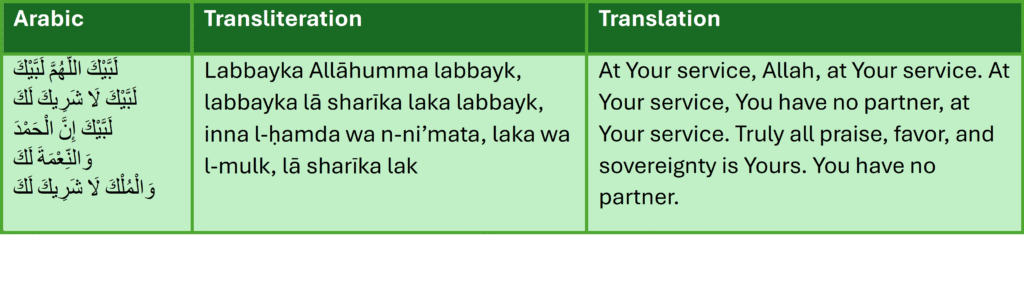
Note: The compulsory part is the intention in the heart, while reciting the Talbiyah is sunnah. By doing this, one has entered the state of Ihram, and all the compulsory rules and actions of Hajj now apply.
TYPES OF INTENTIONS FOR HAJJ:
- Al-Ifrad (Single Intention for Hajj Only): Perform Hajj without combining it with Umrah.
Narrated by Jabir bin Abdullah (RA): The Prophet (SAW) said, “We put on Ihram for Hajj only, and this is called Al-Ifrad.” – Source: Sahih Muslim, Book 15, Hadith 1213d
- Al-Tamattu’ (Hajj and Umrah Separately): Perform Umrah first, then Hajj by entering Ihram twice, first for Umrah and then for Hajj. This is done by completing Umrah, coming out of Ihram, then making a new Ihram for Hajj [whether you are a resident in Makkah or not] and then performing Hajj. The intention for Hajj should be done on the 8th day of Dhul Hijja. This is considered the second-best way.
- Al-Qarana (Hajj and Umrah Together): Make a single intention to perform both Hajj and Umrah in one continuous state of Ihram.
Opinions of Scholars:
- Shafi’I School: Al-Ifrad and Al-Tamattu’ are better than Al-Qaran.
- Hanafi School: Al-Qaran is better than Al-Tamattu’ and Al-Ifrad. Al-Tamattu’ is better than Al-Ifrad.
- Maliki School: Al-Ifrad is better than Al-Tamattu’ and Al-Qaran.
- Hanbali School: Al-Tamattu’ is better than Al-Qaran.
Note on Al-Qiran: There is a dispute among scholars. Hanafi’s say that doing Hajj and Umrah with one Tawaf (7 circumambulation) and one Sa’i (7 times walking between safa & Marwa) is not sufficient; one must do two Tawafs and two Sa’is. However, the first opinion of doing them together is considered stronger.
“Complete the pilgrimage and minor pilgrimage for Allah. But if prevented from proceeding, then offer whatever sacrificial animals you can afford. And do not shave your heads until the sacrificial animal reaches its destination. But if any of you is ill or has a scalp ailment requiring shaving, then compensate either by fasting, charity, or a sacrificial offering. In times of peace, you may combine the pilgrimage and minor pilgrimage then make the sacrificial offering you can afford. Whoever cannot afford that offering, let them fast three days during pilgrimage and seven after returning home—completing ten. These offerings are for those who do not live near the Sacred House. And be mindful of Allah, and know that Allah is severe in punishment.” – Qur’an: [al-Baqarah 2:196]
3. PROHIBITED ACTIONS IN IHRAM:
While in Ihram for Hajj or Umrah, there are ten conditions that are impermissible, particularly for men:
a. Wearing Sewn Clothing or covering the whole body: Men are not permitted to wear anything that is sewn or that covers the body completely. This including shoes that fully cover the feet. Instead they should wear slippers that do not cover the back of the heel or ankle.
Abu Shuja’ said, “A man removes stitched clothes at the time of preparing for the pilgrimage, and he puts on a lower and upper garment of white.” [Source: al-Ghāyah wal-Taqrīb 1/20]
b. Covering the Head (for Men): Men must not cover their heads or any part of it whether the covering is sewn or unsewn, unless there is an excuse, such as a wound. However, shading oneself with an umbrella is permissible as long as it does not touch the head. These conditions do not apply to women.
Narrated by Abdullah ibn Umar (ra): A man stood up and asked, “O Allah’s Messenger! What clothes may be worn in the state of Ihraam?” The Prophet (ﷺ) replied, “Do not wear long flowing shirts or trousers, or turbans, or a hooded cloak; but if somebody has no shoes, he can wear leather stockings provided they are cut short off the ankles, and also, do not wear anything perfumed with al-wars or saffron, and the woman in the state of Ihraam may not wear niqaab, or gloves.” – [Source: Ṣaḥīḥ al-Bukhārī 1741 | Ṣaḥīḥ Muslim]
c. Combing Hair: Combing or styling the hair, either with a comb or hands, is not allowed.
d. Shaving or Plucking Hair: Shaving or plucking hair is forbidden, this includes the hair of the entire body except unless it is a necessity.
“Complete the pilgrimage and minor pilgrimage for Allah. But if prevented from proceeding, then offer whatever sacrificial animals you can afford. And do not shave your heads until the sacrificial animal reaches its destination. But if any of you is ill or has a scalp ailment requiring shaving, then compensate either by fasting, charity, or a sacrificial offering.” – Qur’an [Surah Al-Baqarah, 2:196]
e. cutting Nails: Cutting the nails is not allowed, whether it is one nail or several, unless there is an excuse, such as a broken nail causing harm.
f. Applying Perfume: Perfume must not be used deliberately on any part of the body. It should not be mixed with food or drinks, and one should avoid sitting or sleeping on beds or floors that have perfume, unless there is a barrier. Washing with fragranced products is also forbidden. However, smelling flowers is permissible. It is haram according to the opinion of the Jama’a (majority of scholars) as it goes against the wisdom of Hajj.
Narrated by Anas ibn Malik (ra): The Prophet (ﷺ) performed Hajj on an old saddle, wearing a cloak that was worth four Dirhams or less. Then he said, “O Allah, (this is) a Hajj in which there is no showing off nor reputation sought.” – Source: Sunan Ibn Majah
g. Hunting or Killing Animals: Hunting or killing animals is forbidden. This includes catching and holding animals by their fur or hair. It is not permissible to eat hunted animals, but fishing near the sea is allowed. It is not Ja-iz to eat rabbits, gazelles etc, however the ones from the farm can be bought.
“Believers, do not kill game while on pilgrimage. Whoever kills game intentionally must compensate by offering its equivalence—as judged by two just men among you—to be offered at the Sacred House, or by feeding the needy, or by fasting so that they may taste the consequences of their violations. Allah has forgiven what has been done. But those who persist will be punished by Allah. And Allah is Almighty, capable of punishment.” – Qur’an: [Surah Al-Ma’idah, 5:95]
h. Engaging in Marriage: One must not engage in marriage contracts for themselves or as a representative for others while in ihram. Such marriages are not valid.
Narrated by Jabir bin Abdullah (ra): The Prophet (ﷺ) said, “A Muhrim must neither marry himself, nor arrange the marriage of another one, nor should he make the proposal of marriage.” – Sunan Ibn Majah
i. Intimate Relations: Intercourse with one’s spouse is prohibited during ihram.
“Commitment to pilgrimage is made in appointed months. Whoever commits to performing pilgrimage, let them stay away from intimate relations, foul language, and arguments during pilgrimage.” – Qur’an: [Surah Al-Baqarah, 2:197]
j. Acting on Desires: Engaging in any form of sexual activity or acting on sexual desires is not allowed. If one does so knowingly and willingly, it is impermissible. However, if done out of ignorance, forgetfulness or compulsion, it is not considered haram but requires offering a fidya (sacrifice of a sheep).
Duties of the Hajj:
Hajj comprises various duties, categorised into wajibat (compulsory), Arkan (pillars), sunnah (recommended), and recommended acts [sayings and actions of the prophet] (peace be upon him).
Both the compulsory duties (wajib) and the pillars (arkaan) of Hajj are mandatory and must be performed. However, if a wajib duty is neglected, one must offer a sacrifice (such as a sheep) to make up for it. In contrast, the pillars are essential for the validity of Hajj, and the pilgrimage cannot be completed without them; leaving these cannot be compensated by sacrifice.
THE COMPULSORY (WAJIBAT) OF HAJJ: SHAFI’I MADHAB
1. Entering Ihram from al Miqat: It is compulsory for the pilgrim to do their Ihram from the Miqat at a designated time and place. If a pilgrim passes the Miqat without going into Ihram and enters the Haram (Ka’bah), they have neglected an essential component of Hajj. However, if they have done Ihram before reach it, is acceptable.
2. Spending the Night in Muzdalifah: If the pilgrim leaves Arafah after sunset and arrives in Muzdalifah (located between Arafah and Mina), it is compulsory for them to sleep there and stay until after midnight. The pilgrim does not have to stay until fajr (morning prayer). This is the way of the prophet (peace be upon him).
3. Throwing the Pebbles: Upon leaving Arafah and sleeping in Muzdalifah, the pilgrim collects pebbles (in Muzdalifah) to throw at Jamratal Aqabah (the stoning pillar – located at the end of Mina after Makkah). The pilgrim throws 7 pebbles directly at the stoning pillar from midnight (of the night of Eid) until sunset on the day of Eid (the day of sacrifice).
· During the days of Tashriq (11th, 12th, and 13th of Dhul Hijjah), it is compulsory to throw 7 pebbles at each of the three stoning pillars – The first stoning pillar (located after al-Haith Mosque), the middle stoning pillar and lastly the third stoning pillar (Jamratul Aqabah). This can be done after midnight of the night of Eid until sunset of the day of Eid (the day of sacrifice). However, if one is unable to do so within this time, it can be delayed to the second day without requiring fidya (sacrifice).
· It is compulsory to throw pebbles everyday of the days of Tashriq – the days preceding the day of Eid (11th, 12th, 13th of Dhul Hijjah).
· It is not compulsory to throw pebbles on the third day of Tashriq if one leaves Mina for Makkah before sunset on the second day. However, if sunset occurs before leaving Mina, it is wajib to throw pebbles on the third day.
Schedule for throwing stones:
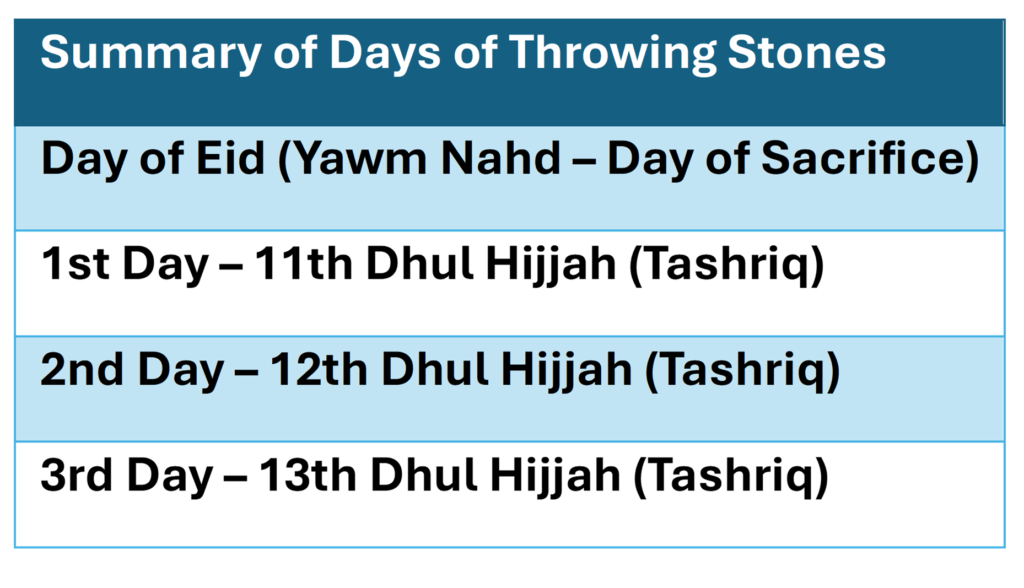
Summary of pebbles thrown: The total number of pebbles thrown over the days amounts to 70 or 49, depending on when the pilgrim departs.
Each day, pilgrims throw 21 pebbles (3 sets of 7). Over the three days of Tashriq (11th, 12th, and 13th of Dhul Hijjah), this totals to 63 pebbles. Adding the 7 pebbles thrown on the 10th of Dhul Hijjah, the total number of pebbles required is 70. For those who leave after two days of Tashriq, they will throw a total of 49 pebbles (21 pebbles each day for two days, plus the 7 pebbles for the 10th of Dhul Hijjah).
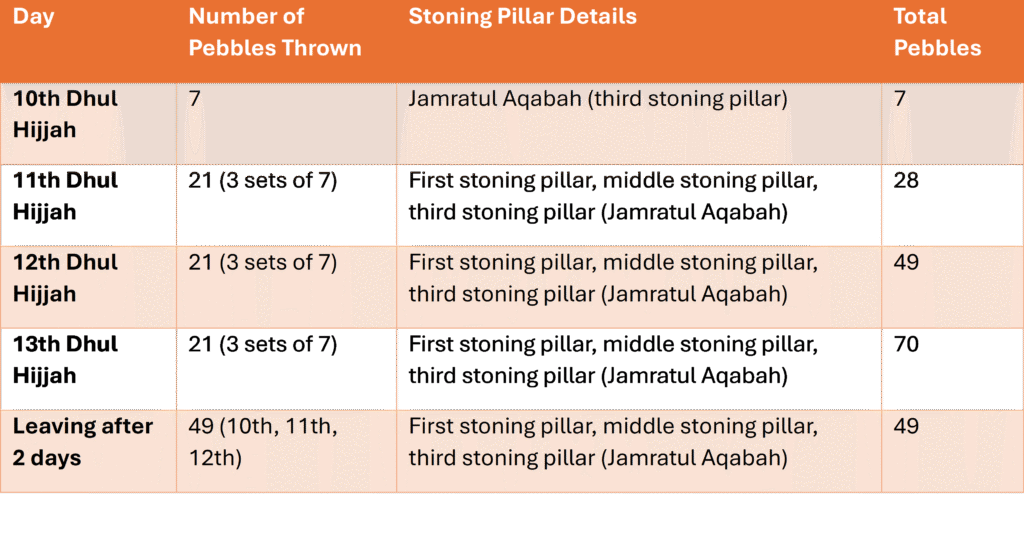
And remember Allah during ˹these˺ appointed days.1 Whoever departs swiftly on the second day is not sinful, neither are those who stay behind ˹till the third—seeking additional reward˺, so long as they are mindful ˹of their Lord˺. And be mindful of Allah, and know that to Him you will ˹all˺ be gathered. – Qur’an: [Surah al-Baqarah: 2:203]
- Spending the Nights in Mina during two nights of Tashriq: It is compulsory for the pilgrim to sleep in Mina for the first and second nights of Tashriq (11th and 12th Dhul Hijjah). However, if the pilgrim leaves Mina before sunset on the second day, they do not need to spend the night in Mina. If they are still in Mina at sunset, it is compulsory to spend the night and throw pebbles on the third day.
Narrated by Jabir ibn Abdullah (RA): The Prophet (ﷺ) performed Hajj and spent the nights in Mina during the days of Tashriq. He said, “Whoever does not spend the night in Mina during the days of Tashriq, he has done nothing.” – Source: Sahih Muslim
- Tawaf al-Wada’ (Farewell Tawaf): After completing their Hajj rituals and functions, it is compulsory for the pilgrim to perform Tawaf around the Ka’bah, known as Tawaf al-Wada’, before leaving Makkah.
Narrated by Ibn Abbas (RA): “The people were ordered to perform the Tawaf of the Kaba (Tawaf-al-Wada`) as the last thing before leaving Mecca, except menstruating women who were excused.” – Source: Sahih Bukhari 1755
If any of the above five compulsory wajibat are neglected without a valid excuse, the pilgrim will have committed a sin. This omission does not align with the principle and essence of Hajj. However, it does not invalidate the Hajj itself. According to the Shafi’i school of thought, the pilgrim must offer a sacrifice (such as a sheep) to compensate for the neglected wajib.
Below will summarise the compulsory [Wajibat] act of Hajj for the Hanafi, Maliki and Hanbali school of thought.
The Compulsory [Wajib] acts of Hajj – Hanafi Madhab
The Hanafi school of thought outlines five compulsory acts (wajibat) of Hajj:
- Sa’i Between Safa and Marwa: Performing the Sa’i, which is walking seven times between the hills of Safa and Marwa.
- Staying in Muzdalifah: Spending time in Muzdalifah, even if for a brief moment, during the second half of the night (after midnight) following Arafah.
- Throwing the Pebbles: Participating in the ritual of throwing pebbles at the three stone pillars during the days of Tashriq.
- Shaving or Cutting Hair: Shaving the head or cutting hair as part of the Hajj rituals.
- Tawaf al-Wada’ (Farewell Tawaf): Performing the farewell circumambulation (Tawaf) around the Ka’bah before leaving Mecca.
The Compulsory [Wajib] acts of Hajj – Maliki Madhab
The Maliki school of thought outlines three compulsory acts (wajibat) of Hajj:
- Avoid Wearing Sewn Clothing and Uncover the Head (for Men): Pilgrims must not wear anything sewn or cover their heads. Men must keep their heads uncovered during the state of Ihram.
- Recite the Talbiyah: Pilgrims must continually recite the Talbiyah.
- Connecting the Talbiyah with the Ihram: The Talbiyah must be closely connected to the act of entering Ihram. If there is a significant delay or separation between the recitation of the Talbiyah and the Ihram, a sacrifice (such as a sheep) must be offered. Thus, the timing for reciting the Talbiyah and wearing the Ihram should be close together.
The Compulsory [Wajib] acts of Hajj – Hanbali Madhab
The Hanbali school of thought outlines seven compulsory acts (wajibat) of Hajj:
- Ihram at the Miqat: Entering the state of Ihram at the designated Miqat.
- Standing in Arafah: Remaining in Arafah on the day of Arafah until sunset.
- Sleeping in Muzdalifah: Spending the night in Muzdalifah if the pilgrim arrives before midnight.
- Sleeping in Mina: Staying in Mina during the nights of Tashriq.
- Throwing the Pebbles in the Correct Sequence: Throwing the pebbles at the three stone pillars in the correct order: The first stoning pillar, the second/middle, and lastly Jamratul Aqabah (the big one).
- Shaving or Cutting Hair: Shaving the head or cutting hair as part of the Hajj rituals.
- Tawaf al-Wada’ (Farewell Tawaf): Performing the farewell circumambulation (Tawaf) around the Ka’bah before leaving Mecca.
The Pillars [Arkaan] of Hajj
The pillars of Hajj are the fundamental components upon which the pilgrimage is built. These essential actions must be performed for the Hajj to be valid. If any of these pillars are omitted, the Hajj becomes invalid. Unlike other obligatory acts (wajibat), neglecting a pillar cannot be rectified by offering a sacrifice [Fidya] or paying a penalty (kaffarah).
The pillars of Hajj are 5:
- Al Ihram: This is the intention of performing Hajj, and it is one of the most critical pillars. The importance of this intention is comparable to the intention for prayer; as there is no prayer without an intention. Similarly, there is no hajj without Ihram.
- Standing in Arafah: The essence of Hajj is to stand in Arafah. Arafah is the name of the mountain that overlooks Mina, approximately 25km southeast of Makkah. As the Prophet Muhammad (SAW) said:
Narrated by AbdurRahman bin Ya’mar: I came to the Holy Prophet (ﷺ) when he was in Arafah. Some people from Najd came and asked him, “How is the Hajj done?” He (the Prophet) ordered a man to reply, “The Hajj is Arafah. Whoever comes over there before the dawn prayer on the night of al-Muzdalifah, his Hajj will be complete…” – Source: Sunan Abi Dawud
This means standing in Arafah is the most crucial deed of Hajj, it is the essence of Hajj.
Conditions of Standing in Arafah
- Timing: The period for standing in Arafah begins at Dhuhr time on the ninth day of Dhul Hijjah and lasts until Fajr on the Day of Sacrifice (Eid). Standing in Arafah outside this duration invalidates the Hajj. Even standing for a brief moment during this time, whether day or night, suffices, although it is preferable to combine part of the day and part of the night. If a pilgrim leaves Arafah before sunset, they must offer a sacrifice. It is mustahab (recommended) to stay until sunset, but not compulsory, as Rasul’Allah (SAW) did.
- Location: The pilgrim must stand within the boundaries of Arafah at any place within its confines. It is insufficient for the pilgrim to stand in the area of Ba’ranah, which faces the boundaries of Arafah but is outside it. Additionally, pilgrims must delay the Maghrib prayer and combine it with Isha in Muzdalifah on their return to Mina, as ordered by Rasul’Allah [peace be upon him].
Narrated by ‘Ali Ibn Abi Talib (RA): The Messenger of Allah (ﷺ) stood at Arafah and said, “Here I stood, and all of Arafah is a place of standing.” – Source: Musnad Ahmad and Sunan Abu Dawood
- Tawaf al-Ifadah: This is one of the essential rituals of Hajj. It involves circumambulating the Ka’bah seven times in a counterclockwise direction. This tawaf is performed after the pilgrim has thrown the pebbles at Jamratul Aqabah, shaved or cut their hair, and exited the state of Ihram.
“Then let them groom themselves, fulfil their vows, and circle the Ancient House.” – Qur’an: [Surah Al-Hajj 22:29]
The conditions for Tawaf al-Ifadah to be accepted are:
- Intention, Purity and covering one’s nakedness [‘Awrah]:
The intention (niyyah) for Tawaf al-Ifadah must be made, similar to the intention required for prayer. The pilgrim must be pure, free from major impurities, and maintain cleanliness [Tahara] in their clothes, body, and the place of tawaf. They must also have wudu (ablution) and be properly covered.
Narrated by Ibn Abbas (RA): The Prophet (ﷺ) said, “Tawaf is prayer, except that Allah (SWT) has made talking in it permissible. Whoever speaks should only speak good words.” – Source: Sunan at-Tirmidhi
- Avoiding doing Tawaf inside Hijr of Ismael:
The pilgrim must ensure that no part of their body enters the Hijr of Ismael during tawaf. The Hijr is a semi-circular area adjacent to the north-west wall of the Ka’bah. It is considered part of the Ka’bah, and the tawaf must be performed around it, not inside it. This is in accordance with the teachings of the prophet [peace be upon him]
Narrated by Aisha (RA): The Prophet (ﷺ) said, “The Hijr is part of the House. Circumambulate the House (the Ka’bah) but do not enter the Hijr while doing so.” – Source: [Sahih al-Bukhari]
- Positioning the Ka’bah to the Left:
During tawaf, the pilgrim must keep the Ka’bah to their left, starting from the Black Stone and continuing until they reach the Black Stone again. This completes one circuit, and the tawaf will not be complete without returning to the starting point, as Rasul’Allah (SAW) demonstrated.
- Completing Seven Circuits:
The pilgrim must complete seven circuits around the Ka’bah. Each full circuit from the Black Stone back to the Black Stone counts as one tawaf, and completing seven circuits fulfils the pillar of tawaf.
Timings for Tawaf al-Ifadah
There are two timings for Tawaf al-Ifadah: the preferred timing and the permissible timing.
- The Preferred Timing: The preferred time to perform Tawaf al-Ifadah is on the Day of al-Nahr (Eid) after throwing the pebbles, performing the sacrifice, and either shaving or cutting the hair.
- Permissible Timing: It is permissible to perform Tawaf al-Ifadah after midnight on the night of al-Nahr (Eid), according to Imam Ahmad and Imam al-Shafi’i.
According to Imam Abu Hanifa, the permissible timing for Tawaf al-Ifadah starts at sunrise on the Day of al-Nahr and ends on the last day of al-Nahr. This timing depends on the first day the pebbles are thrown. Tawaf al-Ifadah must be performed during Hajj the end of this period marks the conclusion of the Hajj rituals.
It is important to note that Tawaf al-Ifadah is an integral part of Hajj and must be completed within the designated time to fulfil the Hajj obligations.
- The Sa’i Between Safa and Marwa: Sa’i involves walking briskly between the two hills of Safa and Marwa, located near the Ka’bah. This must be done seven times in total, starting at Safa and ending at Marwa.
The Prophet Muhammad (SAW) performed the Sa’i and encouraged the pilgrims to do the same. It is reported that he faced the Qibla and addressed the people
Narrated by Aisha (RA): The Prophet (ﷺ) said, “O people, perform Sa’i between Safa and Marwa.” – Source: Sunan an-Nasa’i 2968
Conditions of Sa’i
- After Performing Tawaf: Sa’i should be performed after the Tawaf. This can be either the Tawaf of Arrival (Tawaf al-Qudoom), which is mustahab (recommended) to do upon arrival in Makkah, or after the Tawaf al-Ifadah, which is a pillar of Hajj as guided by Rasul’Allah (SAW).
- Walking Between Safa and Marwa: Sa’i consists of walking the distance between the hills of Safa and Marwa seven times. The journey starts at Safa and ends at Marwa. Each leg from Safa to Marwa is considered one trip, and the return from Marwa to Safa counts as the second trip, and so on, until seven trips are completed.
- Completing the Distance: The entire distance between Safa and Marwa must be walked completely. Leaving even a small distance, such as a “Shiber” (the width between the thumb and finger), will invalidate the Sa’i. It is recommended to touch the walls of Al-Safa and Al-Marwa to ensure the full distance is covered. Recently, clear signs have been placed to indicate the start and end points.
- Continuous Walking: The pilgrim must walk the seven distances between Safa and Marwa continuously, one after the other. If the pilgrim stops for a long time, it invalidates the Sa’i, and they must start again from the beginning. However, stopping to drink Zamzam water is permissible.
- Shaving (Halq) and Cutting the Hair (Taqsir): Shaving the head (Halq) or cutting the hair (Taqsir) is a pillar of Hajj, particularly emphasised in the madhab of Imam Shafi’I as a pillar [rukun].
Conditions of Shaving and Cutting the Hair:
- Timing: Shaving or cutting the hair must not be done before its designated time. The appropriate time starts after midnight on the night of al-Nahr. If a pilgrim shaves before this time, it is considered a sin, and it becomes compulsory to give al fidya (sacrifice).
- Amount of Hair: Shaving the head means shaving the whole head. Cutting the hair involves cutting a minimum of three hairs or more, and the length can be shortened to any amount the pilgrim desires.
- Area of Shaving: The hair must be cut or shaved from the head. Cutting hair from other parts of the body, such as the beard or Mustache, is not sufficient. Women are ordered to cut their hair only and are not ordered to shave it. If a person does not have hair on their head, it is recommended (sunnah) to allow the blade to touch their scalp.
Indeed, Allah will fulfil His Messenger’s vision in all truth: Allah willing, you will surely enter the Sacred Mosque, in security—some with heads shaved and others with hair shortened—without fear. He knew what you did not know, so He first granted you the triumph at hand. – Qur’an: Surah Al-Fath 48:27
The Order of the Pillars of Hajj
Pillars in Shafi’i Madhab:
There is a specific order to follow among these pillars:
- Al Ihram
- Standing in Arafah
- Tawaf
- Sa’i
- Shaving (which can be delayed until after Tawaf, and the pilgrim can perform Tawaf after it)
There is a difference in the madhab of Imam Shafi’i regarding this order. The question is whether shaving is a pillar or just a condition—essentially, whether it is a sixth pillar or only a condition. However, it is crucial to follow the mentioned order, and according to Imam Shafi’i, it is considered a pillar.
Pillars in Hanafi Madhab:
- Standing in Arafah: This is the main pillar of Hajj.
- Tawaf al-Ifadah: Leaving one of these pillars renders the Hajj invalid.
Pillars in Maliki Madhab:
- Al Ihram: It is the intention of saying or doing something that concerns Hajj, such as reciting the Talbiyah and starting the journey. It is better if it ties with the intention.
- Sa’i between Safa and Marwa: To walk between Safa and Marwa seven times.
- Standing in Arafah on the Night of Nahr: Even if one just has to pass through, as long as the pilgrim knows it is Arafah and has the intention of fulfilling this pillar.
- Tawaf al-Ifadah: To go around the Ka’bah seven times.
Pillars in Hanbali Madhab:
- Al Ihram: It is done by making the intention.
- Standing in Arafah
- Tawaf al-Ifadah
- Sa’i between Safa and Marwa
Whoever leaves one of these pillars, their Hajj is invalid because the ritual of Hajj is not counted without it, and whoever leaves Ihram, their rituals are not accepted.
Summary of Comparison of Hajj Pillars in Different Madhabs
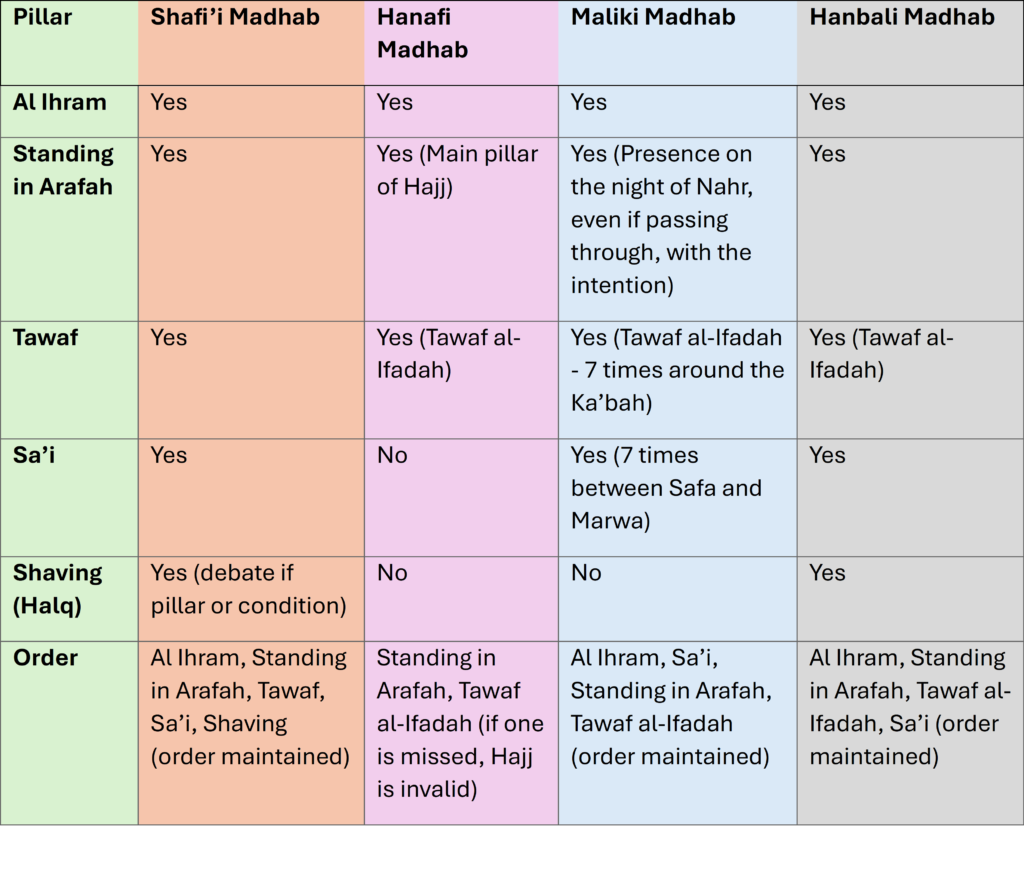
SUNNAH OF HAJJ
The Sunnah of Hajj includes the adab (etiquette) and the non-obligatory actions that the prophet [peace be upon him] emphasised performing. However, these actions are not compulsory.
Sunnah of Ihram:
- Ghusl (Washing) Before Ihram: Perform Ghusl (full body wash) before going into Ihram. If Ghusl is not possible, perform Tayammum (dry purification). This includes thorough personal hygiene such as rmeoving hair from private parts, trimming nails, and removing any dirt. Ghusl is Sunnah for all Hajis, including women, regardless of menstruation or postpartum conditions.
- Declaration of Intention: Declare your intention verbally and follow it with the Talbiyah. Men should recite this loudly whether standing or sitting.
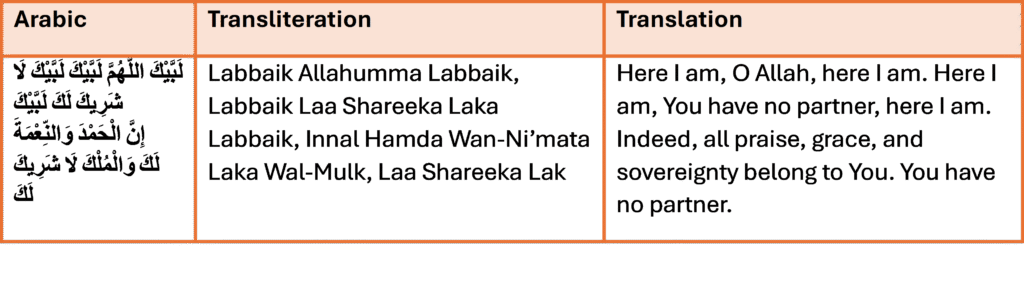
Narrated by ‘Aisha (RA): Rasul’Allah (SAW) mentioned that Jibril (AS) instructed him to tell his companions to raise their voices during Talbiyah, which is recommended (mustahab) until the stoning of Aqabah Al-Kubra on the morning of the Day of Sacrifice (Eid). The pilgrim should face the Qiblah while in Ihram and recite: “Allahuma Ahram Laka Sha’ri Wa Bashari, Al-Lahmi Wa Tammi” (O Allah, my hair, my skin, my flesh, my blood have gone into Ihram for You). However, it is Sunnah for women to recite the Talbiyah quietly so that only they hear it. – Source: Sahih al-Bukhari, Hadith 3667 and 3668
Ibn Malik [may Allah be pleased with him] said: The Messenger of Allah (peace be upon him) said: “There will come a time when the rich of my ummah will make pilgrimages for a picnic, their circles for trade, their readers for hypocrisy and reputation, and their poor for the matter.” – Source: Imam al-Suyuti narrated in the Great Mosque and al-Khatib al-Baghdadi and al-Dailami
- Avoid Worldly Discussions: Abstain from any permissible (mubah) worldly discussions. Be especially cautious about avoiding discussions that are disliked (makruh) or forbidden (haram).
Sunnah of Entering Makkah:
As the Hajj approaches, it is Sunnah to adhere to the following practices upon entering Makkah:
- Enter Makkah before proceeding to Arafah and then head to Arafah from there.
- Perform Ghusl as one enters Makkah near the well of Thi Dhool, which is known to be a well the Prophet (peace be upon him) used to wash with its water before entering Makkah.
- To perform Tawaf Al-Qudoom (Arrival Tawaf) upon entering Makkah as a greeting to the Ka’bah [Tahiya], a practice the Prophet (SAW) ensured to observe.
- Entering the Mosque from Bani Shayba Gate. Upon seeing the Ka’bah, the pilfrim should raise your hands and recite this dua:
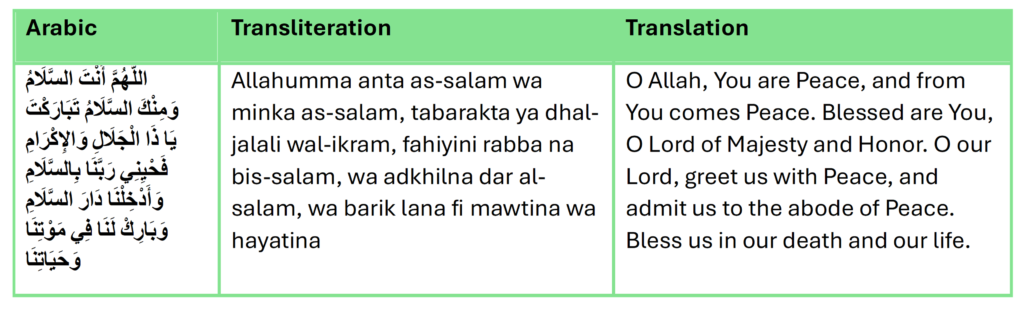

Sunnah of Al Tawaf
- Performing Tawaf on Foot: Tawaf should be performed on foot, unless you have a valid excuse such as a disability, in which case you can use a riding aid. When Umm Salamah was ill, RasulAllah (SAW) instructed her, “Make the Tawaf behind the people riding.”
Narrated Um Salamah (RA): I informed Allah’s Messenger (ﷺ) that I was sick. He said, “Perform Tawaf (of the Ka’ba) while riding behind the people.” So, I performed the Tawaf while Allah’s Messenger (ﷺ) was offering the prayer beside the Ka’ba and was reciting Surat-at-Tur. – Source: Sahih al-Bukhari, Hadith 464
- Kissing Al Hajar Al Aswad [The Black Stone]: At the start of Tawaf, approach Al Hajar Al Aswad (the Black Stone) to kiss it and place your forehead on it, as Rasul’Allah (SAW) did. This is noted by Abu Bakr and Umar and mentioned in the collections of Muslim and Bukhari. If touching it with your hand is not possible, then say, “Bismillah Allahu Akbar La Ilaha IllAllah.” This Sunnah is specifically for men; women do not need to kiss the Ka’bah unless it is empty. If the Tawaf area is crowded and touching Al Hajar Al Aswad may cause harm or inconvenience to others, then this may become makruh (disliked)
Imam Shafi’i and Imam Ahmed mentioned that Rasul’Allah (SAW) advised Umar (RA) about this.
Narrated Umar bin Al-Khattab (RA): The Prophet (ﷺ) said, “O `Umar, you are a strong man. Do not crowd up by the Hajar Al Aswad lest you harm a weak person. If you find a gap, go and touch it, otherwise face it and recite tahlil [La ilaha illallah] and takbir [Allahu Akbar].” – Source: Musnad Ahmad, Hadith 190
Passing by Al Hajar Al Aswad: During each circuit of Tawaf, if possible, kiss Al Hajar Al Aswad or, alternatively, kiss it after completing Tawaf or after performing the two Rak’ats Sunnah of Tawaf behind the Maqam of Sayyiduna Ibrahim (AS). It is Sunnah to repeatedly pass and kiss the Black Stone after completing each Tawaf

Lorem ipsum dolor sit amet, consectetur adipiscing elit. Ut elit tellus, luctus nec ullamcorper mattis, pulvinar dapibus leo.
4.Dua During the First Tawaf:In the first Tawaf, recite:
This is agreed upon by the early generations (Salaf) and the Imams.
Tawaf al-Qudoom is the circumambulation performed upon arriving in Makkah. It holds varying degrees of importance across different Islamic schools of thought:
- Maliki School: Tawaf al-Qudum is considered Wajib (obligatory).
- Other Schools (Hanafi, Shafi’i, Hanbali): Tawaf al-Qudum is regarded as Sunnah (recommended, but not obligatory).
Tawaf al-Wada’ is the farewell circumambulation performed before leaving Makkah signifying the conclusion of one’s pilgrimage. Once you perform Tawaf al-Wada’, it is recommended not to delay your travel. If you decide to stay longer in Makkah after completing Tawaf al-Wada’, you would need to perform it again before finally leaving. It is Sunnah to drink Zamzam water with the intention of seeking all the goodness you desire, while facing the Qiblah.
- Jamhur (Majority of Scholars): Tawaf al-Wada’ is considered Wajib (obligatory) according to the majority of scholars, including the Hanafi, Shafi’i, and Hanbali schools of thought.
- Maliki School: In the Maliki school, Tawaf al-Wada’ is regarded as Sunnah (recommended but not obligatory).
Note: If a woman is menstruating, she is excused from performing Tawaf al-Wada’ (the farewell Tawaf).
Recommended Duas During Tawaf
Dua 1: At the Black Stone (Al Hajar Al Aswad)
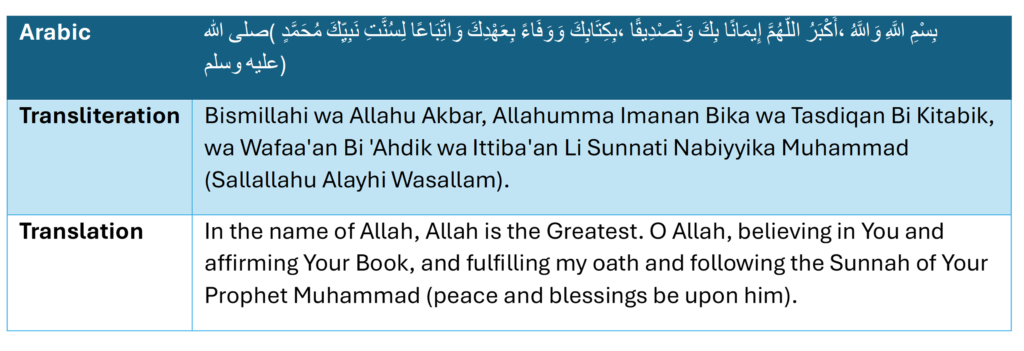
Dua 2: At the Door of the Ka’bah
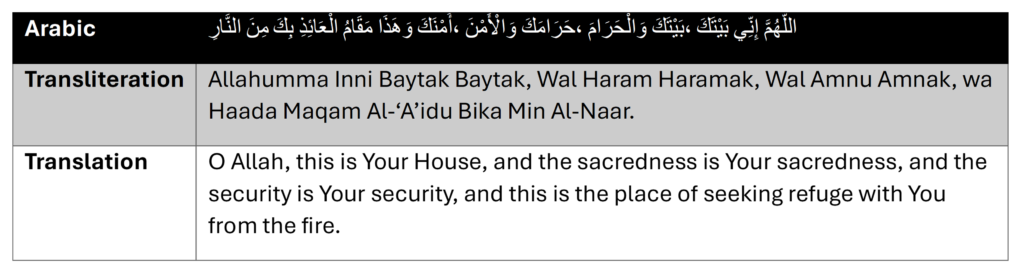
Dua 3: At the End of the Iraqi Corner (before Hajr Aswad)
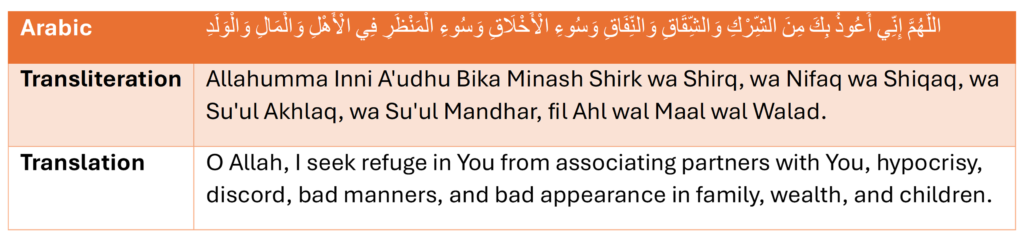
Dua 4: Under the Mizab (Gutter of Mercy)
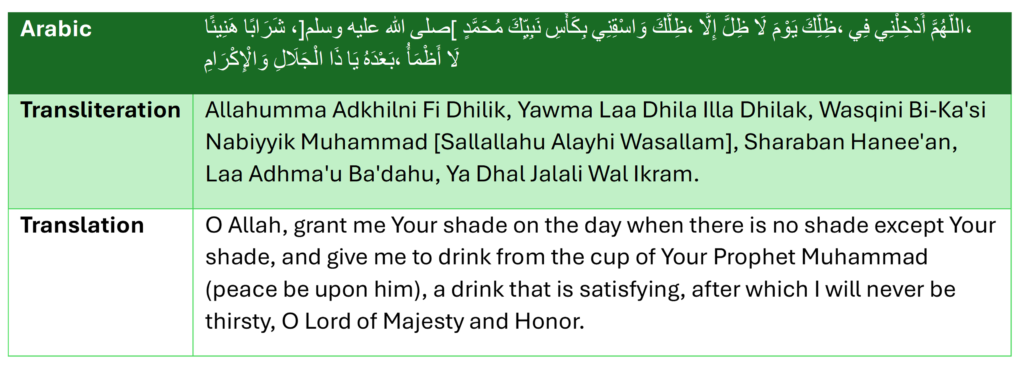
Dua 5: Between the Sham and Yemeni Corners
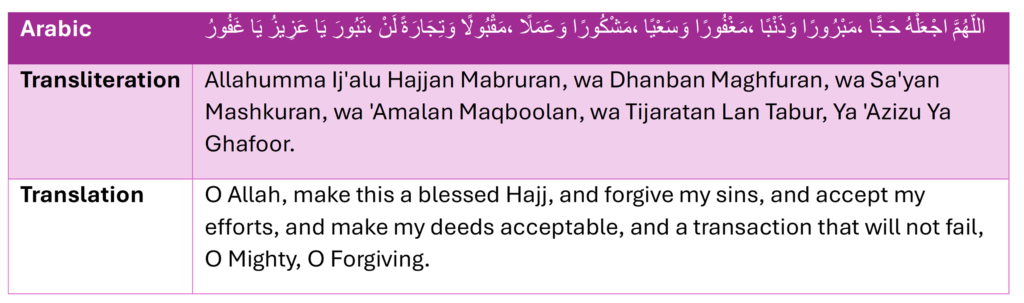
Dua 6: Between the Yemeni Corner and Al
Hajar Al Aswad [As you’re finishing the Tawaf]
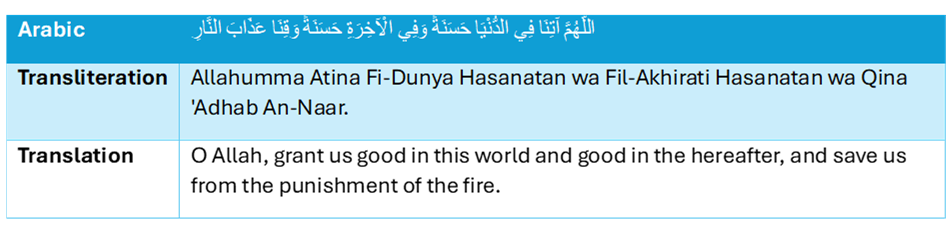
Note: Make any additional duas of your choice during Tawaf. The duas made by Rasul’Allah [peace be upon him] during Tawaf are highly recommended to follow.
Additional Sunnah during tawaf:
· Walking Briskly: During the first three circumambulations (Tawaf) around the Ka’bah, it is recommended for the pilgrim to walk briskly so that their steps blend together. From the fourth to the seventh circumambulation, the pilgrim may walk at a normal pace. If the pilgrim has Sa’i afterward or has already performed Sa’i after Tawaf, it is not necessary to walk briskly.
· Right Arm uncovered: When walking briskly, the pilgrim’s right arm should be uncovered, with the garment placed over the left shoulder (this is called Ithiba’). RasulAllah [peace be upon him] instructed his companions to do the same, saying, “May Allah have mercy on the person who shows their strength.”
· Praying two Rakah behind Maqam Ibrahim: After completing Tawaf, the pilgrim should pray two Rakahs behind Maqam Ibrahim, reciting Surah Al-Kafirun in the first Rakah and Surah Al-Ikhlas in the second. This practice is narrated by Muslim, stating that RasulAllah (SAW) performed it and encouraged others to do the same.
Narrated by Jabir: When Allah’s Messenger (ﷺ) finished circumambulating the House, he came to Maqam Ibrahim. ‘Umar said, “O Messenger of Allah, this is the Maqam of our father Ibrahim, about which Allah says, ‘And take you (people) the Maqam (place) of Ibrahim as a place of prayer.'” [Surah Al-Baqarah 2:125]. The Prophet (ﷺ) then offered two Rak’ahs behind Maqam Ibrahim. – Source: Sahih al-Bukhari 1627 and Sunan Ibn Majah 2960
“And [mention] when We made the House (i.e., the Ka’bah) a place of return for the people and [a place of] security. And take, [O believers], from the standing place of Abraham a place of prayer. And We charged Abraham and Ishmael, saying, ‘Purify My House for those who perform Tawaf and those who are staying [there] for worship and those who bow and prostrate [in prayer].'” – Qur’an: al-Baqarah 2:125
Sunnah of Sa’i (Walking between Safa and Marwa):
- It is Sunnah to perform Sa’i after Tawaf and the pilgrim should not perform another Sa’i after an additional Tawaf. If the pilgrim has already performed Sa’i after Tawaf Al-Qudum (the arrival circumambulation), it is Makruh (disliked) to perform another one after Tawaf Al-Ifadha [which is compulsory during Hajj].
- The pilgrim should go first to the top of Al-Safa so they can see the Ka’bah (unless there is a barrier) and say the following dua when facing the Ka’bah:
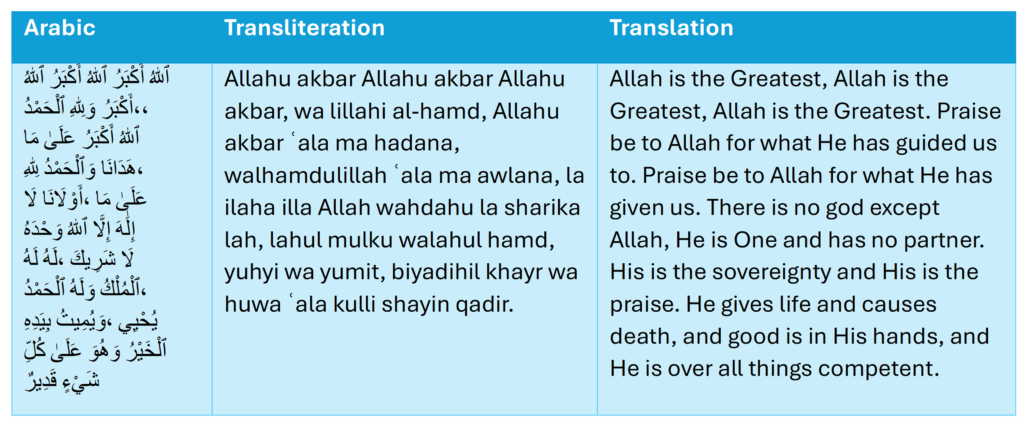

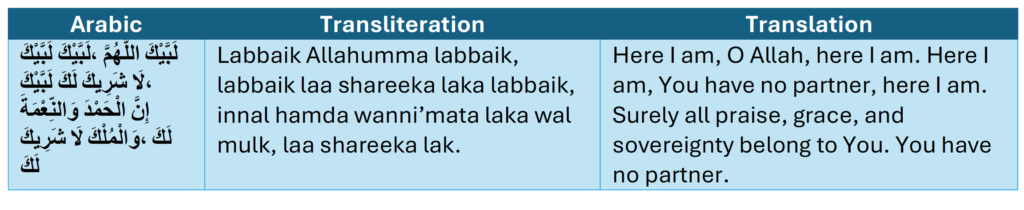
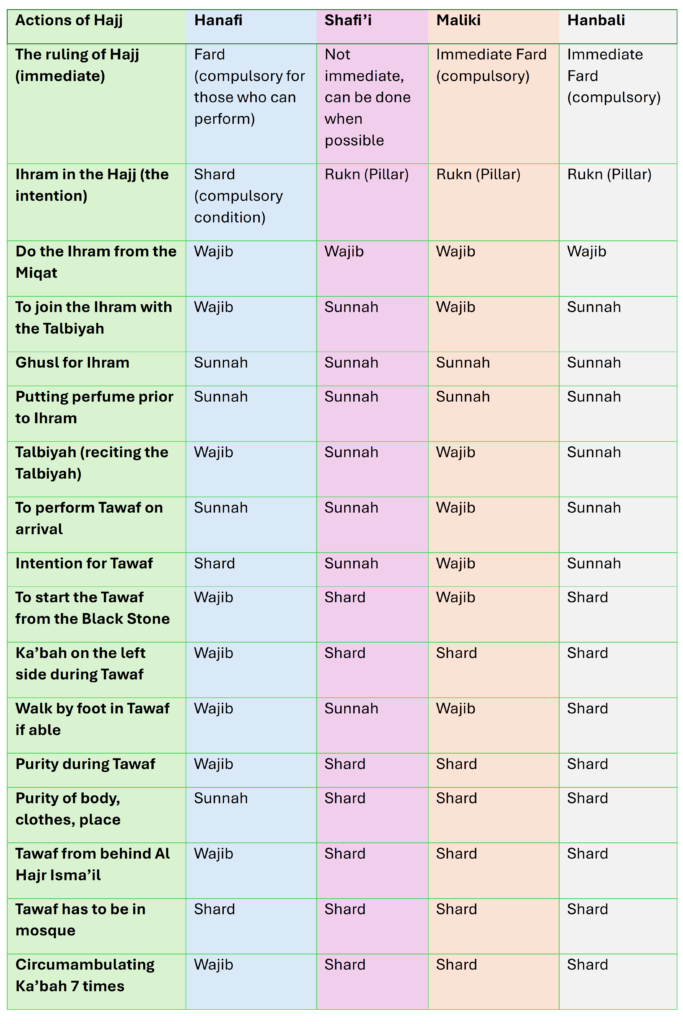
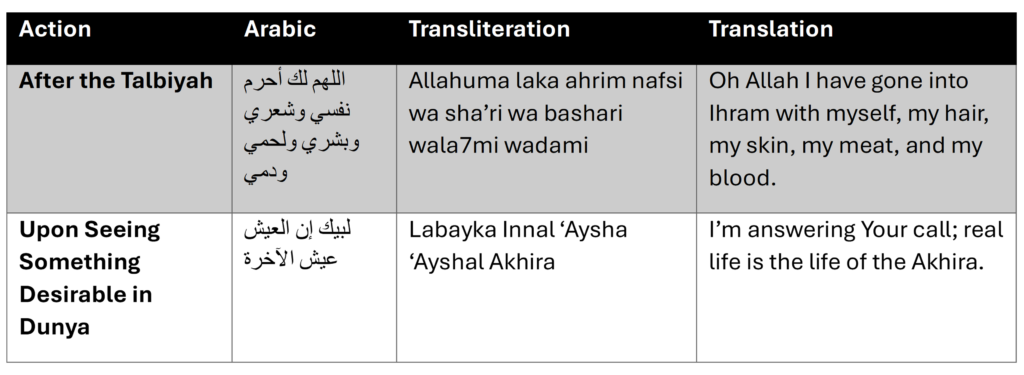
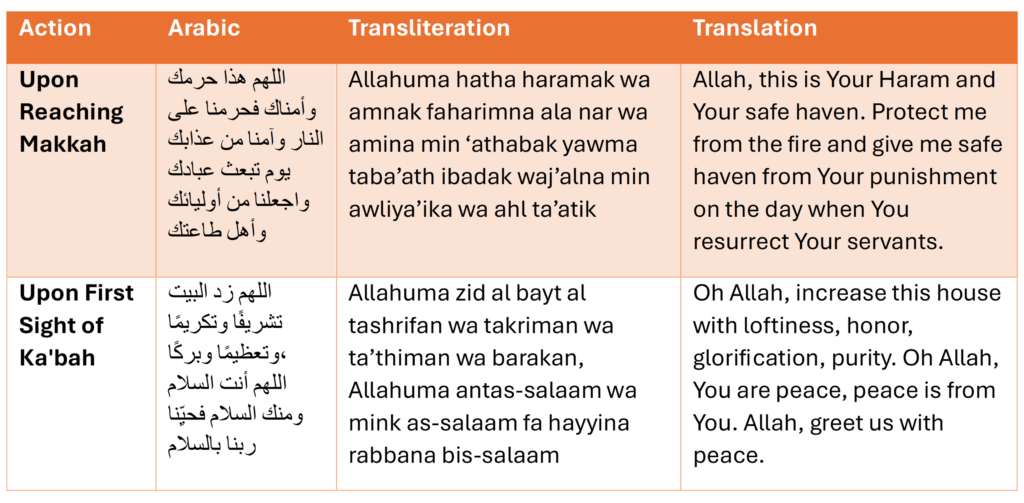
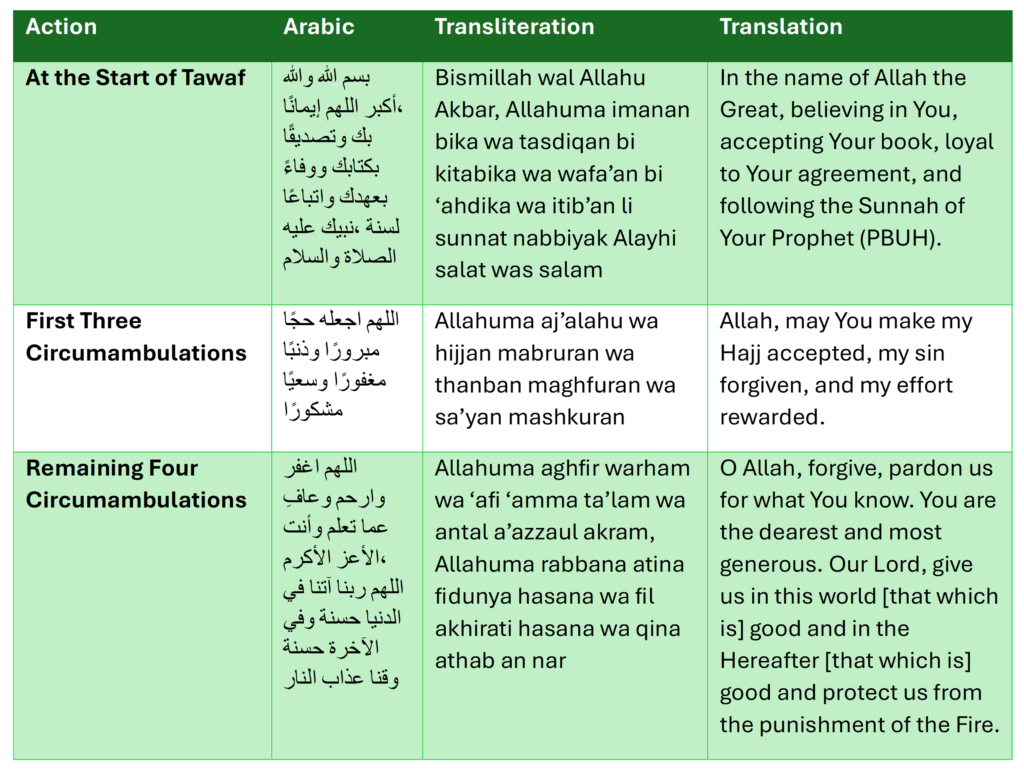
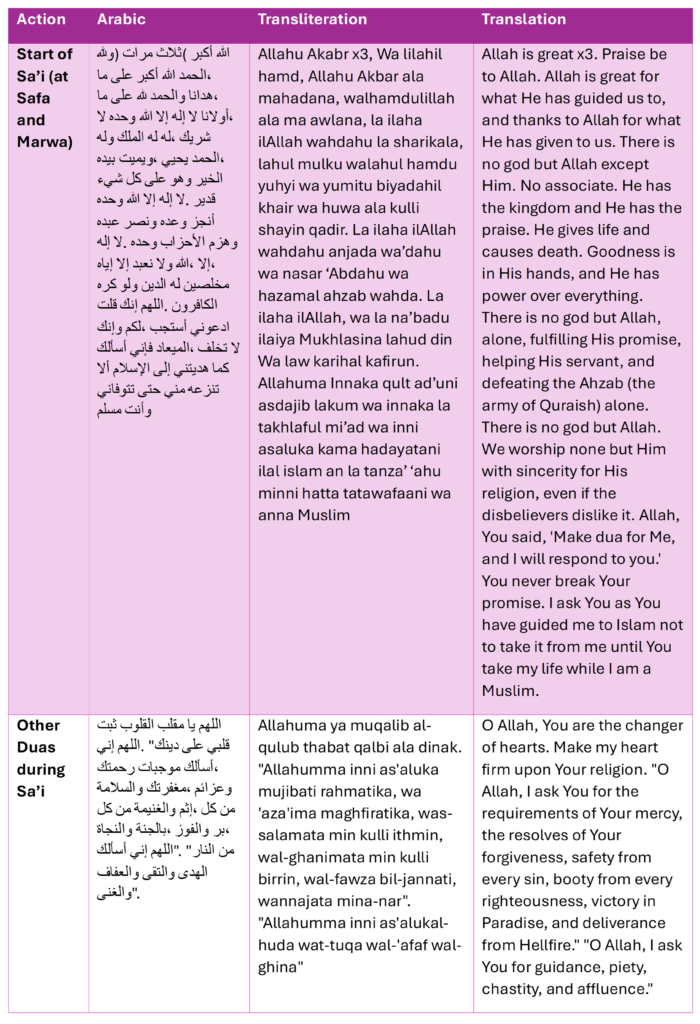
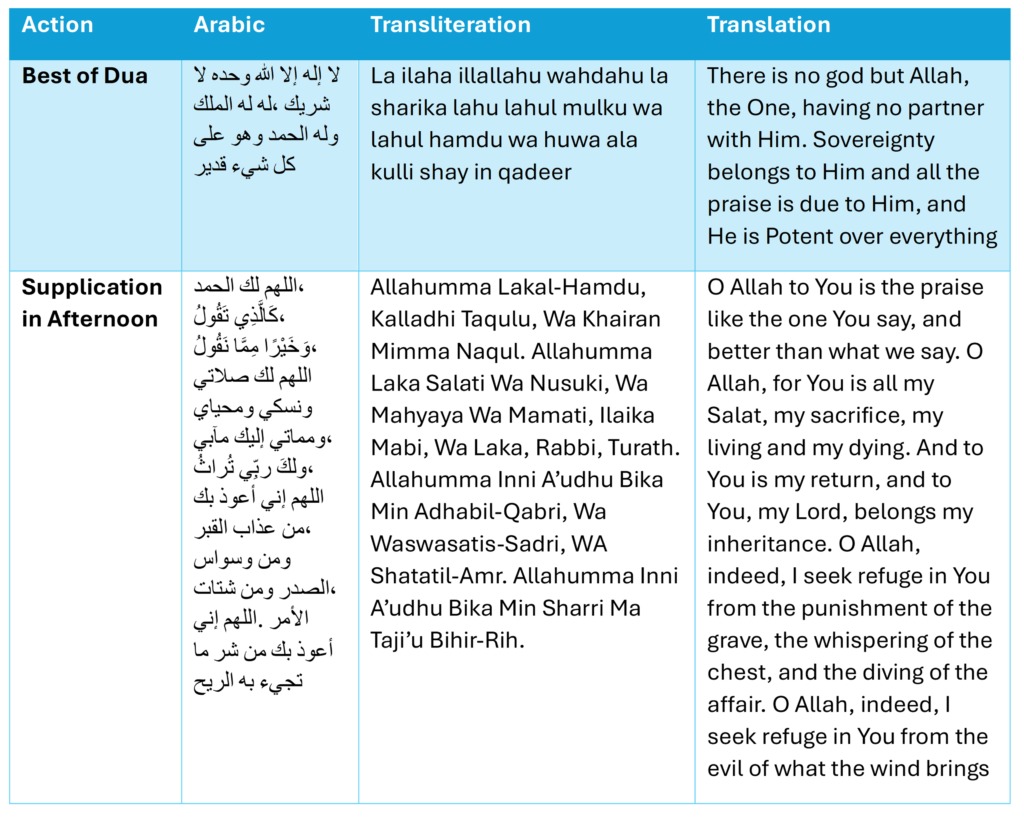
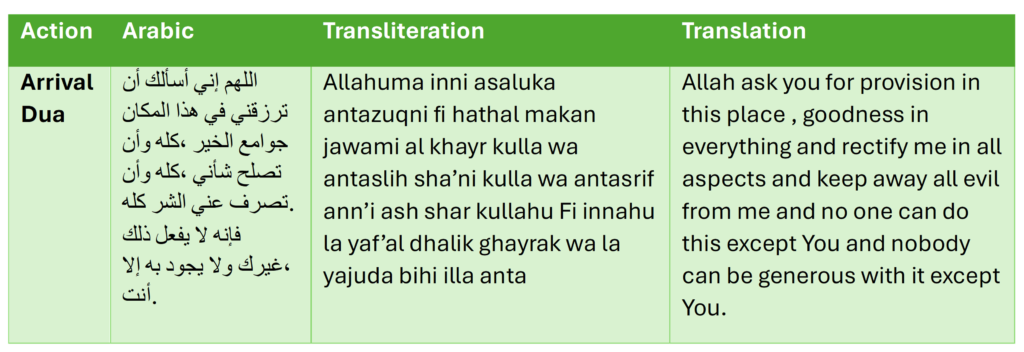
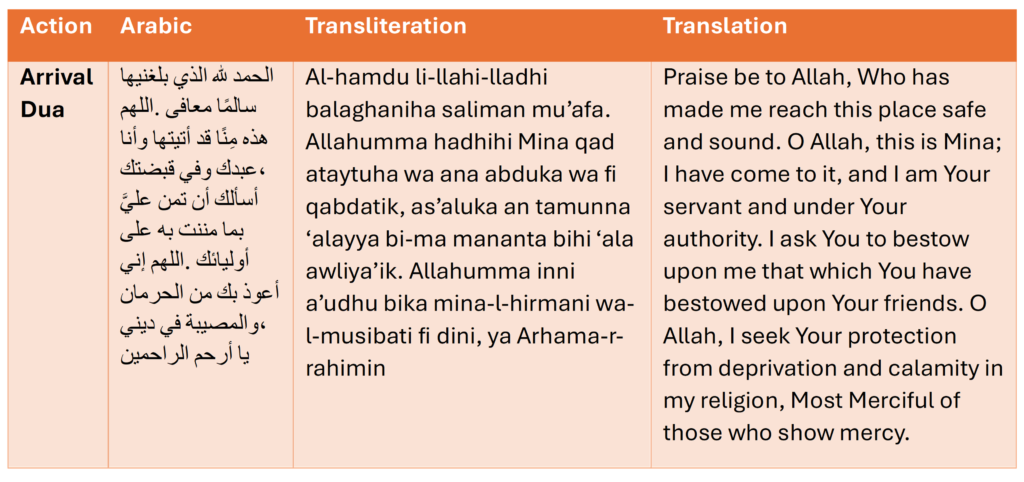
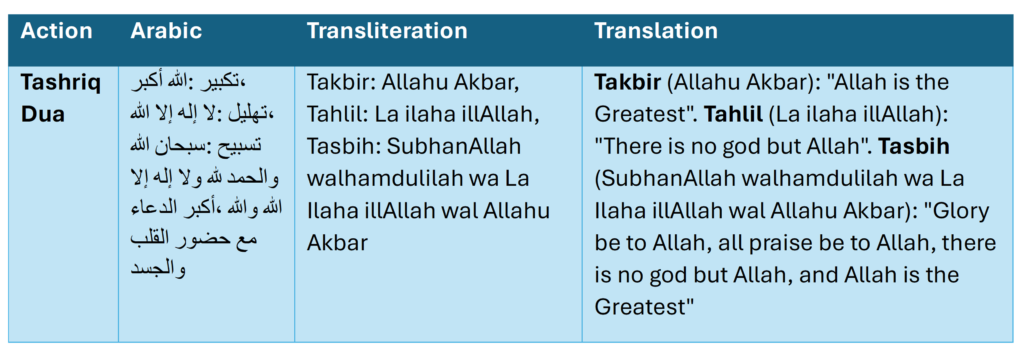
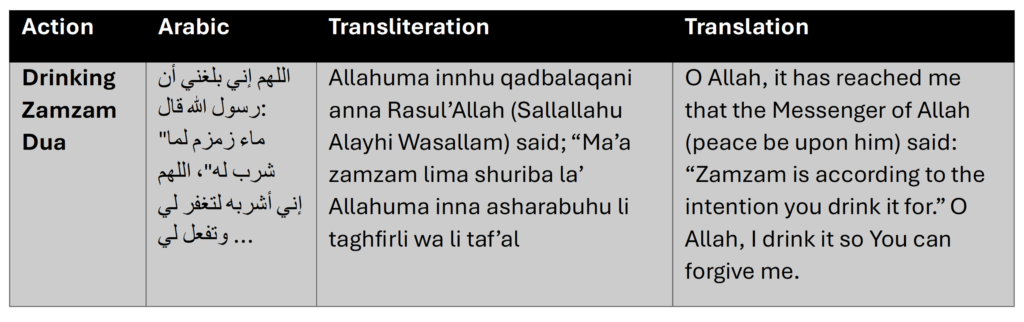
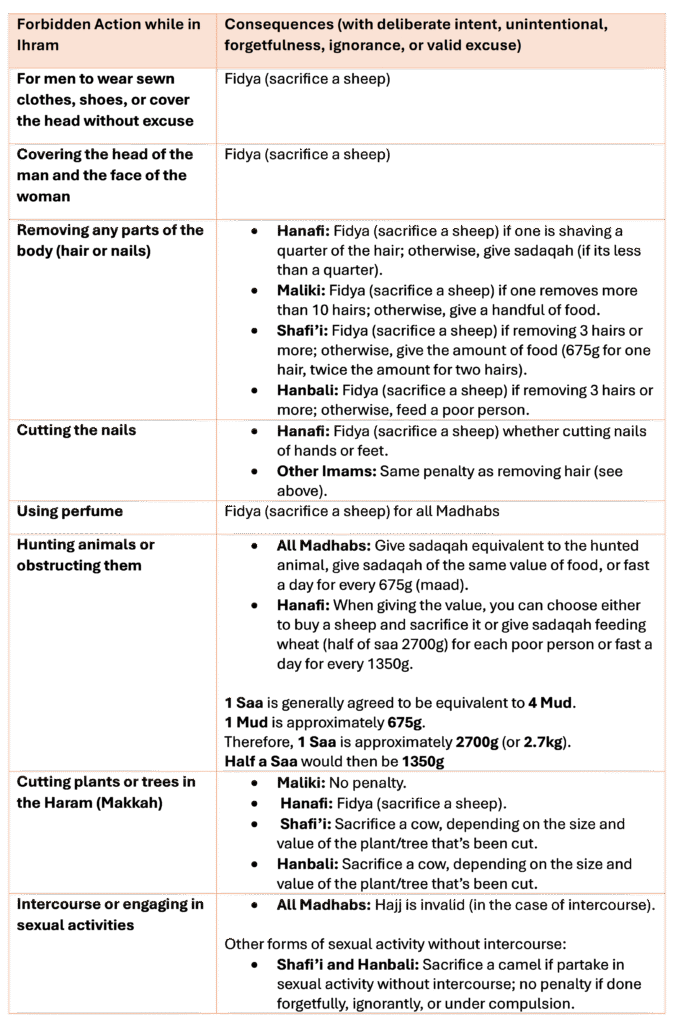
Comprehensive Guide to Hajj Rulings According to the Four Madhahib
This document provides a detailed comparison of the rulings and practices of Hajj (the major pilgrimage) according to the four major Islamic schools of thought (madhahib). It includes details about obligations, prohibited acts, differences in rituals, and specific conditions for each madhhab.
Aspect | Shafi’i | Hanafi | Maliki | Hanbali |
Definition of Hajj | A major act of worship that is obligatory once in a lifetime for eligible Muslims. | A major act of worship that is obligatory once in a lifetime for eligible Muslims. | A major act of worship that is obligatory once in a lifetime for eligible Muslims. | A major act of worship that is obligatory once in a lifetime for eligible Muslims. |
Obligation | Obligatory for Muslims who meet the conditions of capability. | Obligatory for Muslims who meet the conditions of capability. | Obligatory for Muslims who meet the conditions of capability. | Obligatory for Muslims who meet the conditions of capability. |
Conditions for Obligation | 1. Islam | 1. Islam | 1. Islam | 1. Islam |
Pillars of Hajj | 1. Ihram | 1. Ihram | 1. Ihram | 1. Ihram |
Wajib (Necessary) Acts | 1. Ihram from Miqat | 1. Ihram from Miqat | 1. Ihram from Miqat | 1. Ihram from Miqat |
Ihram Prohibitions | 1. Cutting nails | 1. Cutting nails | 1. Cutting nails | 1. Cutting nails |
Validity of Hajj | Invalid if any pillar is missed; expiation required for violating Wajib acts. | Invalid if any pillar is missed; expiation required for violating Wajib acts. | Invalid if any pillar is missed; expiation required for violating Wajib acts. | Invalid if any pillar is missed; expiation required for violating Wajib acts. |
Sequence of Rituals | Following the Sunnah order is recommended; flexibility is allowed. | Following the Sunnah order is recommended; flexibility is allowed. | Following the Sunnah order is recommended; flexibility is allowed. | Following the Sunnah order is recommended; flexibility is allowed. |
Fidyah (Expiation) | Required for violations of Ihram prohibitions or Wajib acts. | Required for violations of Ihram prohibitions or Wajib acts. | Required for violations of Ihram prohibitions or Wajib acts. | Required for violations of Ihram prohibitions or Wajib acts. |
Women’s Specific Rulings | Women must avoid Tawaf during menstruation; Ihram restrictions apply equally. | Women must avoid Tawaf during menstruation; Ihram restrictions apply equally. | Women must avoid Tawaf during menstruation; Ihram restrictions apply equally. | Women must avoid Tawaf during menstruation; Ihram restrictions apply equally. |
Detailed Rulings on Hajj
1. **Definition:** Hajj is a major act of worship obligatory once in a lifetime for every Muslim who meets the conditions of capability.
2. **Pillars of Hajj:** Ihram, standing at Arafah, Tawaf al-Ifadah, and Sa’i between Safa and Marwah are essential for the validity of Hajj.
3. **Wajib Acts:** Include acts such as throwing pebbles at Jamarat, staying at Muzdalifah, and shaving or trimming hair. Missing these requires expiation.
4. **Ihram Prohibitions:** Cutting nails, using perfume, sexual relations, and covering the head (for men) are forbidden in Ihram.
5. **Fidyah (Expiation):** Violations of Ihram prohibitions or Wajib acts require specific expiation, such as fasting, feeding the poor, or sacrificing an animal.
6. **Women’s Rulings:** Women cannot perform Tawaf while menstruating but are otherwise equal in obligation and restrictions.
7. **Flexibility in Rituals:** The sequence of rituals follows the Sunnah but allows flexibility where necessary.