Human Biology in the quran
Development of the embryo
Among the many wonders of the Quran, it also explores the fascinating realm of human biology, describing the development of human life, from gametes to conception, in intricate detail both in the Quran itself and in the Hadith literature.
Fertilisation Of The Sperm And Egg
Development of the embryo
Among the many wonders of the Quran, it also explores the fascinating realm of human biology, describing the development of human life, from gametes to conception, in intricate detail both in the Quran itself and in the Hadith literature. These descriptions provide profound insights, emerging from an era when scientific understanding could not explain such phenomena without the aid of technology . Remarkably, these ancient revelations align seamlessly with modern scientific understanding, further highlighting the Quran’s timeless and divine nature
“Indeed, We created man from a sperm-drop mixture (nutfah) that We may try him; and We made him hearing and seeing.” – Quran: Surah Al-Insan 76:2
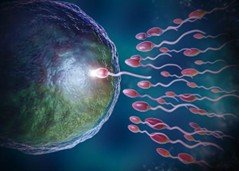
The Quran divides fetal growth and development into four distinct stages. The first stage mentioned in the Quran is known as the ‘Nutfah’. This refers to a small quantity of fluid, which in biological terms symbolises the union of fluids from both the mother and father which are the female and male gametes. This stage marks the beginning of human development.
This is reinforced according to embryologists John Allen and Beverly Kramer, who state that the creation of a human being starts with the fusion of two microscopic cells called gametes. Then, the oocyte, contributed by the mother, and the spermatozoon, contributed by the father, come together to form a single cell known as the zygote. This zygote serves as the foundational cell from which the entire embryo and its supporting structures develop.
The Quranic description of the ‘Nutfah’ as a “sperm-drop mixture” accurately reflects the process of fertilisation, where the genetic material (DNA) from both parents combines to create a zygote with a complete set of chromosomes. This moment signifies the inception of human life, as the genetic blueprint of the individual is established for the first time. The alignment of this Quranic insight with modern embryology underscores its profound accuracy and timeless relevance.
Implantation and early embryo to early organ formation
“Then We made the sperm-drop into a clinging clot (alaqa), and We made the clot into a lump (mudghah).” – Quran: Surah Al-Mu’minun 23:14
“Then We made the sperm-drop into a clinging clot (alaqa), and We made the clot into a lump (mudghah).” – Quran: Surah Al-Mu’minun 23:14
The Quran then provides an astonishingly accurate description of the early stages of embryonic development, particularly during the ‘Alaqa’ stage.
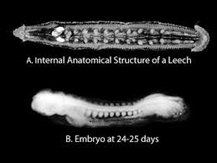
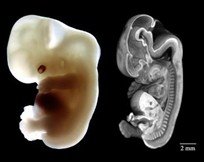
The term ‘Alaqa’ carries multiple meanings, each capturing a unique aspect of this developmental phase. Firstly, it refers to something that clings, just as the embryo firmly attaches itself to the uterine wall, securing its position for further growth. Secondly, this term can also mean a ‘leech-like substance’ and amazingly we find that the embryo’s appearance during this stage resembles a leech-like structure, reflecting its shape and form (as illustrated in the image above)
Lastly, ‘Alaqa’ also alludes to the presence of a blood clot, corresponding to the embryo’s early vascular system, where blood circulation begins. These detailed descriptions, revealed in the Quran over 1400 years ago, strikingly parallel the intricate processes of human embryogenesis.
As the embryo completes the ‘Alaqa’ stage by days 24-25, it transitions into the next phase, known as ‘Mudgah’. This stage, occurring around days 26-27, is characterised by the formation of segmented structures called somites. The term ‘Mudgah’ describes the embryo’s appearance, resembling a “chewed-like substance.”
Modern embryology confirms the accuracy of this description. During this stage, after the formation of the embryo and placenta, the embryo begins to receive nutrients and energy, leading to rapid growth. While the embryo starts to take on a more recognizable form, it remains a small piece of flesh without distinct features, yet the presence of somites gives it a texture akin to teeth marks, as depicted in the image.
These phases mark a period of profound transformation in the embryo, aligning closely with modern embryological findings.
Skeletal and muscular development into a human being
“Then (fa) We made out of the lump bones, then We covered the bones with flesh.” — Quran: Surah Al-Mu’minun 23:14
“Who (God) created you, then (fa) made you even and straight (sawwak) and then (fa) modified you (‘addalak)” — Quran: Surah Al-Infitar 82:7
““Then (fa) We made out of the lump bones, then We covered the bones with flesh.” — Quran: Surah Al-Mu’minun 23:14
“Who (God) created you, then (fa) made you even and straight (sawwak) and then (fa) modified you (‘addalak)” — Quran: Surah Al-Infitar 82:7
The Quran offers a remarkably precise account of embryonic development, describing the formation of bones ‘Iẓām’’ followed by muscles ‘laḥm’. This sequence once challenged by scientists was later confirmed through modern embryology, overturning long-held assumptions.
Around the fifth to seventh week of gestation, mesenchymal cells begin forming a cartilage model that ossifies into bone. This skeletal framework gives the embryo a more human-like shape, distinguishing it from other species and enabling the straightening of the body and development of vital organs. The Quranic use of the conjunction fa (“then”) between the muḍghah (chewed-like lump) and ‘iẓām stages implies a swift, ordered transition that mirrors the biological timeline.
Following osteogenesis, the Quran describes the bones being “clothed with flesh” (kasaunā al-‘iẓām laḥman). This poetic phrasing beautifully captures the migration of myoblasts, which cluster around the skeleton to form dorsal and ventral muscle masses. The verb kasauna conveys meanings such as “to clothe,” “to encase,” and “to cover,” reflecting both the anatomical layering and the elegance of Quranic expression. The term laḥm encompasses not only limb muscles but also those surrounding the axial skeleton, completing the body’s structural and functional design.
This stage exemplifies the Quran’s alignment with scientific discovery revealing a developmental truth centuries before it was observed under the microscope
Final development stage of the human being

“ He created you ˹all˺ from a single soul, then from it He made its mate. And He produced for you four pairs of cattle. He creates you in the wombs of your mothers ˹in stages˺, one development after another, in three layers of darkness. That is Allah—your Lord! All authority belongs to Him. There is no god ˹worthy of worship˺ except Him. How can you then be turned away?” – Quran: Surah Az-Zumar 39:6
“ He
created you ˹all˺ from a single soul, then from it He made its
mate. And He produced for you four pairs of cattle. He creates you in
the wombs of your mothers ˹in stages˺, one development after another, in three layers of
darkness. That is Allah—your Lord! All authority belongs to Him. There is
no god ˹worthy of worship˺ except Him. How can you then be turned away?” – Quran: Surah Az-Zumar 39:6
From the ninth week until birth, human development
unfolds in two primary stages. During the fetal period (ninth week to sixth
month), the body undergoes rapid growth, becoming more proportionate. Facial
features, limbs, and organs become clearly defined, while the nervous system
matures, enabling movement. Bones continue to harden, and muscles strengthen as
the foetus develops further.
In the final growth and maturation stage (sixth
month to term), the fetus gains weight and accumulates fat stores, which are
crucial for survival outside the womb. Organs such as the lungs and brain
continue to mature, and the fetus becomes more responsive to external stimuli.
By the final weeks, the baby typically positions itself head-down in
preparation for birth.
The Quran describes fetal development as occurring
within “three veils of darkness,” as stated in Surah Az-Zumar (39:6): “He creates you in the wombs of your mothers, creation
after creation, in three veils of darkness…” These layers are
interpreted as the abdominal wall, uterine wall, and amniotic sac, which align
with modern embryology’s understanding of the protective layers surrounding the
fetus.
According to Islamic jurists (fuqaha), the soul
(ruh) enters the fetus at around 120 days (four months) after conception. In
Islamic thought, the fetus is not merely a living organism but a potential
human being. True humanity, however, is realised with the infusion of the soul,
which occurs at a specific time determined by divine wisdom. This moment
coincides with the stage when most organs are fully developed, and the fetus
takes on a distinctly human form. This concept is supported not only by the Quran
but also by the Hadith, which further elaborates on the stages of embryonic
development.
The Prophet Muhammad (ﷺ) said:
“Indeed, the creation of one
of you is gathered in his mother’s womb for forty days as a nutfah (drop of
fluid), then he becomes a ‘alaqah (clinging clot) for a similar period, then he
becomes a mudghah (chewed-like substance) for a similar period. Then the angel
is sent to him and breathes the soul into him and is commanded to write four
things: his provision, his lifespan, his deeds, and whether he will be wretched
or blessed.”Sahhih
How could Prophet Muhammad (ﷺ) have known such precise knowledge 1400 years ago, when modern scientists have only recently uncovered this knowledge using advanced equipment and powerful microscopes that did not exist at the time?
In 1981, during the Seventh Medical Conference in Dammam, Saudi Arabia, Dr. Keith Moore, a renowned embryologist, remarked,
“It has been a great pleasure for me to help clarify some statements in the Quran about human development. It is clear to me that these statements must have come to Muhammad from God (Allah), because almost all of this knowledge was not discovered until many centuries later. This proves to me that Muhammad must have been a Messenger of God (Allah).”
This extraordinary alignment between the Quranic descriptions and modern scientific discoveries serves as a profound testament to the divine origin of the Quran and the truth of its message.
Click on this video here to learn about this miracle – https://www.youtube.com/watch?v=fLw_Ku2rSvY
The forelock and human behaviour
“But no! If he does not desist, We will certainly drag him by the forelock— a lying, sinful forelock’ – Quran: Surah Al-Alaq (96:15-16)
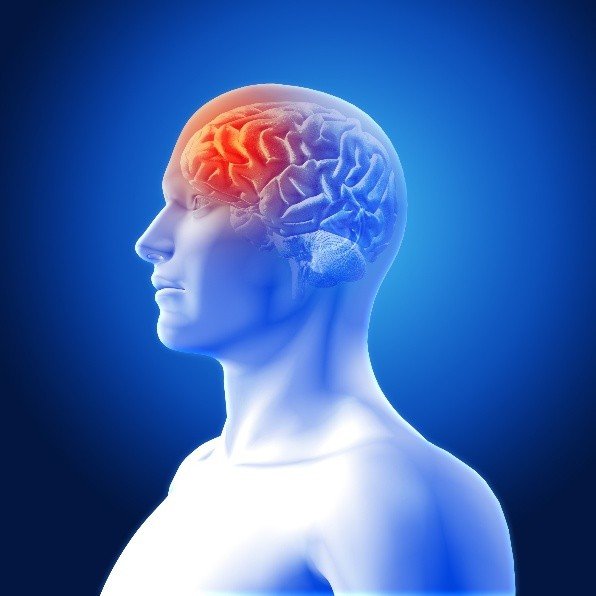
In this chapter (surah) Allah warns of dragging the sinner by the forelock, describing it as both “lying” and “sinning.” At first glance, this may seem symbolic, but modern neuroscience reveals an astonishing alignment with this Quranic description.
The prefrontal cortex, located at the front of the brain, directly behind the forehead, is the centre responsible for human behaviour, decision-making, morality, and personality. It governs our ability to distinguish right from wrong, to act truthfully or deceitfully, and to exercise judgment. In essence, this region directs the choices and actions that reflect who we are.
Research shows that when a person lies, the prefrontal cortex is the area of the brain that is active, making decisions and regulating behaviour. This area is also involved in emotions, initiative, and self-control. In other words, the Quran’s reference to the forelock (nasiyah) as the centre of lies and sin aligns with modern discoveries about the human brain.
The connection between the forelock (nasiyah) and neuroscience was highlighted by Professor Keith L. Moore, who, in a 1980 conference in Cairo, pointed out that the forelock functions similarly in humans and animals. Comparative studies of animal brains demonstrate that this region serves as the centre of control and guidance across species. This insight echoes the Quranic verse:
“There is no creature but that He holds its forelock…” (Surah Hud 11:56)
Additionally, the Prophet Muhammad (peace be upon him) referred to the forelock (nasiyah) in prayers and teachings, acknowledging it as the locus of control in both humans and animals. These references align strikingly with modern neuroscience, which only identified the function of the frontal lobe in the mid-19th century.
A famous historical case in 1842 involved a railway worker in the United States whose frontal lobe was injured. Although other bodily functions remained intact, his personality and behaviour changed dramatically. This was the first scientific observation linking the frontal region of the brain to behaviour, decision-making, and morality precisely what the Quran had highlighted fourteen centuries earlier.
As Professor Moore emphasises, knowledge of the forelock’s function was unknown in medical literature during the Prophet’s time. The Quran’s statement about the forelock being the centre of sin, deceit, and moral choice could only have come from Divine Knowledge.
Click on this video here to learn about this miracle – https://www.youtube.com/watch?v=EXy7_G0Rt08