
Performing Prayer During Illness
Core Principle: Prayer is a fundamental obligation in Islam, and it remains obligatory even when a person is sick. However, Islam provides practical concessions to ensure that the sick can still fulfill their prayers according to their ability. These concessions include performing it while sitting or lying down, using gestures instead of full movements, shortening prayer and relying on tayammum if water use is difficult. The goal is to maintain the obligation of prayer while accommodating the limitations caused by illness.

Recitation During Illness: If you are able to speak, you must still recite al‑Fātiḥah and the required supplications. If you are unable to speak, recitation in the heart is sufficient.
Gestures Explained: For head gestures: rukūʿ is a slight nod, and sujūd is a deeper nod. Sujūd should be lower than rukūʿ if possible.
Facing the Qiblah: Face the qiblah if you are able without harm. If turning causes pain or danger, pray in the direction you are in. There is no sin in this situation.
Wuḍū’ During Illness: If water is safe to use, perform wuḍū’ normally. Assistance is allowed. If water causes harm or is medically restricted, perform tayammum instead.
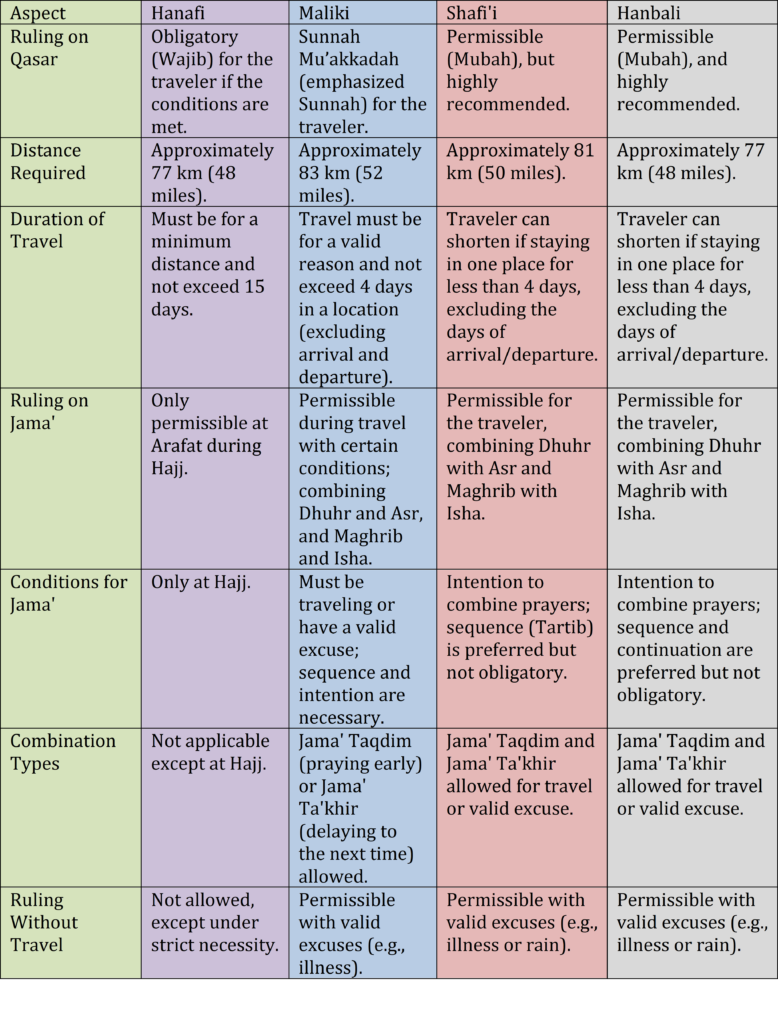
Combining Prayers: If illness makes repeated movement difficult, it is permissible to combine Ẓuhr with ʿAṣr and Maghrib with ʿIshā’. This is a permission, not an obligation.
Clothing and Purity: If changing clothes or removing impurity causes harm, pray as you are. Necessity excuses difficulty.
Unconsciousness: If a person is fully unconscious, prayer is lifted during that period. When consciousness returns, they resume prayer.
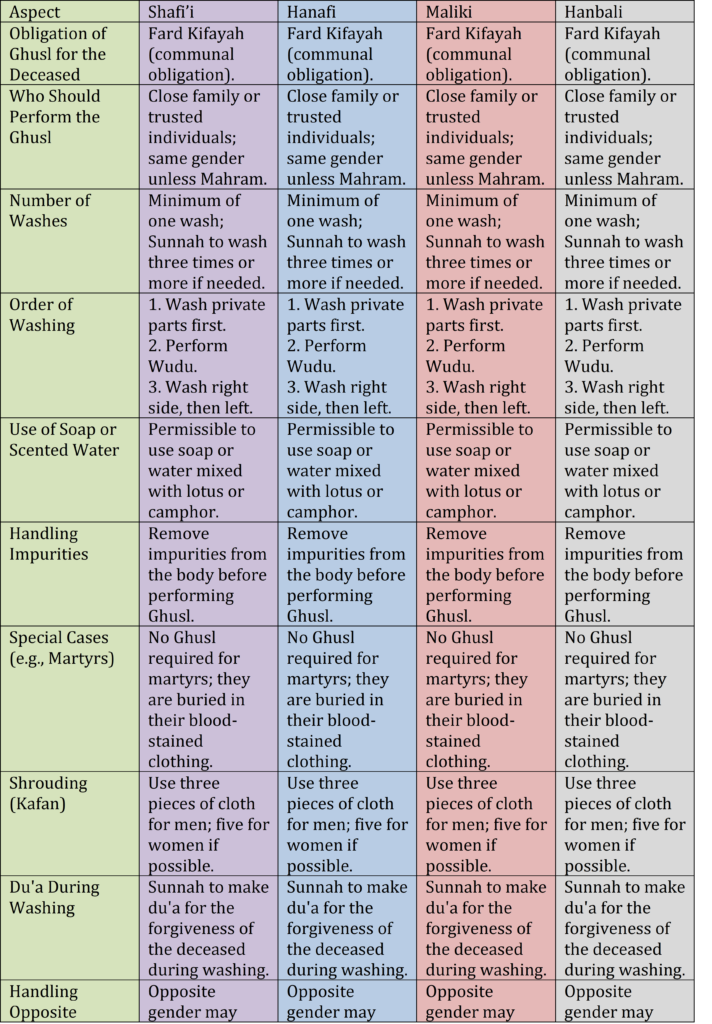
Performing Prayer During Illness – Four Madhāhib Comparison

Rulings of Prayer During Battle (Ṣalāt al-Khawf)
Islam does not waive ṣalāh due to fear or battle. Instead, Allah legislated special concessions to ensure prayer is performed according to one’s ability.
Obligation of Prayer Remains and salah is never abandoned even during active combat. The form of prayer changes based on the level of danger. This form of prayer is called Ṣalāt al-Khawf (The Prayer of Fear).
“When you ˹O Prophet˺ are ˹campaigning˺ with them and you lead them in prayer, let one group of them pray with you—while armed. When they prostrate themselves, let the other group stand guard behind them. Then the group that has not yet prayed will join you in prayer—and let them be vigilant and armed. The disbelievers wish to see you neglect your weapons and belongings so they may launch a sudden assault. But there is no blame if you lay aside your weapons due to heavy rain or illness—yet take precaution. Indeed, Allah has prepared a humiliating punishment for the disbelievers.” – Qur’an, Sūrah al-Nisāʾ 4:102
1. If the Enemy Is Present but Not Actively Attacking
· When circumstances allow, prayer is performed in congregation using a rotating-group system where the army split into two groups. One group prays with the imam while the other remains on guard, then they alternate. Weapons are carried and vigilance is maintained throughout.
· If organised congregation becomes unsafe due to intense combat, the jamāʿah may dissolve without sin. Each person then prays individually while moving, on foot, or while riding.
This was practiced by the Prophet ﷺ and mentioned in the Qurʾān Sūrat al-Nisāʾ 4:102
Prayer While Riding a Horse
Prayer while riding a horse is explicitly permitted during fear or battle. Standing is waived, and the worshipper remains seated. Facing the qiblah is required only if possible. Bowing and prostration are performed by head gestures. Movement of the horse does not invalidate the prayer, and weapons may be carried and used if necessary.
“If you are in danger, pray on foot or while riding. But when you are safe, remember Allah for teaching you what you did not know.” – Qur’an Sūrah al-Baqarah 2:239
If Unable to Perform Physical Movements, Rukūʿ and sujūd are done by head or eye gestures. If even that is not possible, prayer is performed in the heart according to some scholars.
Farḍ and Nafl Distinction: Obligatory prayers may be prayed on horseback only in cases of fear or necessity. Without fear, farḍ prayers must be prayed after dismounting if possible. Voluntary prayers are permitted on horseback even without fear.
3. Timing of Prayer
- The obligation of ṣalāh is tied to its prescribed time. Fear, danger, or combat does not remove the time requirement, but it may change the way prayer is performed.
- If unavoidable combat causes the entire prayer time to pass, there is no sin. The prayer must be made up (qaḍāʾ) as soon as it becomes safe. Furthermore, if the army is travelling, prayers are shortened as usual. Fear prayer does not cancel qaṣr, and both may be combined when applicable
Madhhab Opinions on Timing
 Blood, Wounds, and Impurity: Blood, wounds, and unavoidable impurity are excused when their removal would cause harm or is not possible. Prayer is performed in the best condition achievable
Scope of Application: Ṣalāt al-Khawf applies not only to formal warfare, but to any genuine situation of fear, such as guarding, protecting civilians, or escaping danger.
Ṣalāt al-Khawf: Four Madhhab Comparison

Summary: Prayer is never abandoned in Islam. When circumstances become extreme, its form adapts, while its obligation remains. All four Sunni schools of law agree on the legitimacy of Ṣalāt al-Khawf and prayer while riding during fear. Differences relate only to details, not to the principle.