
This table outlines the Purification refers to cleanliness and removal of impurities, whether tangible like physical filth, or intangible, such as spiritual faults. It is said: “The water became purified,”
TAHARA – PURIFICATION
Rules of Purification, and it includes:
- Introduction
- Rules of Purification
- Rules of Water
- Rules of Utensils
- Rules of Wudu (Ablution) for the One Being Led in Prayer
- Rules of Ghusl (Full Body Ritual Washing) and Janabah (State of Major Ritual Impurity)
Praise be to Allah, the Lord of the Worlds, who has elevated the status of knowledge and favored the scholars; He (the Exalted) said:
“Say, ‘Are those who know equal to those who do not know?’ Only those of understanding will remember.” – Qur’an: Az-Zumar 39: 9
And may prayers and peace be upon our master Muhammad, the best of mankind, who said in the authentic hadith Narrated Ibn ‘Abbas:
“Whomever Allah wants good for, He grants him understanding in the religion.” – Source: Jami` at-Tirmidhi 2645
And may Allah be pleased with his noble companions who accompanied the Messenger of Allah (peace and blessings be upon him), learned from him, and conveyed to us what they had drawn from him. And may Allah have mercy on the complete scholars who carried the knowledge until it reached us.
To proceed: Verily, the Islamic sciences are among the greatest acts of drawing near to Allah, the Exalted. Among these sciences is the science of Islamic jurisprudence (Fiqh), through which the worship of a Muslim becomes correct and accepted by Allah, the Exalted.
Indeed, Allah, the Exalted, urged the believers to seek knowledge. He, the Exalted, said:
“But why should not there go forth a group from every division of them to become learned in religion and to warn their people when they return to them that they might be cautious?” – Qur’an: At-Tawbah 9:122
And here we are, with the success of Allah, beginning the study of some rulings in Islamic jurisprudence.
(1) Narrated by Al-Bukhari in the Book of Knowledge, Chapter: Whomever Allah wants good for, He grants him understanding in the religion, Hadith no. (71); and Muslim in the Book of Zakat, Chapter: The prohibition of begging, Hadith no. (1037).
Rulings of Purification
The Classification of Fiqh According to the Scholars:
The jurists have divided fiqh into four sections:
- Acts of worship.
- Marriage and what is related to it.
- Criminal offenses.
Sources of Islamic Jurisprudence:
- The Noble Qur’an
- The Noble Sunnah
- Consensus (Ijmaʿ)
- Analogical reasoning (Qiyas).
Definition of Purification:
Linguistically:
Purification refers to cleanliness and removal of impurities, whether tangible like physical filth, or intangible, such as spiritual faults. It is said: “The water became purified,” meaning it became cleansed of dirt and impurities; and “He purified himself from envy,” meaning he rid himself of it.
In Islamic law (Sharʿ):
Purification in the Shariah is the performance of acts that make prayer permissible, such as wudu (ablution), i.e., removing a state of ritual impurity (hadath) and eliminating physical impurity (Najasah).
Types of Purification:
Purification in Sharia is divided into two types: physical purification and spiritual purification.
- Spiritual purification: It is the purification of the heart and limbs from the filth of sins, such as being free from backbiting and gossip. The Prophet ﷺ said: “Indeed, Allah does not look at your bodies nor at your appearances, but He looks at your hearts.” And he pointed with his fingers to his chest. – Source: Bukhari & Muslim
- Physical purification: It is the cleanliness of the body from tangible impurity, and it is of two types:
- Purification from ritual impurity (Hadath), which is:
- Major purification: Performed through Ghusl (a full ritual bath).
- Minor purification: Performed through Wudu (ablution).
- Purification from filth (Najasah), which is:
This involves removing physical impurity usually by washing. For heavy objects (that cannot be washed), such as a word or a wall – purification is done by wiping them clean.
Meaning of “Hadath” (State of Ritual Impurity): Hadath refers to everything that necessitates wudu or ghusl, and it is a legal state that prevents a person from performing acts of worship, such as prayer, touching the Mushaf (Qur’an), and similar acts.
Meaning of “Khabath” (Filth/Physical impurity): Khabath or Najasah refers to physical impurities – that is anything considered repulsive or unclean that invalidates the validity of prayer. For example blood, urine, and any substance that is inherently prohibited for consumption, such as alcohol.
Rulings of Water
Water is divided into four categories:
- Pure and purifying
- Pure and purifying but disliked
- Pure but not purifying
Pure and Purifying: This refers to unrestricted (absolute) water. It is any water that descends from the sky or springs from the earth. Its ruling is that it purifies from both states of ritual impurity (hadath) and physical filth (Najasah).
Evidence: Al-Bukhari and others narrated from Abu Hurayrah (may Allah be pleased with him): A Bedouin stood and urinated in the mosque, so the people stood to harm him. But the Prophet ﷺ said: “Leave him, and pour over his urine a bucket of water (or a bucketful of water), for you have been sent to make things easy, not to make things difficult.”
- “To harm him” means to rebuke him with verbally or physically.
- “Sajlān” refers to a bucket filled with water.
The Messenger of Allah ﷺ commanded to pour water over the place of the urine (impurity) which is proof that water possesses the quality of purification.
- Pure and Purifying but Disliked (Makruh):
It is water heated by the sun, and its disliked status depends on three conditions: - That it is in a hot country.
- That it is placed in containers made of metals that can be hammered into shape, excluding gold and silver, such as iron and copper, and any metal capable of being beaten.
- That it is used on the body.
Ash-Shafiʿi (may Allah have mercy on him) said that ʿUmar (may Allah be pleased with him) used to dislike bathing with it. He said: “I do not dislike sun-heated water except from a medical standpoint.” Then he narrated: “It may cause vitiligo (leukoderma).”
This is because the sharpness of the sun causes a vapor to rise and settle on the water. If it meets the body while hot, it may harm it and cause vitiligo, which is a skin disease.
- Pure but Not Purifying (Tahir Ghayr Mutahhir):
This is divided into two parts: - A small amount of water used: This is the water used in an obligatory purification (Wudu or Ghusl).
Evidence that it is pure:
Al‑Bukhārī and Muslim narrated from Jābir ibn ʿAbdillah (may Allah be pleased with him): The Prophet ﷺ visited me while I was unconscious, performed wudu, and poured the water of his wudu over me. (“Unconscious”: in a coma due to severe illness. “From his wudu”: the water he used in his ablution.)
If this water were impure, the Prophet ﷺ would not have used it
Evidence that it is not purifying:
Narrated from Abu Hurayrah (may Allah be pleased with him) that the Prophet ﷺ said: “None of you should bathe in ‘standing water’ while in a state of janabah (major ritual impurity).” They said: “O Abu Hurayrah, then how should he do so?” He said: “He should take from it by scooping.” – Source: Muslim
(1) Al-Bukhari, Muslim, Abu Dawud, an-Nasa’i, at-Tirmidhi, Ibn Majah, and Ahmad.
(“Standing water” means stagnant water.)
This indicates that bathing directly in a small amount of water removes its purifying ability, otherwise the prophet ﷺ would not have prohibited it. It is understood to refer to a small amount of water due to other evidence.
And the ruling for wudu in this case is the same as for ghusl because the meaning in both is the same: removing a state of ritual impurity.
- Water mixed with pure substance: This refers to unrestricted water that has been mixed with pure substances that water does not normally require and cannot be separated after mixing. For example, tea and licorice water. Such water remains pure, but it cannot purify.
- Impure Water (Najis):
This is water in which impurity has fallen, and it is of two types: - A small amount (less than two qullahs): This water becomes impure immediately when impurity falls into it, even if none of its characteristics (colour, smell, taste) change.
- Two qullahs = 500 Baghdad ratls, equal to 857 kilograms, and in volume equal to a cubit and a quarter in length, width, and depth.
The five (authors of the Sunan) narrated from ʿAbdullah ibn ʿUmar (may Allah be pleased with them both) that he said: I heard the Messenger of Allah ﷺ being asked about water in open land and what wild animals and beasts may come across it. He said: “If the water reaches two qullahs, it does not carry impurity.”
And in the wording of Abu Dawud: “Then it does not become impure.”
(1) Al-Bukhari, Muslim, Abu Dawud, an-Nasa’i, at-Tirmidhi, Ibn Majah, and Ahmad).
The Understanding of the Hadith:
If the water is less than two qullahs, it becomes impure even without change (colour, smell, taste).
Abu Hurayrah (may Allah be pleased with him), that the Prophet ﷺ said: “When one of you wakes up from his sleep, let him not dip his hand into the vessel until he washes it three times, for he does not know where his hand spent the night.”
This prohibition is due to the possibility of being contaminated with unseen impurity, which does not alter the water’s characteristics, yet still renders it impure.
B. A Large Amount (two qullahs or more): This water does not become impure merely by impurity falling into it; rather, it only becomes impure if the impurity changes one of its three characteristics: color, taste, or smell. The evidence for this is consensus.
An-Nawawi said in Al-Majmuʿ: Ibn al-Mundhir said: “They (the scholars) unanimously agreed that water — whether little or much — if impurity falls into it and changes its taste, color, or smell, then it is impure.”
Which of these waters are suitable for purification:
Not all four types of water are suitable for purification, i.e removing both ritual impurity and physical filth. Only the first and second types are suitable, though using the second on the body is disliked. The third type is not suitable for purification, even though it is pure in itself. The fourth type is impure and is not suitable for any use.
- Visible Impurity and Legal Impurity
- Visible Impurity (Najāsah ʿAyniyyah): This refers to any impurity that has a tangible presence or a discernible characteristic, such as a visible color or smell, for example, feces, urine, or blood.
- Legal Impurity (Najāsah Hukmiyyah): This refers to an impurity whose substance has dried and whose traces have disappeared, such that no color or smell remains. An example is urine that came into contact with a garment, then dried, leaving no visible trace.
Narrated Lubabah bint al-Harith, she said: “Al-Husayn ibn ʿAli urinated in the lap of the Prophet ﷺ, so I said, ‘O Messenger of Allah, give me your garment and wear another one.’ He said: ‘It is only sprinkled for the urine of a boy, and washed for the urine of a girl.’” (1) – Source: Sunan Abi Dawud 375
The Indication of the Hadith:
It is understood from this hadith that the urine of a young boy who has not eaten solid food has a light impurity, and it is sufficient to sprinkle it, meaning spray it with water.
Understanding the Hadith from scientific perspective:
Newborn girls can experience temporary vaginal discharge and, in some cases, slight bleeding due to the withdrawal of maternal hormones after birth. Because the female urinary opening is located close to the reproductive opening, outward moisture may be present in that area. Meaning, moisture from normal secretions can sometimes be present on the outer skin in that region compared to a male infant, whose anatomy is different.
This physiological difference has been mentioned by some scholars as part of the wisdom behind treating the impurity with greater thoroughness in the case of a female infant.
Thus, the legal ruling reflects a divinely guided differentiation in how purification is performed, while both remain within the broader category of impurity that must be cleansed. The lighter method prescribed for the boy who has not yet begun eating solid food and the more complete washing required for the girl demonstrate that Islamic law distinguishes between cases based on subtle natural differences. And Allah knows best.
(1) Sunan Ibn Mājah: Book of Purification, Chapter: What has been reported about the urine of a boy who has not been fed solid food, Hadith no. (515).
Therefore, we find that centuries before the discovery of bacteria, the Prophet ﷺ was connected to revelation, taught by the All-Wise, All-Knowing.
Abu Dawud narrated in his Sunan with his chain of transmission from Umm Qays bint Miḥṣan: She came to the Messenger of Allah ﷺ with her young son who had not yet eaten food, and the Messenger of Allah ﷺ seated him in his lap. The boy urinated on his garment, so he ﷺ called for water and sprinkled it with water and did not wash it. – Source: Bukhari & Muslim (Mishkat al-Masabih 497)
From this, it becomes clear that the urine of a boy who has not yet been nourished by food is sprinkled (with water), but once he has been nourished, then it is washed.
As for the girl, her urine is washed in all cases, whether she has eaten or not.
Rulings of Utensils
Utensils: They are containers; the plural of ināʾ (vessel), and the plural of āniyah is awānī.
The Ruling on Using Gold and Silver Utensils:
It is forbidden to use gold and silver utensils for all types of use, such as for ablution or drinking.
Narrated Ḥudhayfah ibn al-Yamān (may Allah be pleased with him) who said, I heard the Messenger of Allah ﷺ say: “Do not wear silk or brocade, and do not drink from gold and silver vessels, and do not eat from their plates, for they are for them in this world and for us in the Hereafter.” – Source: Al-Bukhari and Muslim
[“Dībāj” is a luxurious type of silk. “Āniyah” is the plural of ināʾ (vessel). “Ṣiḥāfihā” is the plural of ṣaḥfah, which is a large dish.]
The prohibition includes both men and women. Just as usage is prohibited, so is possession, that is, owning them for decoration or the like is also not allowed.
The Ruling on Using Utensils Made from Precious Metals:
It is permissible to use utensils made from precious metals such as diamonds, pearls, coral, and others, as there is no text prohibiting their use. The original ruling is permissibility unless proof of prohibition exists.
Conditions for Permissible Use of Silver in Utensils:
A small amount of silver is permitted in utensils under two conditions:
1. That the amount of silver is small.
2. Its use serves a genuine need.
Narrated Anas ibn Mālik: “The cup of the Prophet ﷺ broke, so he fixed the cracked part with a silver chain.” – Source: Al-Bukhari
And this is an agreed-upon matter.
The Ruling on Using the Utensils of Non-Muslims:
It is permissible to use these utensils.
Narrated Abū Thaʿlabah (may Allah be pleased with him) that the Prophet ﷺ said:
“Then wash them and eat from them.” – Source: Al-Bukhari
And the command to wash them is for recommendation, due to the possibility of contamination from their use of wine or pork and the like. The same ruling applies to their clothing and similar items.
Rulings of Wudū’ (Ablution)
Meaning of Wudū’: The act of washing and wiping specific parts of the body in preparation for worship, e.g. prayer. It is called Wudu because of the brightness (Wada’ah وضاءة) it brings to the limbs through purification.
The scholars have unanimously agreed that prayer is not valid without purification if one is able to do it.
Narrated Abū Hurayrah (may Allah be pleased with him) that the Prophet ﷺ said: “Allah does not accept the prayer of any of you when he breaks his wudū’ until he performs wudū’.” – Source: Al-Bukhārī and Muslim
The obligatory acts of wudū’ are six:
- Intention
- Washing the face
- Washing the hands including the elbows
- Wiping part of the head
- Washing the feet including the ankles
- Observing the correct order
- The Intention: Wudū’ is an act of worship, and acts of worship are distinguished by intention.
Narrated Umar Ibn al-Khattab (may Allah be pleased with him) that the Messenger of Allah ﷺ said: “Indeed, actions are only by their intentions, and indeed, every person will have only what he intended.” – Source: Al-Bukhārī]
The place of intention is the heart, and it is recommended to pronounce it verbally.
- Washing the entire face as commanded by Allah, the Exalted in Surah Mai’dah 5:6 saying, “wash your faces.”
The limits of the face: from the hairline to the bottom of the chin in length, and from ear to ear in width.
- Washing the hands including the elbows as commanded by Allah, the Exalted in Surah Mai’dah 5:6 saying, “And your hands up to the elbows.”
“Elbows” is the plural of mirfaq, which is where the forearm meets the upper arm.
It is obligatory to wash all the skin and hair. If there is a ring, water must reach underneath it.
- Wiping part of the head, even one hair, as long as it is within the limits of the head; as commanded by Allah, the Exalted in Surah Mai’dah 5:6 saying, “wipe your heads.”
- Washing the feet including the ankles as commanded by Allah, the Exalted in Surah Mai’dah 5:6 saying, “wash your feet to the ankles.”
Al-kaʿbān (the two ankles) is the dual form of kaʿb, which is the protruding bone on each side where the shin meets the foot.
- Observing the correct order as mentioned above, and this is understood from the verse:
“O you who believe! When you rise for prayer, wash your faces and your hands up to the elbows, and wipe your heads and your feet up to the ankles.” – Qur’an: Al-Māʾidah 5:6
This is also observed from the action of the Prophet ﷺ, as he never performed wudū’ except in this order.
The Sunnahs (Recommended Acts) of Wudū’:
Wudū’ has many Sunnahs. The most important of them are the following:
- Saying Bismillāh at its beginning.
- Washing the hands three times before putting them into the vessel.
- Using the siwāk (tooth-stick).
- Rinsing the mouth (al-madhmaḍah).
- Inhaling water into the nose with the right hand (al-istinshāq) and expelling it with the left hand (al-istinthār).
- Running the fingers through a thick beard.
- Wiping the entire head.
- Running water between the fingers of the hands and feet.
- Wiping the outer and inner parts of the ears with fresh water (not the water of the head).
- Repeating all the obligatory and Sunnah actions three times.
- Giving precedence to the right over the left in washing the hands and feet.
- Ad-dalk: rubbing the limb with the hand while washing.
- Al-muwālāh: washing the limbs in succession without interruption.
- Not speaking during wudū’, in imitation of the Messenger ﷺ.
- Saying the testimony (shahādah) at the end of wudū’ and supplicating: “Ashhadu an lā ilāha illa Allāh waḥdahu lā sharīka lah, wa ashhadu anna Muḥammadan ʿabduhū wa rasū” – “Allāhumma ajʿalnī min at-tawwābīn, wajʿalnī min al-mutaṭahhirīn.” – “Subḥānaka Allāhumma wa bi ḥamdik, ashhadu an lā ilāha illā ant, astaghfiruka wa atūbu ilayk.”
Makruh (Disliked) acts: Among the disliked acts of wudū’ is excessiveness in using water.
The Nullifiers of Wudū’:
Wudū’ is nullified by four things:
- Anything that exits from either of the two private parts, such as urine, feces, blood, or gas.
- Loss of intellect through sleep or other causes, except sleep while firmly seated on the ground. Firmly seated means sitting while the buttocks are in full contact with the ground.
- Skin-to-skin contact between an adult, non-mahram (marriageable), male and female without any barriers.
- Touching the private part of a human (whether one’s own or someone else’s) with the palm or inner surface of the fingers.
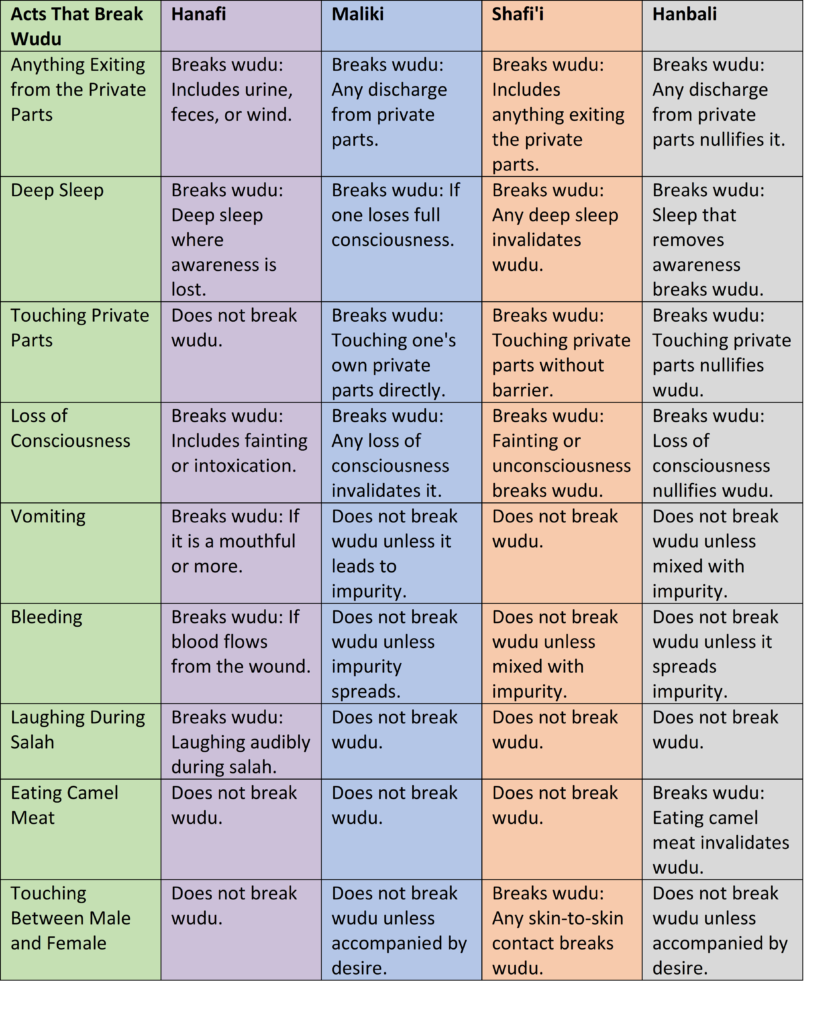
Note: Different Madhab have different rulings, check below according to your madhab.
Matters for Which Wudū’ Is Required:
The matters for which wudū’ is obligatory are:
- Circumambulating the Kaʿbah, because ṭawāf is like prayer; purification is required for it.
- Touching and carrying the Muṣḥaf (the written Qur’an). Allah, the Exalted said: “None touch it except the purified.” – Qur’an: Al-Wāqiʿah 56:79
Rulings of Ghusl
Ghusl is legislated, whether for cleanliness or for lifting a state of ritual impurity, whether it is a condition for an act of worship or not.
Its legislation is proven by the Qur’an, the Sunnah, and consensus.
“Indeed, Allah loves those who repent often and loves those who purify themselves.” – Qur’an: Al-Baqarah 2:222
Meaning: those who purify themselves from ritual impurity, physical and moral filth.
Types of Ghusl
Ghusl is of two types: obligatory (fard) and recommended (mandūb).
- Obligatory Ghusl: It is the complete washing of the entire body with the intention of purification. It becomes obligatory when a person enters a state of major ritual impurity.
Major Ritual Impurity:
Janābah (Sexual intercourse, Ejaculation), menstruation, childbirth, and death.
Janābah: A person in the state of janābah is someone who is not in a state of purity due to ejaculation or intercourse. Due being in a state of janābah, he is “distanced” from performing prayer as long as he remains in that state. Originally its meaning is “distance.”
The word junub (one in a state of janābah) applies equally to masculine and feminine, singular and plural.
The following are prohibited while in the state of janābah:
- Prayer
- Circumambulation of the Kaʿbah
- Remaining in or sitting in the mosque
- Touching, carrying, or reciting the Muṣḥaf (written Qur’an)
Menstruation: It is a natural blood, meaning it is by nature that exits from the innermost part of the woman’s womb after she reaches puberty, in a state of health, without any apparent cause, at known intervals.
The duration of menstruation: There is a minimum, a maximum, and a common duration for menstruation.
- The minimum duration: One day and one night.
- The maximum duration: Fifteen days and nights.
- The common (most frequent) duration: six or seven days.
The minimum purity between two menstruations is fifteen days, according to the majority of scholars, and there is no maximum limit for purity.
If a woman sees blood for less than the minimum duration of menstruation, or she sees blood after the maximum duration, then this blood is considered istihāḍah (irregular or abnormal bleeding), not menstrual blood.
Menstrual blood is distinguishable from the blood of istihāḍah.
Istihāḍah: It is blood due to a condition or illness that comes from a vein from the lower part of the womb. This blood nullifies wudū’, but does not require ghusl, nor does it necessitate abandoning prayer or fasting.
The woman experiencing istihāḍah usually washes off the blood, wraps the area, makes wudū’ for each obligatory prayer, and prays.
Abū Dāwūd narrated from Fāṭimah bint Abī Ḥubaysh that she used to experience istihāḍah, and the Prophet ﷺ said to her: “If it is the blood of menstruation, then it is black blood that is recognised. So when that occurs, stop praying. But if it is the other (type), then make wudū’ and pray, for it is only a vein.”
What is prohibited during menstruation:
- Prayer
Recitation of the Qur’an, touching or carrying the Muṣḥaf - Remaining in the mosque
- Circumambulation (ṭawāf)
- Fasting
- Intercourse (sexual relations)
Childbirth: It is the act of delivering the fetus. After the birth of the child, blood called nifās emerges.
Nifās: It is the blood that exits following childbirth. It is called nifās because it comes forth after the baby’s delivery, and the woman is called nufāsā’ (experiencing postpartum bleeding). Blood that comes during labor or at the moment of delivery is not considered nifās, due to its precedence before the exit of the child. Rather, it is considered corrupted blood (دم فساد). According to this ruling, prayer remains obligatory during labor even if she sees blood; if she is unable to perform prayer, it must be made up afterward. There is a difference of opinion among the four schools on this, explained in detail in the study “Menstruation between Sharīʿah and Medicine.”
Duration of Nifās: It may extend for days, most often forty days, some scholars say sixty days. What exceeds that is considered istihāḍah. All rulings that apply to menstruation apply to nifās, and this is by scholarly consensus.
It is also said that any bleeding a pregnant woman sees is considered istihāḍah, regardless of its nature, not menstrual blood, because pregnancy obstructs the menstruation outlet. This is the majority opinion.
Duration of Pregnancy: The minimum duration: six months, taken from the two noble verses:
“And his gestation and weaning [period] is thirty months.” – Qur’an: Al‑Aḥqāf 46:15
“And weaning is within two years.” – Qur’an: Luqmān 31:14
If the total time for gestation and weaning is thirty months, and the weaning alone is two years, then the gestation period is six months, which is its minimum. So if a married woman gives birth to a living child in less than six months, the paternity is not established for the father.
Usual Duration of Pregnancy: It is nine months, based on common experience, as most women give birth around nine months after conception, plus or minus a few days.
In Ad‑Durr Al‑Manthūr, ‘Umar (may Allah be pleased with him) was asked about a woman who delivered a baby after six months. ‘Alī (may Allah honor his face) responded, citing the verse “And his gestation and weaning is thirty months.” Then it was reported to ‘Umar that she bore another child after six months. He then sent for her to be stoned for adultery, but when ‘Alī learned of it, he intervened, citing the same verse and saying, “How much do you find remaining except six months?” ‘Umar said, “By Allah, I had not understood this. Go to the woman.” She reassured her sister: “Do not grieve, for by Allah, I have never unveiled my private part to anyone else besides him.” Then the boy grew and the husband accepted him, for he resembled him the most.
Death: When a Muslim dies, it becomes obligatory on the Muslims to perform ghusl on the deceased. This is a communal obligation (fard kifāyah). If some among his relatives or others perform it, the obligation is lifted from the rest; if no one performs it, they all commit a sin. The washing must be performed with the intention of ghusl. This ruling applies to non-martyrs; the martyr is not washed.
Narrated Ibn ‘Abbās (may Allah be pleased with them) that the Messenger of Allah ﷺ said regarding one whose she-camel had cut him: “Wash him with water and sidr (lotus leaves).” – Source: Al-Bukhārī
- Recommended (Sunnah) Ghusls: These are ghusls without which prayer is valid, but the Sharīʿah has recommended them.
They are:
- Ghusl for Jumuʿah (Friday prayer)
- Ghusl for the two ʿEids
- Ghusl on the occasion of solar and lunar eclipses
- Ghusl for seeking rain (Istisqā’)
- Ghusl after washing the deceased
- Ghusls related to Hajj (entering Mecca, standing at Arafah
Disliked Acts (Makāruh) for Ghusl:
- Wastage (extravagance) of water
- Bathing in standing water (to avoid rendering it impure and unsuitable for purification)
Comparison of Menstruation Rules in the Four Madhahib
1. Scenarios of Overlapping States
– **Istihada Overlapping with Menstruation or Postpartum Bleeding (Nifas):**
– If irregular bleeding occurs during the habitual menstrual period, it is treated as menstruation.
– If bleeding occurs outside the normal period, it is treated as istihada.
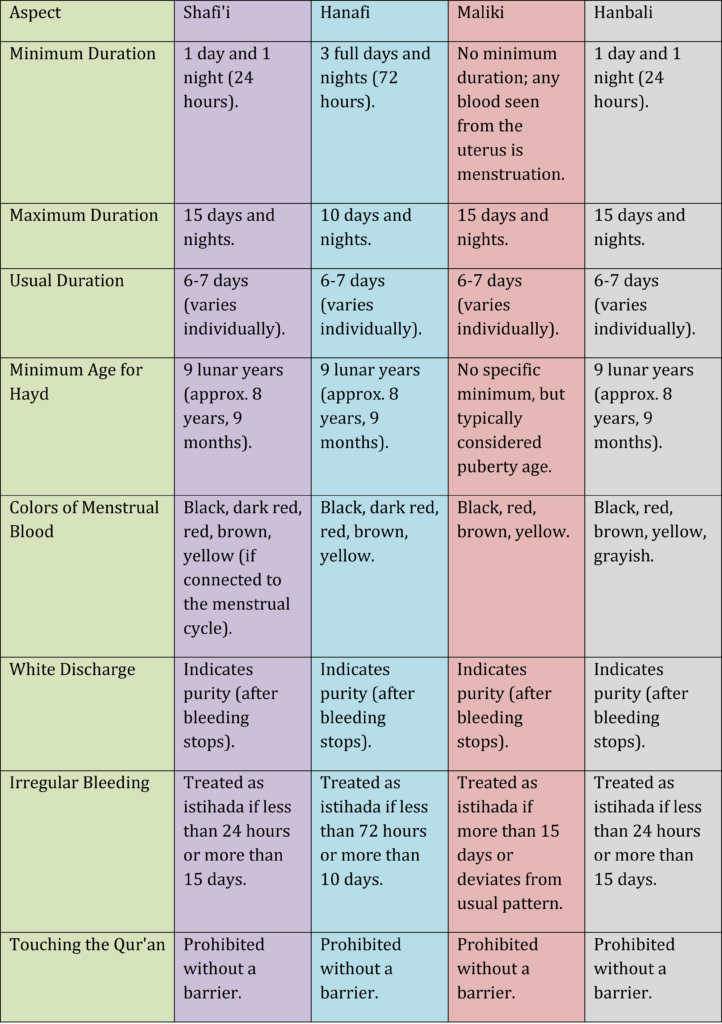
Additional Detailed Rulings on Menstruation
1. Scenarios of Overlapping States
– **Istihada Overlapping with Menstruation or Postpartum Bleeding (Nifas):**
– If irregular bleeding occurs during the habitual menstrual period, it is treated as menstruation.
– If bleeding occurs outside the normal period, it is treated as istihada.
– Postpartum bleeding (nifas) may overlap with menstruation if it extends beyond the maximum limit of nifas (40 days in most madhahib).
– **Distinguishing Habitual Patterns:**
– In cases of uncertainty, a woman reverts to her most recent habitual cycle.
– For women who do not have a clear pattern, the rulings differ by madhhab, with some relying on the dominant color or physical signs of the blood.
2.Determination of Habitual Cycles
– **Changes in Cycle Length or Pattern:**
– A change in the duration or timing of the cycle requires observing the new pattern for consistency over multiple cycles.
– If irregularity persists, women are instructed to consult their previous habitual pattern or follow the default maximum and minimum limits.
– **Undistinguishable Bleeding:**
– If a woman cannot distinguish between istihada and menstruation, she follows the usual duration of menstruation (6-7 days) or her personal habitual length.
3. Special Cases
– **Pregnancy and Menstruation:**
– In the majority of madhahib, bleeding during pregnancy is considered istihada, not menstruation.
– Some exceptions exist in rare circumstances, such as early pregnancy.
– **Post-Menopausal Bleeding:**
– Bleeding that occurs after menopause is not considered menstruation in any madhhab.
– Menopause age varies (usually around 50 years) but depends on individual health and circumstances.
4. Practical Concerns
– **Hygiene and Purity:**
– Women are encouraged to use barriers like pads or clean cloths to prevent blood from contaminating clothing or prayer spaces.
– Washing and maintaining cleanliness is emphasized, especially before performing ghusl.
– **Managing Heavy Flow:**
– In cases of heavy flow or prolonged bleeding, women may follow istihada rulings and perform purification (wudu) for each prayer time.
5. Post-Menstrual Purity Rituals
– **Conditions for Ghusl:**
– Intention (niyyah) is essential before performing ghusl.
– Water must reach all parts of the body, including under the nails and hair roots.
– **Timing of Ghusl:**
– Ghusl must be performed immediately after bleeding stops to resume acts of worship such as salah and fasting.
– **Checking for Purity:**
– Women can confirm purity by observing a white discharge or dryness from the vaginal area.
Ruling For Different Mathahab For Wadhu
Wudu Pillars Across the Four Madhhabs:
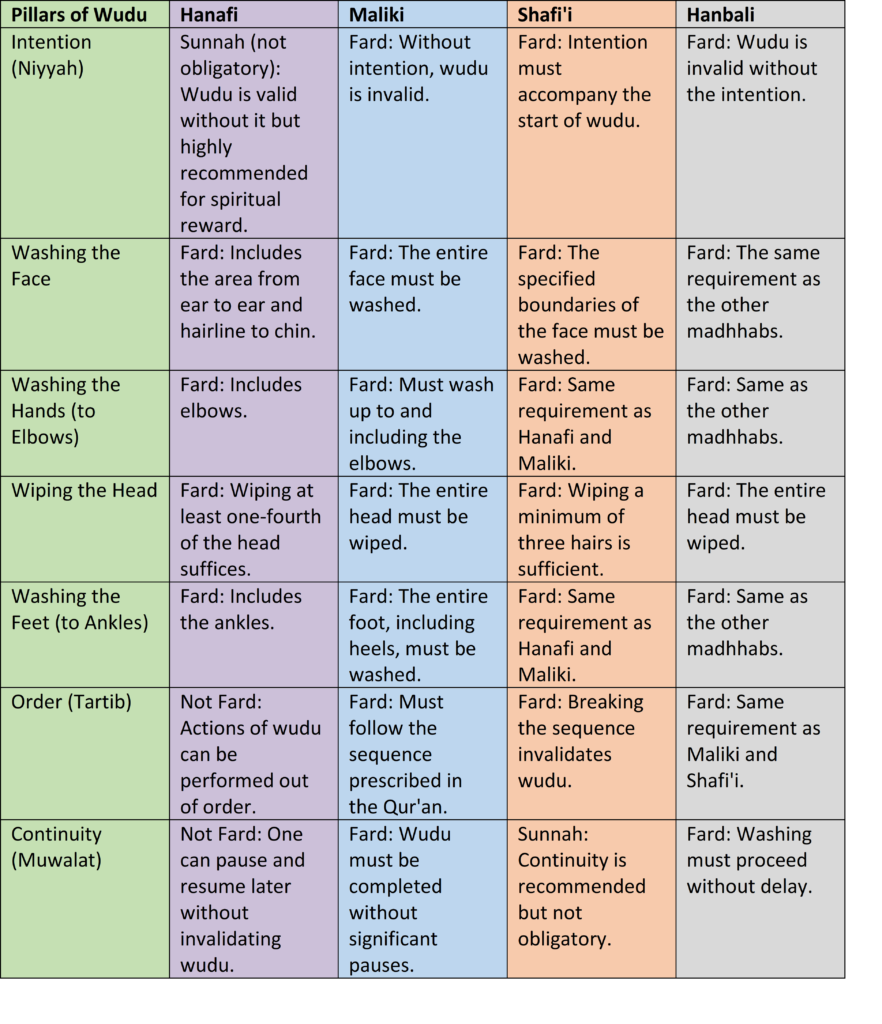
Detailed Explanation of Key Differences:
- Intention (Niyyah):
– Hanafi: Considered sunnah (not obligatory), meaning wudu is valid without it but is highly recommended for spiritual reward.
– Maliki, Shafi’i, Hanbali: Intention is a fard (obligatory) pillar; performing wudu without a conscious intention renders it invalid. - Washing the Face:
– All schools agree this is a fard act, with slight variations in specifying the boundaries of the face. - Washing the Hands (to Elbows):
– Washing the hands and forearms up to and including the elbows is a fard pillar in all four madhhabs. - Wiping the Head (Masah):
– Hanafi: Wiping at least one-fourth of the head suffices.
– Maliki: Wiping the entire head is mandatory.
– Shafi’i: Wiping even a small part (e.g., three hairs) suffices.
– Hanbali: Wiping the entire head is required. - Washing the Feet (to Ankles):
– All madhhabs agree this is a fard act, requiring washing the feet and ankles thoroughly. - Order (Tartib):
– Hanafi: Sequence is not obligatory; flexibility is allowed.
– Maliki, Shafi’i, Hanbali: Order must follow the sequence in the Qur’an (5:6). - Continuity (Muwalat):
– Hanafi: Gaps between washing are permitted.
– Maliki, Hanbali: Continuity is obligatory; wudu must be done without interruptions.
– Shafi’i: Continuity is sunnah; while recommended, it is not obligatory.
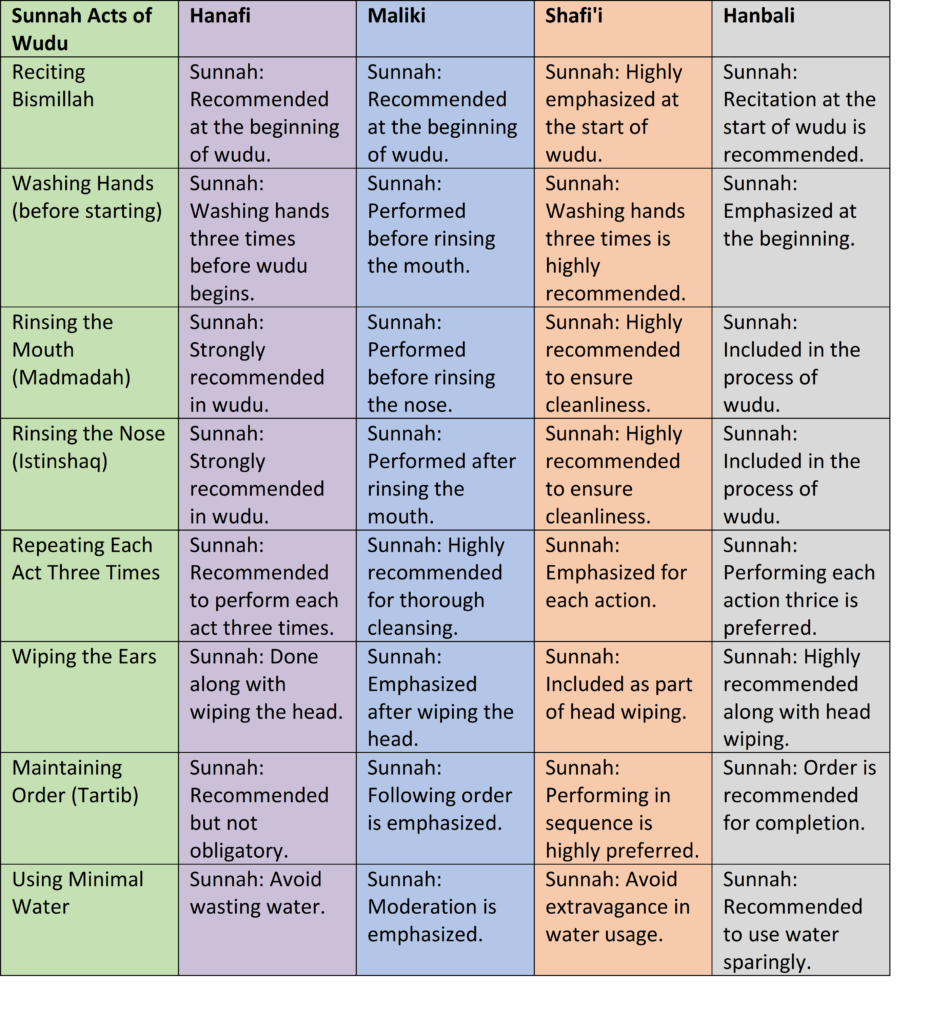
Sunnah Acts of Wudu Across the Four Madhhabs
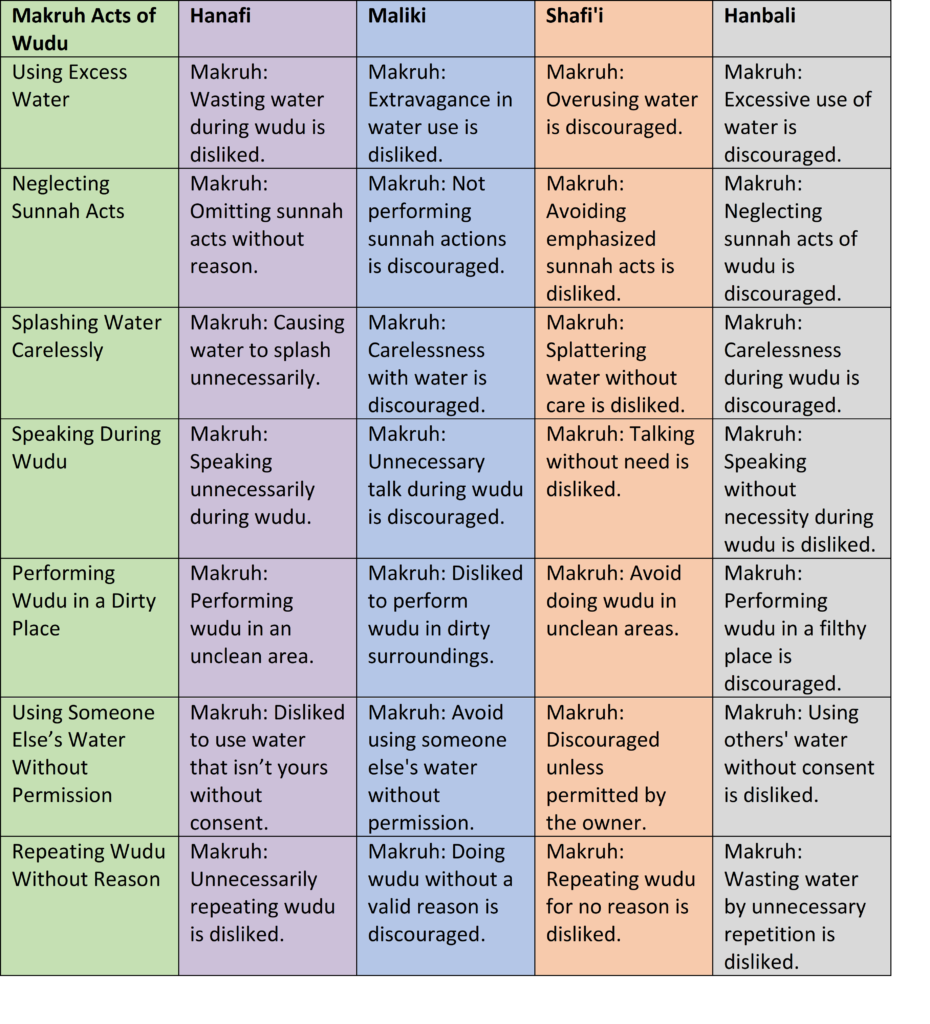
Makruh Acts of Wudu Across the Four Madhhabs
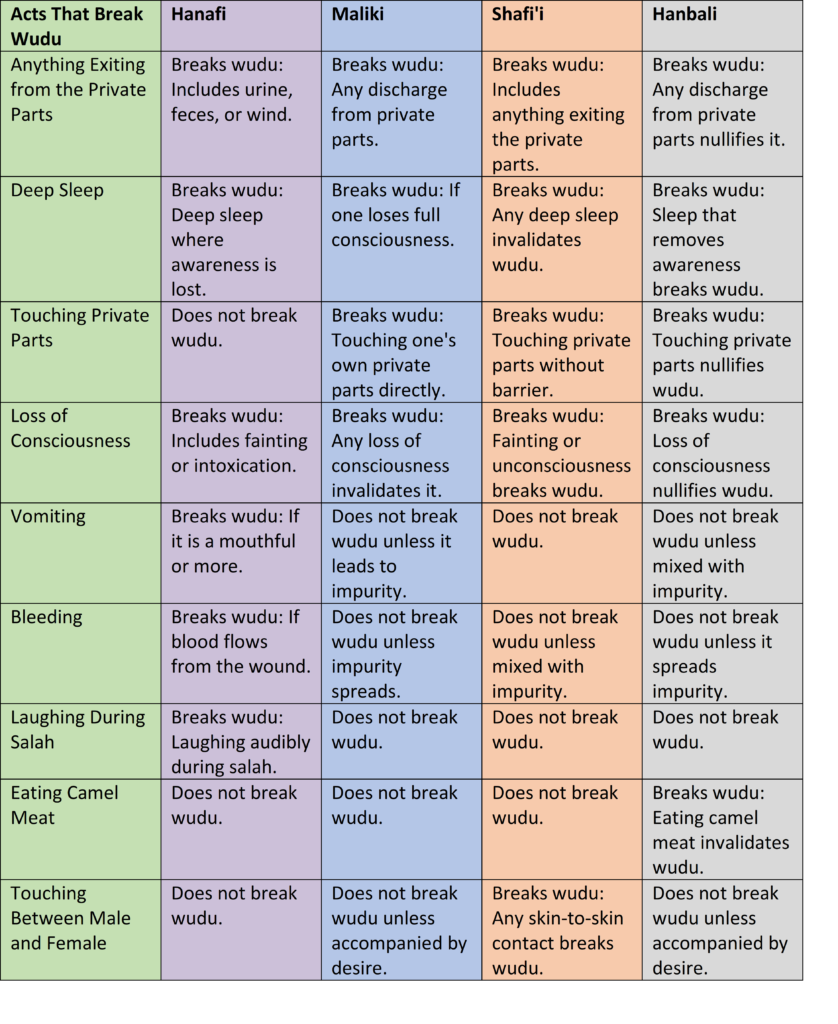
Comparison of Acts That Break Wudu Across the Four Madhhabs
The madhhabs differ significantly on whether this act invalidates wudu, depending on conditions like direct contact and accompanying desire. The table also compares other acts that nullify wudu, reflecting the unique jurisprudential approaches of each madhhab.
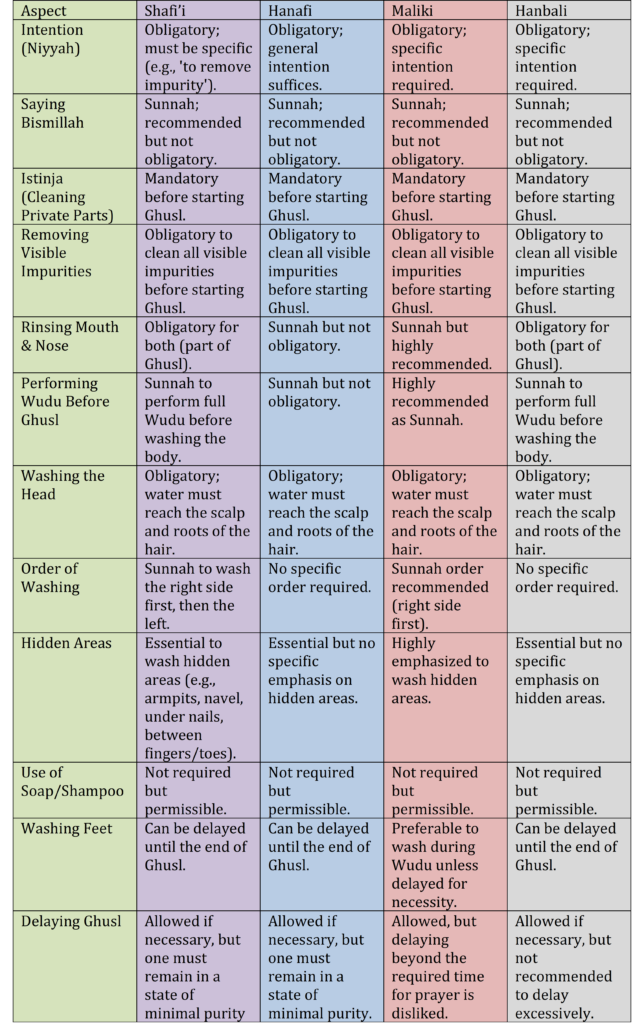
Detailed Comparison of Ghusl Sequence According to the Four Madhahib
This document provides a detailed comparison of the sequence and rulings for performing Ghusl (ritual purification) according to the four major Islamic schools of thought (madhahib). It includes obligatory (fard) acts, Sunnah practices, and specific details for each madhhab.
Detailed Steps of Ghusl
1. **Intention (Niyyah):** Formulate the intention in your heart to purify yourself for Allah.
2. **Say Bismillah:** Begin by saying “Bismillah” (optional but Sunnah).
3. **Wash Hands:** Wash both hands three times.
4. **Perform Istinja:** Clean the private parts thoroughly to remove all impurities (*najasa*).
5. **Remove Physical Impurities:** Clean any other visible impurities on the body.
6. **Perform Wudu:** Perform a complete Wudu, including rinsing the mouth (*madmadah*) and nose (*istinshaq*), unless you delay washing the feet until the end.
7. **Wash the Head:** Pour water over the head three times, ensuring it reaches the scalp and roots of the hair.
8. **Wash the Right Side, Then the Left:** Wash the entire body, starting with the right side, followed by the left.
9. **Ensure Water Reaches Hidden Areas:** Pay attention to hidden areas such as armpits, between fingers/toes, navel, and under nails.
10. **Wash Feet (if not done during Wudu):** Wash feet if delayed until the end of Ghusl.
Rulings for a woman experiencing Istihada
What is Istihada
Isitihada refers to irregular or abnormal vaginal bleeding that is not considered menstrual (ḥayḍ) or post-childbirth bleeding (nifās).
What makes istihāda different?
- It happens outside the normal period days
- It may be lighter, continuous, or unpredictable
- Islam treats it as a medical condition, not menstruation
A woman experiencing istihāda continues her acts of worship, including ṣalāh and fasting, because this bleeding is not considered menstruation. However, there are specific rulings she must follow when performing ṣalāh.
How to Perform Ṣalāh During Istihāda
1. The Prayer time must begin for the Fard (Obligatory) prayer:
Once the time for the farḍ prayer enters (e.g. Duhur time), she should:
- Clean the private area
- Use a pad/cotton to prevent the blood spreading
This process is known as Tahaffudh (preventing the spread of blood
2. Perform Wuḍūʾ After the Prayer Time Begins
Wuḍūʾ is only valid if it is performed after the time for the prayer has entered, according to the Shāfiʿī School of thought. Therefore, wudu cannot be made before the Adhan and a new wudu is required for every Fard prayer.
3. Pray Immediately
After making wudu one must pray immediately. Once the prayer is completed, the wudu automatically ends. However, the same wudu can be used for Sunnah prayers (Rawatib), as well as touching or carrying the Qur’an etc.
When the next Fard Salah begins, the same process is repeated.
· Clean
· New pad/cotton (if needed)
· New Wudu after the time of Salah enters
· Pray immediately
Note: Blood flowing during the prayer does not invalidate the prayer, even if one feels it during sujud. Allah does not burden you beyond capacity. Allah rewards you for every hardship.
Fasting During Istihāḍah: Fasting in Ramaḍān and voluntary fasts are valid during istihāḍah. Bleeding does not invalidate the fast.
Recitation of Qur’an and Masjid: A woman in istihāḍah may recite the Qur’an, engage in dhikr, attend the masjid, and participate fully in acts of worship.
Marital Relations: According to the majority of scholars, marital relations are permitted during istihāḍah, as the prohibition applies only to menstruation.
Ghusl and Istihāḍah: Ghusl is not required for istihāḍah. It is required only at the end of valid menstruation, nifās, or due to major impurity.
Missed Prayers: If a woman missed prayers because she mistakenly believed istihāda bleeding was menstruation, the following are the opinions of the four schools of fiqh:

Wisdom Behind the Ruling: Islam differentiates between natural cycles and illness so that women are not cut off from worship and Allah’s mercy remains accessible.
When bleeding is ruled istiḥāḍa – Comparison of the Four Madhāhib

Istihāḍah (Irregular Bleeding) – Comparison of the Four Madhāhib
