
Skip to content
cropped bgrmeoved logo.png

ISLAM MY RELIGION

Sunnah Is The Path Of The Prophet Muhammed (p.b.u.h)

  • Home
    • About Us
  • My Religion
    • Islam
      • Testimony(Shahada)
      • Prayer(Salat)
        • Tahara
      • Charity(Zakat)
      • Sawm(Fasting)THE FIQH OF FASTING [SAWM]
      • Pilgrimage(Hajj)
    • Iman(Faith)
      • Allah(ﷻ)
      • Angels
      • Messengers
      • Holy Books
      • Day Of Judgement
      • Predestination
    • Excellence(Ihsān)
    • Signs Of Day of Judgement
  • Our Source Of Religion
    • The Quran
      • Reciting Quran
      • Tafsir
      • Miracles Of Quran
    • THE Sunnah Of Mohammed(ﷺ)(His Words Or Acts)
      • Sira
      • HADITH
  • Muslim’s Hub
    • Articles
    • Inspirational Men&Women In Islam
    • Advisory/Questions
  • Blogs
    • The declaration of [shahāda]
    • Belief in Allah ﷻ -ʿAQĪDAH
    • HAJJ – PILGRAMAGE
    • scientific Miracles of the holy Quran
    • ZAKAT
    • FASTING
    • Salat/ Prayer
    • Angels
    • ḤADĪTH OF GABRIEL:
    • God: Great is His Majesty], created angels from light.
    • Visiting The Grave Of Prophet Muhammed(SAWS)
  • Toggle search form

TAHARAH TABLES

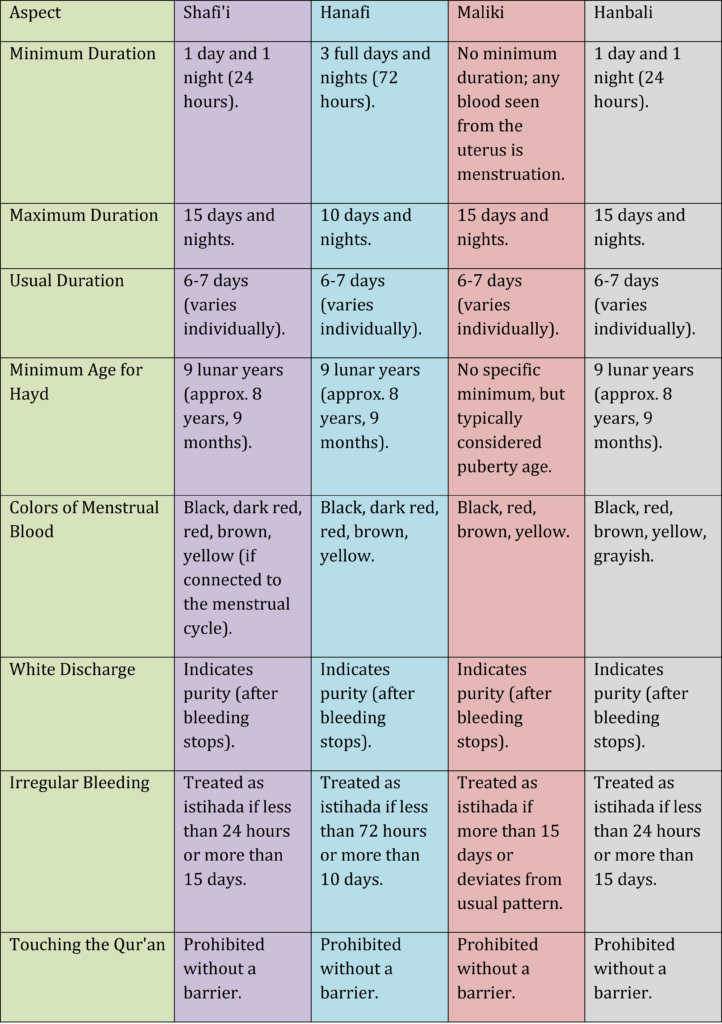
Comparison of Menstruation Rules in the Four Madhahib

1. Scenarios of Overlapping States

– **Istihada Overlapping with Menstruation or Postpartum Bleeding (Nifas):**
  – If irregular bleeding occurs during the habitual menstrual period, it is treated as menstruation.
  – If bleeding occurs outside the normal period, it is treated as istihada.

pic table comparison of menstruation rules in the four madhahib
Additional Detailed Rulings on Menstruation
1. Scenarios of Overlapping States

– **Istihada Overlapping with Menstruation or Postpartum Bleeding (Nifas):**
  – If irregular bleeding occurs during the habitual menstrual period, it is treated as menstruation.
  – If bleeding occurs outside the normal period, it is treated as istihada.
  – Postpartum bleeding (nifas) may overlap with menstruation if it extends beyond the maximum limit of nifas (40 days in most madhahib).
– **Distinguishing Habitual Patterns:**
  – In cases of uncertainty, a woman reverts to her most recent habitual cycle.
  – For women who do not have a clear pattern, the rulings differ by madhhab, with some relying on the dominant color or physical signs of the blood.

2.Determination of Habitual Cycles

– **Changes in Cycle Length or Pattern:**
  – A change in the duration or timing of the cycle requires observing the new pattern for consistency over multiple cycles.
  – If irregularity persists, women are instructed to consult their previous habitual pattern or follow the default maximum and minimum limits.
– **Undistinguishable Bleeding:**
  – If a woman cannot distinguish between istihada and menstruation, she follows the usual duration of menstruation (6-7 days) or her personal habitual length.

3. Special Cases

– **Pregnancy and Menstruation:**
  – In the majority of madhahib, bleeding during pregnancy is considered istihada, not menstruation.
  – Some exceptions exist in rare circumstances, such as early pregnancy.
– **Post-Menopausal Bleeding:**
  – Bleeding that occurs after menopause is not considered menstruation in any madhhab.
  – Menopause age varies (usually around 50 years) but depends on individual health and circumstances.

4. Practical Concerns

– **Hygiene and Purity:**
  – Women are encouraged to use barriers like pads or clean cloths to prevent blood from contaminating clothing or prayer spaces.
  – Washing and maintaining cleanliness is emphasized, especially before performing ghusl.
– **Managing Heavy Flow:**
  – In cases of heavy flow or prolonged bleeding, women may follow istihada rulings and perform purification (wudu) for each prayer time.

5. Post-Menstrual Purity Rituals

– **Conditions for Ghusl:**
  – Intention (niyyah) is essential before performing ghusl.
  – Water must reach all parts of the body, including under the nails and hair roots.
– **Timing of Ghusl:**
  – Ghusl must be performed immediately after bleeding stops to resume acts of worship such as salah and fasting.
– **Checking for Purity:**
  – Women can confirm purity by observing a white discharge or dryness from the vaginal area.

Ruling For Different Mathahab For Wadhu
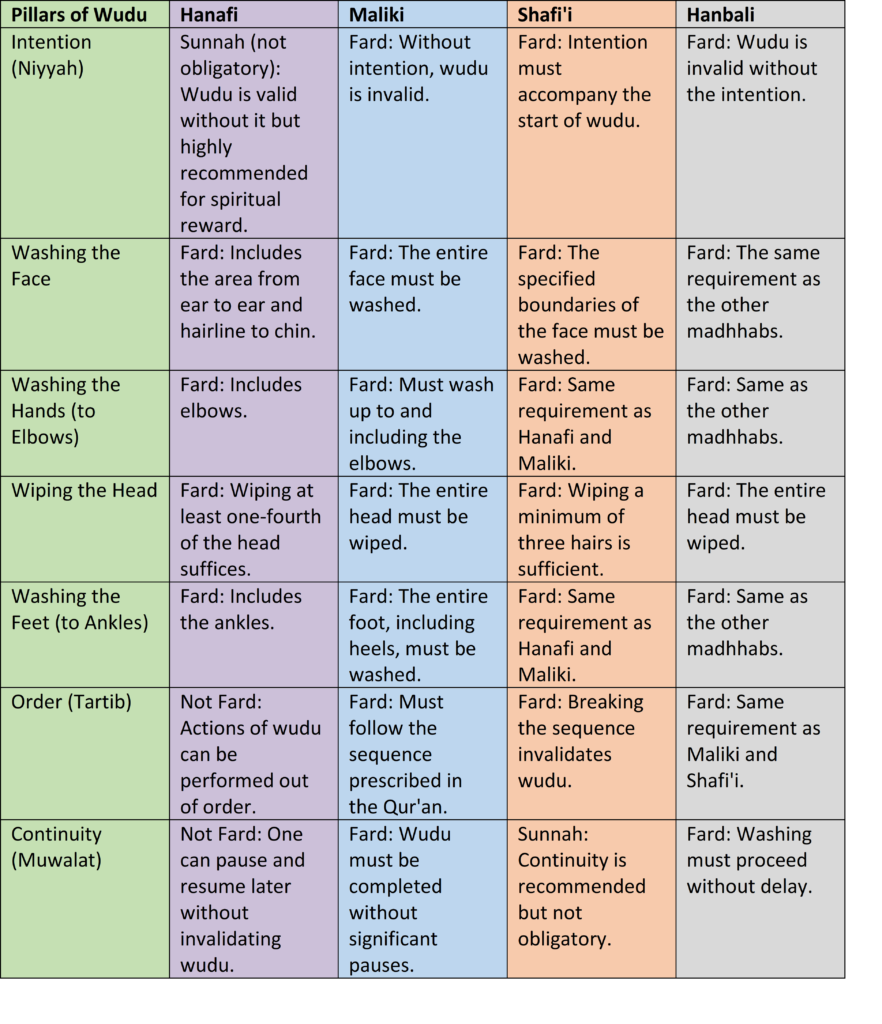
Wudu Pillars Across the Four Madhhabs:
pic table wudu pillars

Detailed Explanation of Key Differences:

  1. Intention (Niyyah):
    – Hanafi: Considered sunnah (not obligatory), meaning wudu is valid without it but is highly recommended for spiritual reward.
    – Maliki, Shafi’i, Hanbali: Intention is a fard (obligatory) pillar; performing wudu without a conscious intention renders it invalid.
  2. Washing the Face:
    – All schools agree this is a fard act, with slight variations in specifying the boundaries of the face.
  3. Washing the Hands (to Elbows):
    – Washing the hands and forearms up to and including the elbows is a fard pillar in all four madhhabs.
  4. Wiping the Head (Masah):
    – Hanafi: Wiping at least one-fourth of the head suffices.
    – Maliki: Wiping the entire head is mandatory.
       – Shafi’i: Wiping even a small part (e.g., three hairs) suffices.
       – Hanbali: Wiping the entire head is required.
  5. Washing the Feet (to Ankles):
    – All madhhabs agree this is a fard act, requiring washing the feet and ankles thoroughly.
  6. Order (Tartib):
    – Hanafi: Sequence is not obligatory; flexibility is allowed.
    – Maliki, Shafi’i, Hanbali: Order must follow the sequence in the Qur’an (5:6).
  7. Continuity (Muwalat):
    – Hanafi: Gaps between washing are permitted.
    – Maliki, Hanbali: Continuity is obligatory; wudu must be done without interruptions.
       – Shafi’i: Continuity is sunnah; while recommended, it is not obligatory.
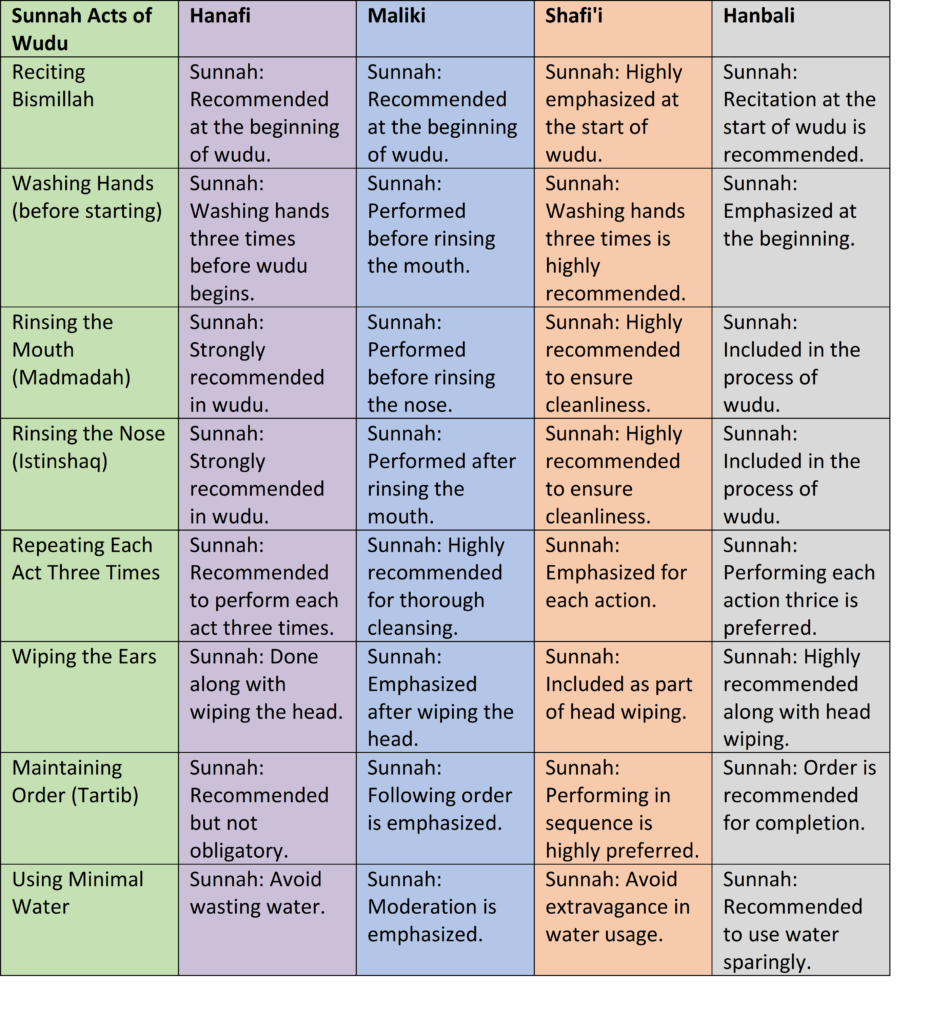
Sunnah Acts of Wudu Across the Four Madhhabs
pic table sunah acts of wudu
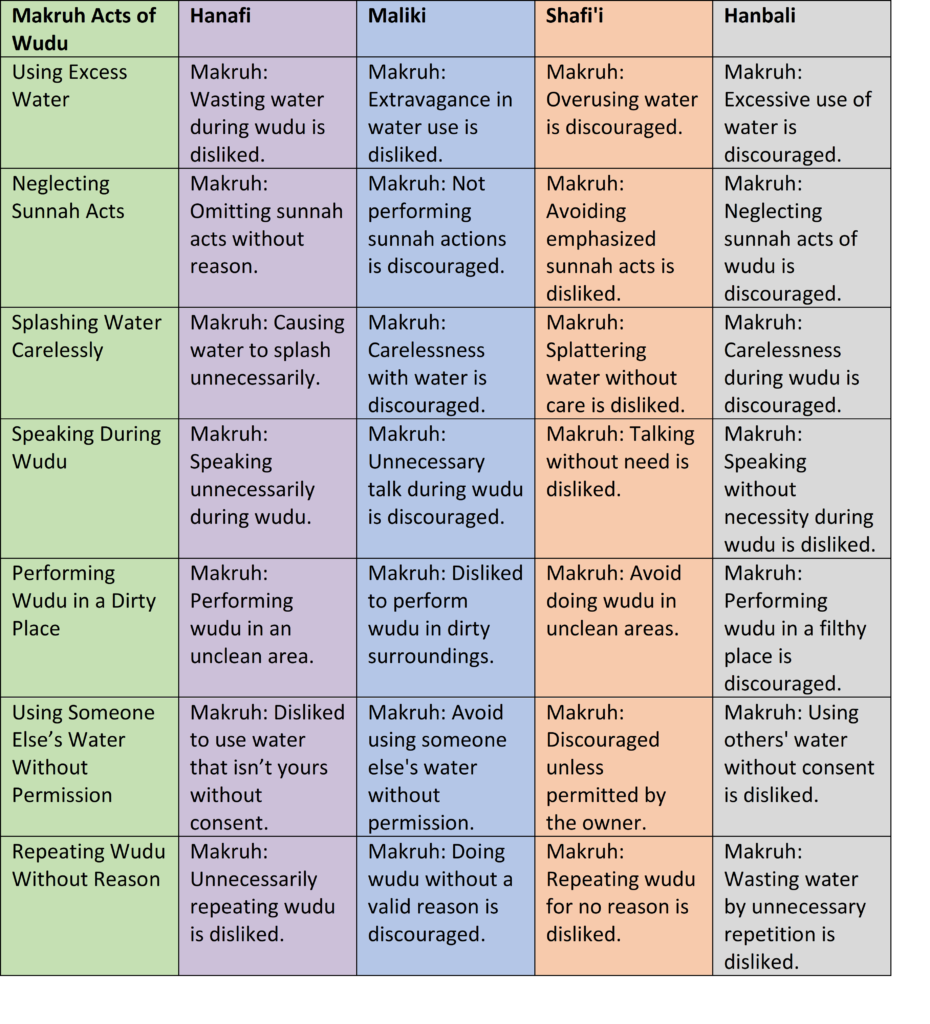
Makruh Acts of Wudu Across the Four Madhhabs
pic table makruh acts of wudu

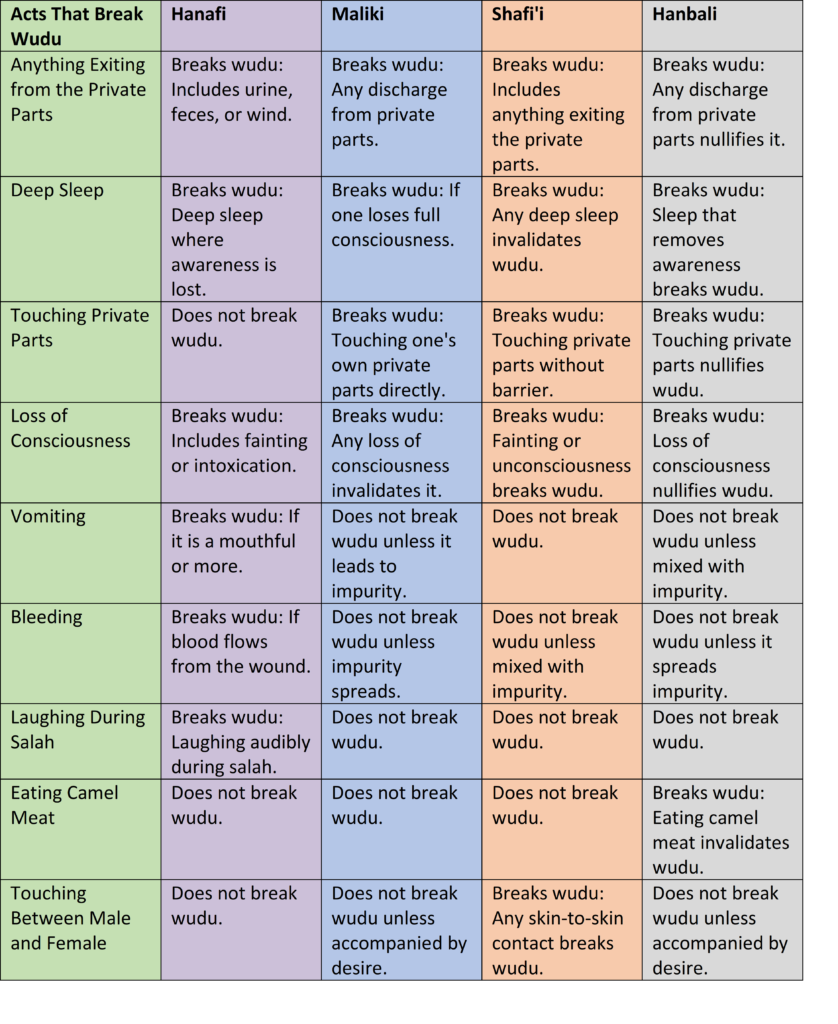
Comparison of Acts That Break Wudu Across the Four Madhhabs

The madhhabs differ significantly on whether this act invalidates wudu, depending on conditions like direct contact and accompanying desire. The table also compares other acts that nullify wudu, reflecting the unique jurisprudential approaches of each madhhab.

pic table acts that breaks wudu
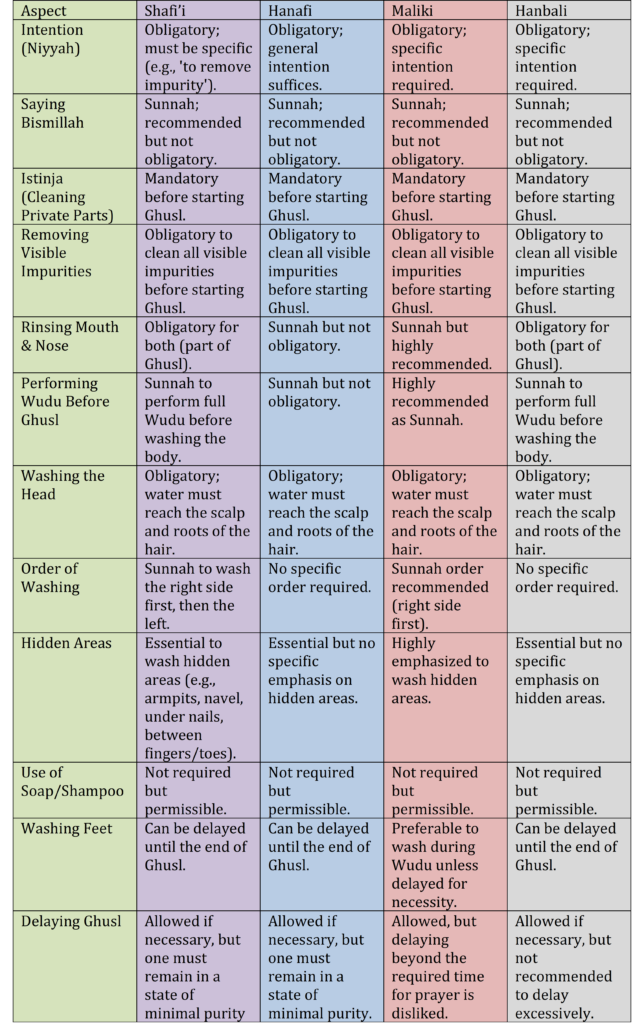
Detailed Comparison of Ghusl Sequence According to the Four Madhahib

This document provides a detailed comparison of the sequence and rulings for performing Ghusl (ritual purification) according to the four major Islamic schools of thought (madhahib). It includes obligatory (fard) acts, Sunnah practices, and specific details for each madhhab.

pic. table ghsul

Detailed Steps of Ghusl

1. **Intention (Niyyah):** Formulate the intention in your heart to purify yourself for Allah.
2. **Say Bismillah:** Begin by saying “Bismillah” (optional but Sunnah).
3. **Wash Hands:** Wash both hands three times.
4. **Perform Istinja:** Clean the private parts thoroughly to remove all impurities (*najasa*).
5. **Remove Physical Impurities:** Clean any other visible impurities on the body.
6. **Perform Wudu:** Perform a complete Wudu, including rinsing the mouth (*madmadah*) and nose (*istinshaq*), unless you delay washing the feet until the end.
7. **Wash the Head:** Pour water over the head three times, ensuring it reaches the scalp and roots of the hair.
8. **Wash the Right Side, Then the Left:** Wash the entire body, starting with the right side, followed by the left.
9. **Ensure Water Reaches Hidden Areas:** Pay attention to hidden areas such as armpits, between fingers/toes, navel, and under nails.
10. **Wash Feet (if not done during Wudu):** Wash feet if delayed until the end of Ghusl.

Rulings for a woman experiencing Istihada

What is Istihada

Isitihada refers to irregular or abnormal vaginal bleeding that is not considered menstrual (ḥayḍ) or post-childbirth bleeding (nifās).

What makes istihāda different?

  • It happens outside the normal period days
  • It may be lighter, continuous, or unpredictable
  • Islam treats it as a medical condition, not menstruation

A woman experiencing istihāda continues her acts of worship, including ṣalāh and fasting, because this bleeding is not considered menstruation. However, there are specific rulings she must follow when performing ṣalāh.

How to Perform Ṣalāh During Istihāda

1.      The Prayer time must begin for the Fard (Obligatory) prayer:

Once the time for the farḍ prayer enters (e.g. Duhur time), she should:

  • Clean the private area
  • Use a pad/cotton to prevent the blood spreading

This process is known as Tahaffudh (preventing the spread of blood

2.      Perform Wuḍūʾ After the Prayer Time Begins

Wuḍūʾ is only valid if it is performed after the time for the prayer has entered, according to the Shāfiʿī School of thought. Therefore, wudu cannot be made before the Adhan and a new wudu is required for every Fard prayer.

3.      Pray Immediately

After making wudu one must pray immediately. Once the prayer is completed, the wudu automatically ends. However, the same wudu can be used for Sunnah prayers (Rawatib), as well as touching or carrying the Qur’an etc.

When the next Fard Salah begins, the same process is repeated.

·       Clean

·       New pad/cotton (if needed)

·       New Wudu after the time of Salah enters

·       Pray immediately

Note: Blood flowing during the prayer does not invalidate the prayer, even if one feels it during sujud. Allah does not burden you beyond capacity. Allah rewards you for every hardship.

Fasting During Istihāḍah: Fasting in Ramaḍān and voluntary fasts are valid during istihāḍah. Bleeding does not invalidate the fast.

Recitation of Qur’an and Masjid: A woman in istihāḍah may recite the Qur’an, engage in dhikr, attend the masjid, and participate fully in acts of worship.

Marital Relations: According to the majority of scholars, marital relations are permitted during istihāḍah, as the prohibition applies only to menstruation.

Ghusl and Istihāḍah: Ghusl is not required for istihāḍah. It is required only at the end of valid menstruation, nifās, or due to major impurity.

Missed Prayers: If a woman missed prayers because she mistakenly believed istihāda bleeding was menstruation, the following are the opinions of the four schools of fiqh:

B9colNc4a5yRAAAAAElFTkSuQmCC


Wisdom Behind the Ruling:
Islam differentiates between natural cycles and illness so that women are not cut off from worship and Allah’s mercy remains accessible.

When bleeding is ruled istiḥāḍa – Comparison of the Four Madhāhib

V2BuXwxOKokAAAAASUVORK5CYII=

 Istihāḍah (Irregular Bleeding) – Comparison of the Four Madhāhib

DCCcr2QkAICAEhIASEgBAQAkJACAgBITCoCYjhO6gvjzROCAgBISAEhIAQEAJCQAgIASEgBC6UgBi+F0pQthcCQkAICAEhIASEgBAQAkJACAiBQU1ADN9BfXmkcUJACAgBISAEhIAQEAJCQAgIASFwoQTE8L1QgrK9EBACQkAICAEhIASEgBAQAkJACAxqAmL4DurLI40TAkJACAgBISAEhIAQEAJCQAgIgQslIIbvhRKU7YWAEBACQkAICAEhIASEgBAQAkJgUBMQw3dQXx5pnBAQAkJACAgBISAEhIAQEAJCQAhcKAExfC+UoGwvBISAEBACQkAICAEhIASEgBAQAoOawP8AzEltItRQ7c8AAAAASUVORK5CYII=

EMAIL US: islammyreligioninfo@gmail.com

  • Home
  • My Religion
  • Our Source Of Religion
  • Muslim’s Hub
  • Blogs
  • About Us

Copyright©2025 ISLAMMYRELIGION.COM

Powered by PressBook Blog WordPress theme

Accessibility Adjustments

Powered by OneTap

How long do you want to hide the toolbar?
Hide Toolbar Duration
Select your accessibility profile
Vision Impaired Mode
Enhances website's visuals
Seizure Safe Profile
Clear flashes & reduces color
ADHD Friendly Mode
Focused browsing, distraction-free
Blindness Mode
Reduces distractions, improves focus
Epilepsy Safe Mode
Dims colors and stops blinking
Content Modules
Font Size

Default

Line Height

Default

Color Modules
Orientation Modules